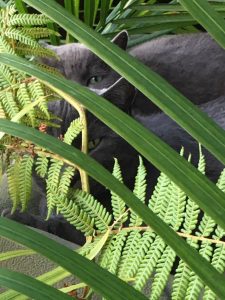
 Cats have good instincts for the most part—and those who live in the elements must develop excellent instincts or they won’t survive the seasons, the storms, the drought, and the lack of food. In our world there are many homeless, abandoned, unwanted cats—more than I can report here. The numbers are to unsettling. And those numbers are all our doing—human-caused. The numbers I like to focus on are the number of cats that are being cared for—are loved, well-fed, warm, and safe. That is a high number too and that’s also because of us.
Bless those of us (individuals from the human race) 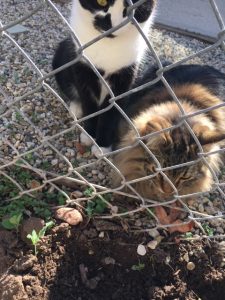 who care for the homeless cats. I think we’ve all fed a stray, adopted or rescued cats over the years, helped and taught someone else care properly for their cat, including our children. Bless us, but some humans go above and beyond.
Today I’d like to take my hat off to those who provide food and a safe place for cats, but also to those who providing housing for those cats that prefer not to be confined indoors with a family—cats who would 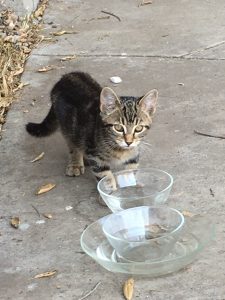 otherwise be out in the cold, rain, snow, and extreme heat.
There are caring individuals who design and build houses for cats out of plastic bins, tires, Styrofoam containers, repurposed dog houses, and more. Some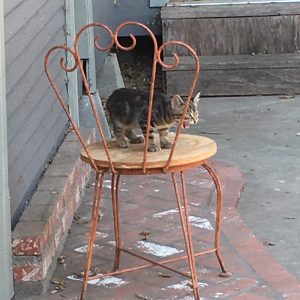 people and rescue groups purchase ready-made insulated, heated houses for cats trying to survive neighborhoods. They come in one- or two-cat size or for multiple cats in just about any style you want. Or you can
  find plans for cat houses online. Here’s a fun site with some interesting ideas for indoor and outdoor cats: https://bookmypainting.com/blog/cat-house-diy
This site features some very innovative ideas for outdoor cat houses made of everyday things you may never have thought of. https://excitedcats.com/diy-outdoor-cat-house-plans/
And if you ever get to Turkey, you must visit the Cat Village there and see the array of houses they provide for the 100 resident cats. Here’s a sneak peek: https://www.lonelyplanet.com/articles/turkeys-cat-village
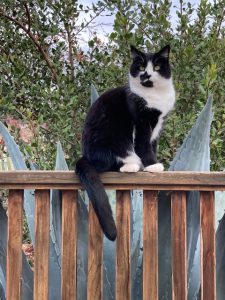
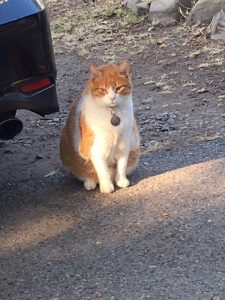
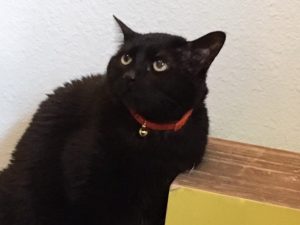
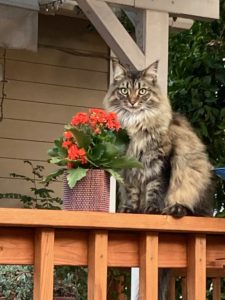 Just look at this gorgeous photo I snapped of our next door neighbor, Mollie, one evening as we dined on our patio with her human. Mollie and her actual sister, Annie, (the sleek black and white cat pictured below) always follow their family members when they take a walk, visit other neighbors, and even when we used to have our monthly neighborhood potlucks. Charming.
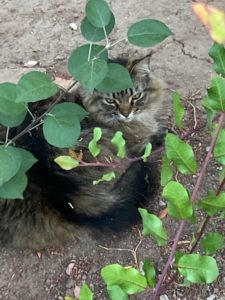 Mollie and Annie consider our yard an extension of their yard, one reason being there are no dogs and there are a lot of birds and squirrels to watch, and trees to climb. While some neighbors don’t appreciate visits from neighborhood cats, I enjoy seeing them outside, staring in at Olivia and Sophie, accompanying me as I putter in my yard, and just
  relaxing in a sun puddle or in the shade of our guava tree.
 our yard that I’m not in love with—those expert bird-hunting cats, for example. Annie and Mollie are not very good at it and not motivated by hunger, although I have seen them trot home from here with a rodent in their mouth. Thank you, girls.
 It is said that if movie goers or readers love or hate a character that’s a huge compliment to the screen writer or author. I’m pleased to say that readers often comment on my characters. “I’d like to know those people.” “They’re so nice to each other.” “Your characters are so interesting.” “I love watching the characters grow through each story.”
 reviews and that they write to me. I consider this a huge compliment because that’s what I attempt to achieve—a connection, not only to the cats in my stories, but to the human characters.
 Certainly not everyone in my stories is kind and interesting. You must have the bad guy or gal—otherwise there’s no conflict. Even the coziest of mysteries must have a conflict, which is generally tied into the mystery. But to have readers see my characters as people they feel they know, that they’d love to sit down with and get to know, is a good feeling.
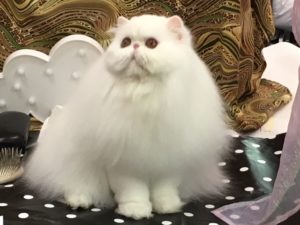 Earlier this week we talked about cat breeds from all over the world—some of them are derived from mutations and forced breeding experiments. What happens when we aren’t careful with breeding programs or when we exploit a mutation? We can get genetic issues.
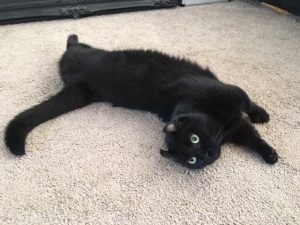 —actually a kinkalow-munchkin—who is being treated for a liver infection. I began to wonder if the munchkin and/or the kinkalow is prone to liver problems.
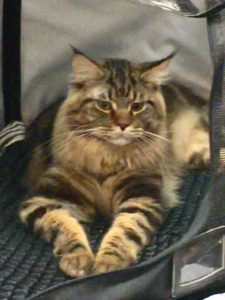 saying… If we discover the cat has a lot of a particular breed in its DNA, we might choose another cat that may not have the issues that are often found in these breeds.
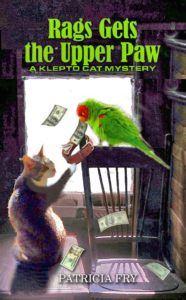 First, I’d like to announce that Book 53 of the Klepto Cat Mysteries is available now in both print and Kindle versions. I think you’ll enjoy this lively and fun and suspenseful story where Rags Gets the Upper Paw. Oh yes, he keeps busy in this tale of many dimensions, which he shares with a bird friend, as you can see from the cover. Who better to pair a precocious cat with than a clever and spirited parrot? Available now at Amazon.com.
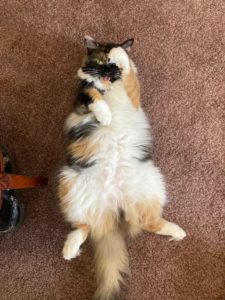 to this week? If your cats are like ours, they are pretty much creatures of habit—you’ll find them sleeping in one favorite spot by morning, another when the sun comes out, another place in the late afternoon and they go to bed in the same spot each night. They play with the same toys, react the same to their treats
 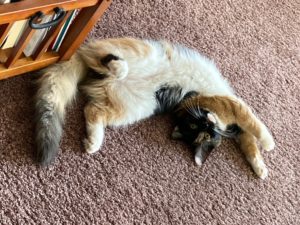 and they follow the same routine at meal time. Our Olivia prefers to graze on kibbles. She’ll occasionally eat canned food, but mostly she seems to think it’s gross.
 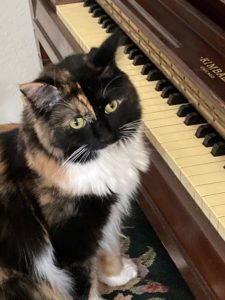 Sophie, on the other hand, nibbles on kibbles, but she love, love, loves a meal of canned food. Three times a day it’s the same thing. She finds me wherever I am and yowls reallllly loud. I look at the clock and often it is almost right on the button time for her to eat. She watches me head for the kitchen then she waits in her
 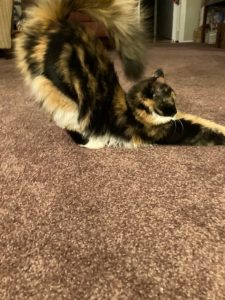 usual feeding spot for me to place her plate on the floor. Not Olivia. I used to try feeding her yummy cat food. She’d take one sniff and walk away.
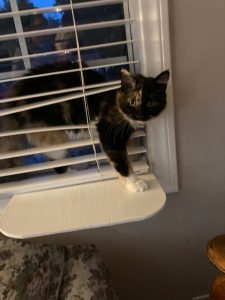 It’s charming to watch the cats follow their habits—their chosen patterns of life day in and day out, but I enjoy a little shift in their routines, too. It might drive me crazy and scare me silly when I can’t find Olivia anywhere. I’m accustomed to seeing her in certain places at certain times—but not
 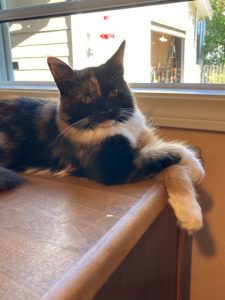 always. She likes to mix it up a bit at times and make me look for her. I think, sometimes, that she has a warped sense of humor as she obviously hears me calling and she stays quiet. Sometimes she’s actually watching me walk past her while screeching her name. Yet she continues to hide, often in plain sight. Sure, I can see the humor in it once I find her. I
 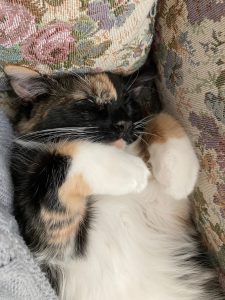 can forgive her for frightening me—fearing she has slipped out, broken through a window screen, or is hurt somewhere. Yeah, I have a big imagination.
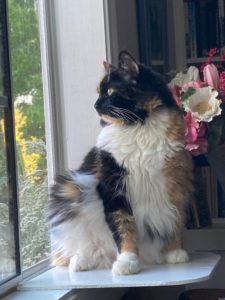 eerie as if the two of them exchanged a secret message or something.
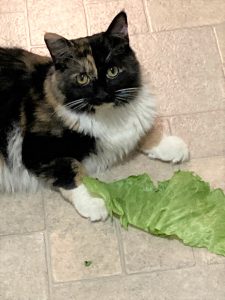
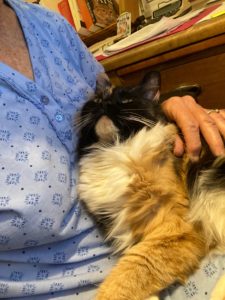 Good news—remember that Olivia is a feisty (sweet and sassy) calico. She turned one year old in May, and she has not been okay with a grooming routine. However, I’ve been persistent—she has fairly long, fluffy fur and sharp claws. She needs regular combing and nail-trimming. Well, we’ve finally come to a pretty good understanding about her personal hygiene. If she’s relaxed in my lap, I may be able to trim the nails on one paw at a time. In order to do another one, we need to obtain the same level of relaxation together on another day. And we’re doing more combing and brushing. There’s one rule I must adhere to—leave the floofy tummy alone. Her claws might be trimmed, but she still has sharp teeth.
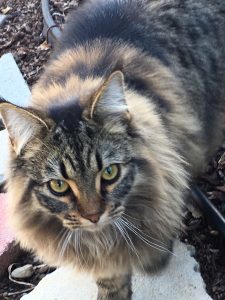 are out there that most of us haven’t heard of and where do they come from? I was surprised by the answers and you might be too. While there are a lot of cat breeds from the US, many of them seem to be created from mutations and breeding experiments. The Maine coon is thought to be the only or one of only a few natural crossbreeds attributed to the US.
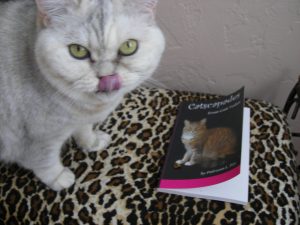 The Burmese originated in Burma, of course, the British shorthair is from England and we’ve all heard of the Egyptian Mau and the Norwegian forest cat. Oh yes and there’s the Japanese bobtail, the American curl, American bobtail, and so forth, and it’s pretty clear that a cat called Chartreux is
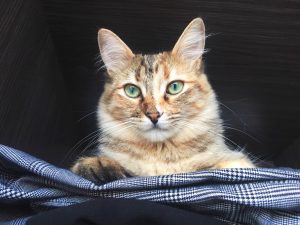 from France, right? But have you heard of the Sokoke from Kenya, Raas from Indonesia, and the Donskoy from Russia. There’s also the Australian Mist—you guessed it from Australia. We need to check out that one for a future blog post, and the Aegean from Greece.
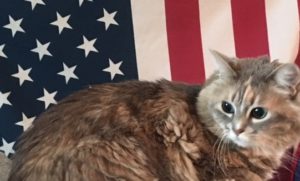 With the 20th anniversary of 9/11 occurring a day ahead of National Pet Memorial Day this year, we’ll acknowledge both on behalf of our pets.
 effort and love.
 It’s true, even some well-known pet food companies are making eco-friendly cat food from insects. Well, they tried feeding cats a vegetarian diet and that didn’t go over too well. Cats need protein. When scientists discovered that certain insects are similar in food value to meat, they went with it. Why? It’s less of a stress on
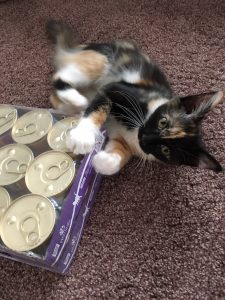 the eco-system. Factory farming requires massive quantities of energy and water, for example. Not so with insect farming.
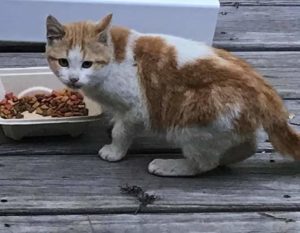 companies that make insect-based cat food: Tomojo, Catit Nuna, Conscientious Cat and Purina—Beyond Nature. Here’s a link to Catit Nuna’s website. It’s quite informative.
 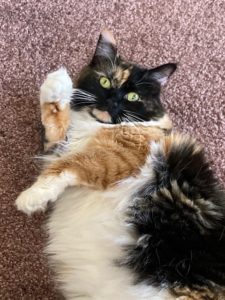 As the world seems to be spinning out of control with prophecies and scientific predictions and even science fiction ideas becoming our reality, Olivia and I stay hunkered down in my office. Thank heavens for my love of writing and the ability to pursue it, because it is sustaining me in many ways throughout this rough patch.
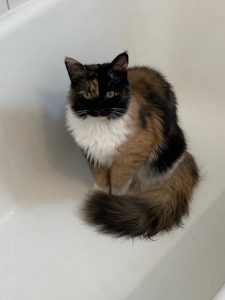 So what’s happening in the factory? We continue to have fun creating and producing enjoyable stories featuring some of the most incredible and aMEWsing cats around. Watch for Book 3 of Olivia’s Calico Cat Mystery series to debut around the first of October.
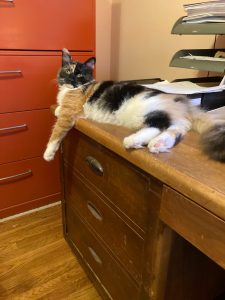 send you an autographed and PAWtographed copy of the book when it’s published. As you may know Olivia insists that her name be part of the title. It should be brief—only a few words. Here’s a hint: This story involves missing cats that are disappearing under the most unusual circumstances. The clues Olivia finds at the scenes are blatant, but what in the heck do they mean? Of course, Olivia and a new fur-friend lead the charge toward pawing the unexpected culprit.
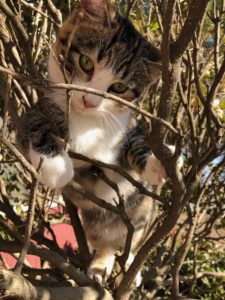 Did you read about the amazing cat, Binx, who survived the collapse of the Surfside building? There he was, probably sleeping peacefully in his apartment with his family on the 9th floor, when all heck broke loose and he found himself tumbling through concrete, wood, glass, furniture, and knick knacks and landing somewhere amidst it all. Miraculously he made his way out of the rubble, was recognized by someone who feeds cats in the area and reunited with family members. Amazing!
 in an abandoned house for two months and survived. When the new owners stepped inside, they found the cat thin and weak, but alive. It appears that he survived on pieces of paper he found in the home and water from a small leak in the plumbing. Amazing.
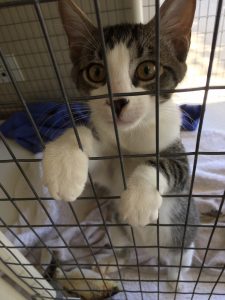 discovery of a kitten trapped inside a maze of pipes in the wall.