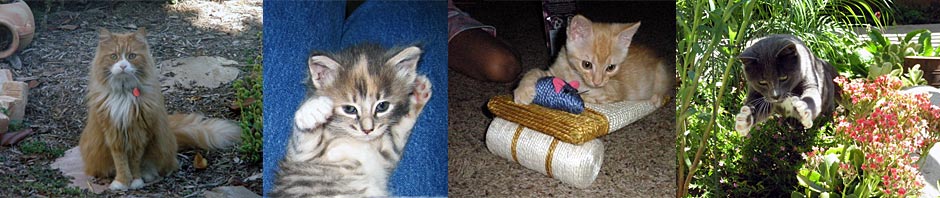
 Life changes when you invite a cat into your home. Even if you’ve had cats for years, bringing in a kitten can shake up your world a bit. Each cat or kitten you adopt comes with different requirements.
Just this morning I was reminded again (by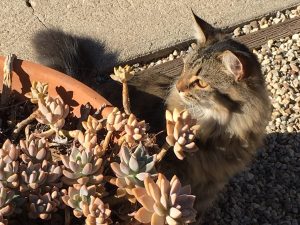 Olivia, of course) to close a drawer in my large filing cabinet. Open it, take an item out, and close it immediately. That’s the drill since curious Olivia joined our family. Otherwise, she’ll jump up into the drawer and climb through the back of it into parts unknown and unreachable.
We had a kitten once who chewed on the blind pulls off. That made things inconvenient when she’d chew one right off. 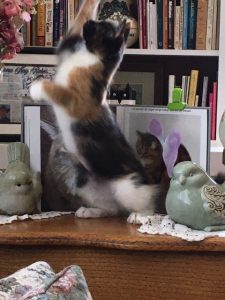 I’ve known of kittens who have become caught up in blind pulls—a definite danger. I once had a cat fall or jump out a window after pushing the screen off. Now I always do a screen check before I leave a window open. If I leave the house, I close the window. We hide our chocolate behind closed doors. Chocolate is toxic to cats and dogs. I’ve had to stop using ribbon and bows on gifts—
 there are no bows or ribbon of any kind under our Christmas tree. String, cord, thread, yarn, twin are also an attraction (and
  a danger) for some cats. Sophie once chewed on metallic bows and vomited blood as a result. Our refined Himalayan waited until we went to bed one night, then dove into a plate of chocolate brownies. Thankfully, I caught her in the act and stored the brownies away like I should have done in the first place.
We think of puppies getting into this sort of trouble, 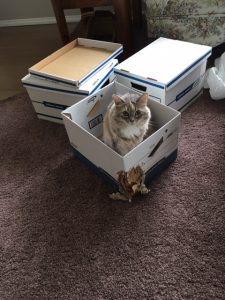 but some cats do too. That’s why we must stay alert, especially when we bring in a new cat or kitten or a new potential attraction to the cat and kitten residents—such as toxic plants. Unfortunately, there seem to be more plants that are toxic than are not. When I get a plant or flowers as a gift, I always conduct research to find out if it’s safe for cats—you know, just in case they want to nibble on the blossom or the leaves. If not, the bouquet or plant is given a special place on our outdoor patio deck.
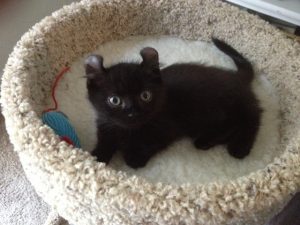 My adorable and sweet grandcat, Brucie, the Munchkin, has been diagnosed with a fatty liver. I wondered if this might be a genetic thing. I’ve always been a bit suspicious of the problems indiscriminate breeding in cats can create. Well, the Munchkin, like so many other breeds, does have its genetic problems, but fatty liver isn’t typically one of them. This, we’re told, is often caused by obesity in cats. Sure, the Munchkin might have a tendency to gain excess weight
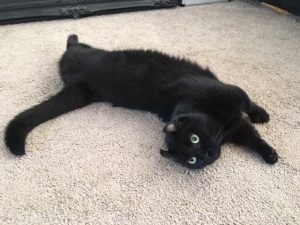 because they may not be as active as a cat with longer legs, but just about any breed cat (some more than others) is prone to obesity, and susceptible to fatty liver.
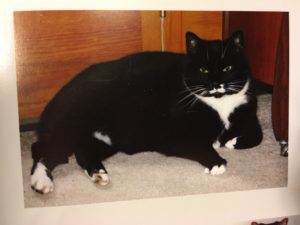 causing this illness. And rapid weight loss is one of the red flags for diagnosing this condition.
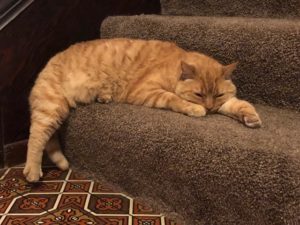 not adjusting well to the noisy little intruders into his purrfect life.
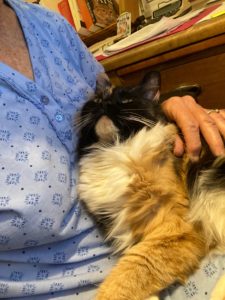 There’s nothing like being the friend of a cat. Whether it’s your own cat that you care for, clean up after, groom, watch play, and just enjoy being around, or a relative’s or neighbor’s cat, the friendship is priceless.
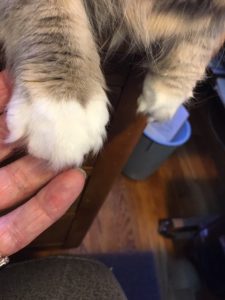 precarious and often dangerous situations, however, that trust is displayed a bit differently. Yeah, I can look at Olivia’s fluffy tummy, but don’t touch it. She’ll curl up in my lap, but there are definite no-nos, like getting too friendly with one of her paws, for example.
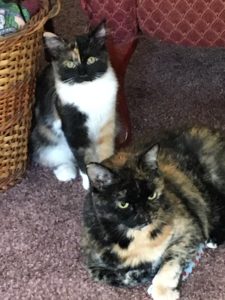 in our lap and let us pet her all over, but do not envelop her with your hands or she will explode.
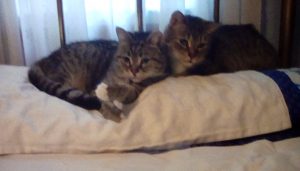 Sophie, who has been with us through four other cats over 17 years, and Olivia, who is just a year old. It’s as if Sophie has been waiting to meet Olivia for years. She has never made up to one of our cats like she has Olivia. They don’t curl up in a tight ball together to sleep, but they have what appears to be a meaningful relationship with an occasional licky-face between them, frequent checking on one another, occasional frolicking together, and, well a sort of mutual respect between them. We’re so pleased that Sophie accepted the intruding kitten and that Olivia seems to honor and respect Sophie.
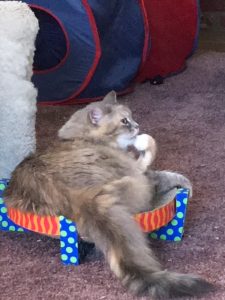 Who doesn’t enjoy watching a cat take a lick-bath? It’s almost mesmerizing—hypnotic and a little intriguing to see some of the positions she gets into and how intent she is in the cleaning process. It’s sometimes like a hypnotic adventure for the cat as she focuses so meticulously to the task at hand.
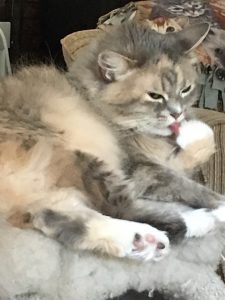 their heritage. Cats seem to like to be clean, but their after-dinner bath ritual has a deeper significance than that. Their wild ancestors learned the extreme importance of cleaning themselves after a eating so predators/intruders couldn’t detect them by the scent of their meal.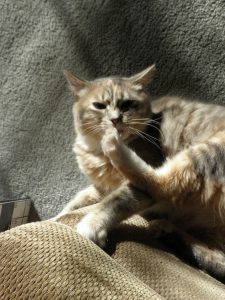
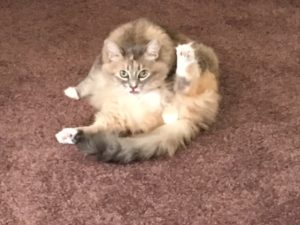 such a thing as excessive licking. Our 17-year-old tortie, Sophie, has a tendency to excessively lick certain areas along her side until the fur is almost gone. Why? The veterinarian says this is stress-related. The first time she did this was after we’d evacuated during the Thomas fire here in our area. I took the cats to my mother’s for a couple of days and, while Sophie seemed to take this in her stride, we found out later it was a very stressful experience for her.
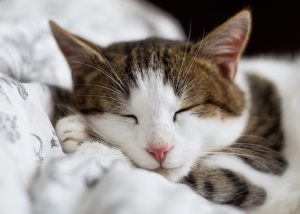
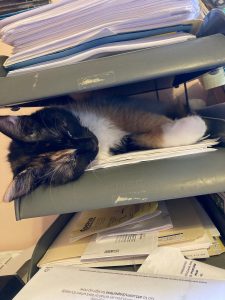 We buy our cats cushy beds and put them in the perfect spot where they’ll be safe and comfortable during long naps. But it’s a rare cat in my household who will actually use the beds. Neither Olivia nor Sophie sleeps in a cat bed—ever. Another thing I notice about their sleeping habits is that they frequently change where they sleep.
 throughout the day. It’s summer, we’re in and out of the house. We have windows open at times—generally open only a smidge unless we’re in the room with the cats. Yes, we have window screens and screen doors, and neither of our cats seem to have a yearning to dart out the doors, however, if a door were to be left open or a screen should be pushed out, I don’t doubt they’d decide to take advantage or, heaven f
 orbid, they could fall. I’ll never forget one time I was closing up for the night. It was summer and the doors were open. I went to close one door in a darkened room and there was resistance. I pushed the door a second. It wouldn’t close. So I opened it wide and Lily (our tabby) squeezed out into the room from between the door and the screen door. Oopsie. Imagine the potential danger and scare if the screen had been unlatched. … The things our cats teach us…
 the day is that they sleep a lot—yeah, that’s what cats do, but also in different places. Sophie (at 17 years) is more predictable than Olivia is. I’ll find Sophie on my unmade bed first thing early in the mornings. When the sun
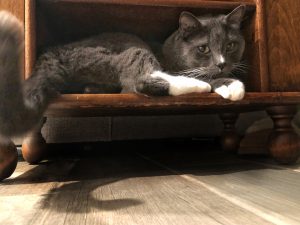
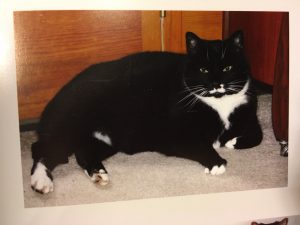 comes out and the blinds are open, Sophie enjoys lolling in a sun puddle in the living room. Later, I’ll find her in one of four places—on my bed (after it’s made), curled up in the pink chair or the loveseat or sleeping in their nylon tunnel.
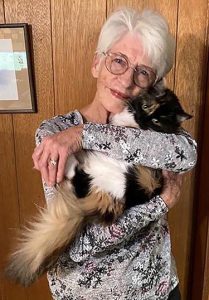 I’ve met cats that would make terrific therapy cats—you know, those who will lay on the bed with a sick child or adult and allow petting while providing enormous comfort in just being and maybe purring. Some nursing homes have resident cats who slip in and out of patients’ rooms providing something the medical field can’t. I mean who doesn’t smile when they see a sweet face of a cat who wants nothing more than to be with you?
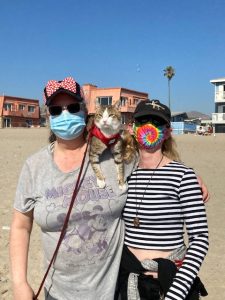 folks in nursing homes. So often the kittens would trigger wonderful memories. I recall one woman sitting up in her bed, petting one of the kittens, and sharing her memories of the cats she knew growing up on a farm. She had the best time reminiscing that day.
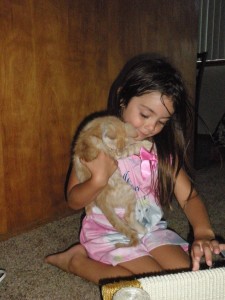 In one of my Klepto Cat Mysteries I include a segment about Rags and other cats participating in a children’s reading program—where the cats just sit with the child and listen to them read. Yes, this is a real thing and it works. Poor readers gain confidence in their reading skills when they sit with a cat who will listen to them read. And believe it or not
 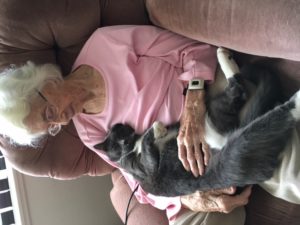 there are associations for therapy and support cats. In fact, several of them.
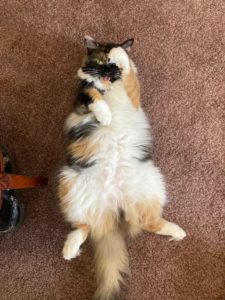 Olivia has a gorgeous fluffy white tummy that I love to tickle when she displays it during one of her yoga stretches. She prefers, however, that I keep my hands off her delicate tummy, so mostly try to I comply. While admiring her tummy one day this last week I recalled an article I read once describing how cat color is formed in the womb. I thought you might be interested too, so I went in search of the article and didn’t find it. As I recall, one fact I thought fascinating was that kittens start out white. The color is produced from top to bottom which is why so many cats have white tummies. Many calicos do, as well as tabbies,
 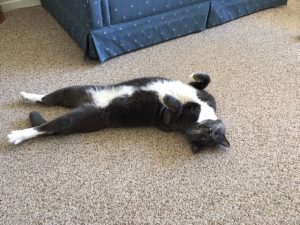 tuxedo cats and some others. You’ll also notice that a lot of cats have white paws—giving the impression that the gestation period sometimes ends before all of the kitten’s color is dispersed, so the extremities are left white.
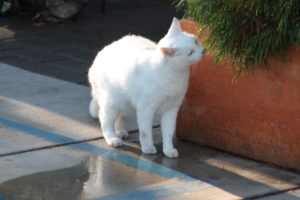 pattern-related information—some of which you’ve probably never heard before. For example,
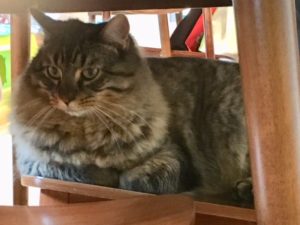 shades of brown in a cat’s fur actually comes from the black gene.
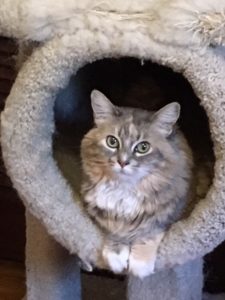 of color.
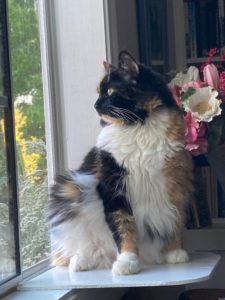 Hey, that might be a good title for one of her books. You may have noticed that so far I’m using Olivia’s name in the titles for the Calico Cat Mysteries. I’m not sure how long I’ll be able to come up with title ideas, but it’s fun while it lasts.
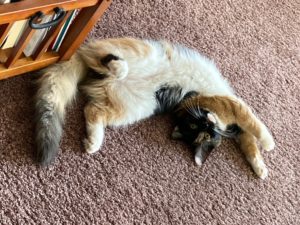 purrsonality. As you know I had her tested to see what cat breeds are in her DNA. She is definitely an interesting blend of breeds, and sometimes an inkling of a particular breed
 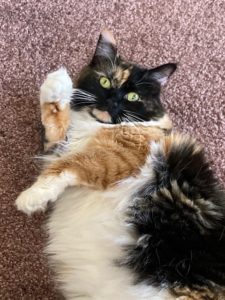 seems to emerge.
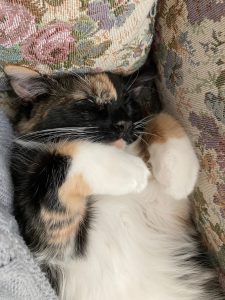 standoffish—she doesn’t even want me to touch her, more like the Egyptian Mau. She can be as active as the Abyssinian and as quiet as the Ragdoll. She might carry something in her mouth and even go fetch it and bring it to me like the Abyssinian or the Ragdoll in her genetic pool might, and she can jump like a gazelle—wait, that’s not a cat. She is thought to come from the genetic pool of the Cheetah, so maybe that’s where that skill comes from.
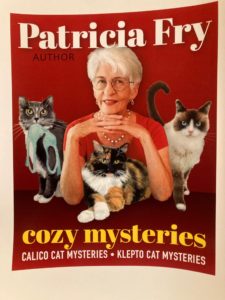 People wonder, now that I’m writing two cozy mystery series with cats, do I ever get the characters mixed up. Do I attribute one of Rags’s traits to Olivia and vice versa? Do I actually ever work on two books at once? I have to say “yes” to all of the above.
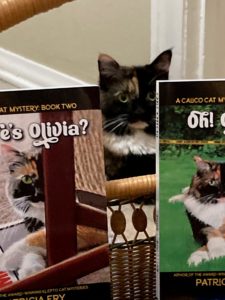 pretty good start on the next Calico Cat Mystery. For example, the pre-publication readers had Book 3 of the Calico Cat series last week and I took the opportunity to start outlining Book 54 of the Klepto Cat Mystery. Most of you know that we published Book 53 of the Klepto Cat Mysteries within the last few weeks. And we’ll be ready to publish
 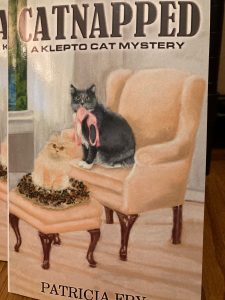 Book 3 of the Calico Cat Mysteries next month.
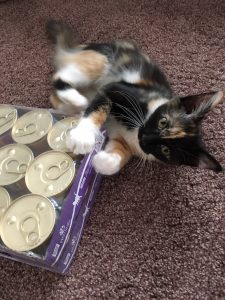 I’ve learned a lot over the years about cats and their traits and preferences. It’s been an interesting and enjoyable journey. One thing that was always fairly straightforward with all of the cats I’ve loved is their eating habits. You put down a plate or a bowl of food and they eat it. Oh, we’ve had cats, over the years get sick and stop eating. Red Flag! That cat gets an immediate trip to the vet. We discover the problem, attempt to remedy it and usually the cat will resume eating—depending on the problem and the age of the cat and so forth.
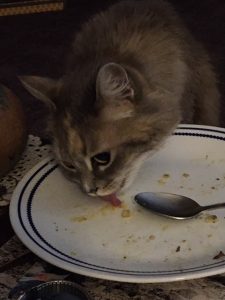 Calico Cat Mystery). Well, she has never been a very good eater, yet she’s a fairly big girl and has plenty of meat on her bones. At nearly 11 pounds, I’m sure she’s just fine. But darn it, I want to see her eat.
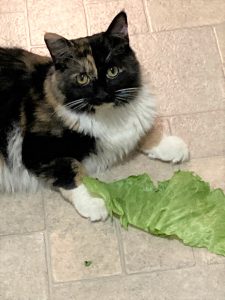 I’d sit with Olivia when I’d feed her and watch her sneak up to the plate as if stalking it, take a sniff, maybe a taste, and dart off to parts unknown. Sometimes I’d watch for thirty minutes—nothing. I’d leave the area and come back to find the food gone.