Note: Monday’s post is late because of a website glitch. I’ll follow tomorrow with Wednesday’s post and bring you Friday’s post on Saturday.
 Cats are certainly good at grooming. Most of them are fastidious when it comes to personal hygiene. Some cats will help us with our grooming, as well—licking our hand or face while we’re cuddling with them. And cats groom other cats—their kittens, their housemates–feline or canine, a random cat they meet up with in the yard.
The grooming routine of a cat is traced back to their 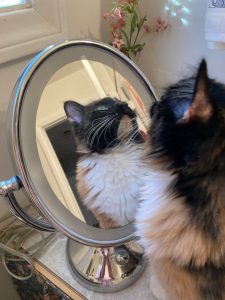 wild cat ancestors who relied on fastidiousness for their very safety. A tiger or lion or cheetah cannot risk detection from the scent of the last thing they ate, so after eating they lick all of the smelly evidence from their fur.
If you’ve ever felt a cat’s tongue on your skin, you know it’s made for cleaning—like the bath sponge you use in the shower. I read the other day that the “barbs” on a cat’s tongue is made from the same substance as is in our fingernails.
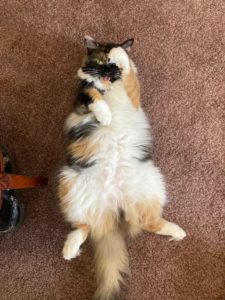
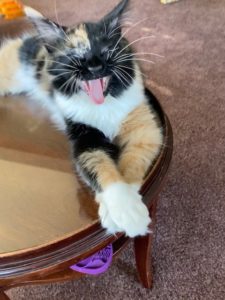 So yes, cats do a great job of grooming, but sometimes they need help. Cats get mats where they can’t reach with their tongue to untangle the fur—around their neck, for example. Some types of fur tend to mat more easily than others and grooming becomes a job the cat can’t manage on her own. Lately, I use my cuddle time with Olivia to work small mats out from around her
 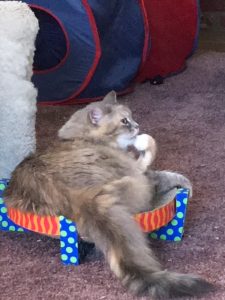 neck. I unravel the tangles with my fingers, then use a wire brush or comb to finish the job. One small beginning of a mat can take a whole cuddle session.
It’s wise to brush/comb your medium to long-hair cat often to prevent mats and catch those that are just starting. Use a fine-tooth grooming comb to help a short-hair cat shed her undercoat. If you have a cat like 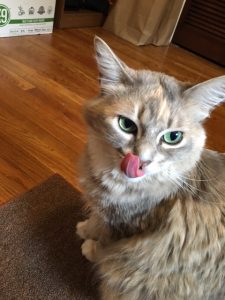 Olivia, though, the tummy and under arms are off limits—“no touchy there, Mom.” So it becomes a more difficult situation. However, if she is relaxed enough I can sometimes get in there and make headway. Blunt-nose scissors are recommended for tough mats. I’ve cut many mats from cats that keep those mats a secret until they’re painful.
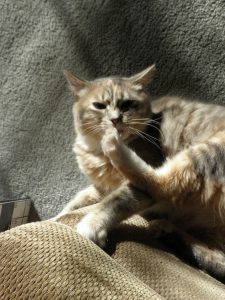
There are also powders and other products you can use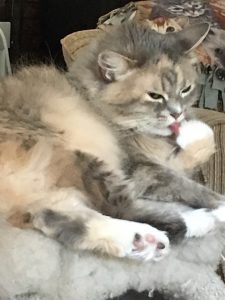 on cat fur that will help to prevent and loosen mats. Choose wisely—make sure the product is safe for your cats and use it according to directions.
There are also instructions for dematting a cat on the internet—by people who know more about approaching this task than I do. We’d love to hear from those of you who have discovered successful methods of helping your cat with her mats.
Of course, each cat is different in their fur-type and their tolerance level. What works for one might not work for another. I had a lovely calico years ago who was horribly prone to mats. She and I could manage those on most of her body, except for her tummy. Finally I discovered a solution. Each summer I’d take Daisy to the groomer and have them shave her tummy. The fur always grew back in time for winter, you couldn’t even tell she’d been shaved because the fur fringe around her sides covered our secret. She still looked beautiful and felt so much better. I like that solution better than shaving the whole cat, which is the kindest thing to do with cats that have mats beyond what you or the cat can handle.
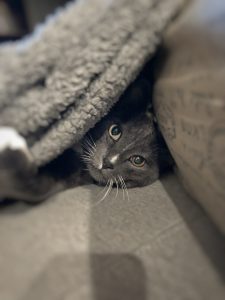
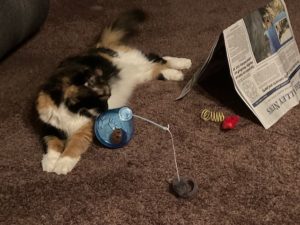 Does your cat have favorite games she likes to play either alone or with someone? Some of my cats liked to hide under a blanket and bat at fingers or toys we’d push underneath or that we’d tap on top of the blanket. Some cats like to leap high in the air after wads of paper or a light-weight toy. Most cats like to chase toys or other items. I’ve even known some who followed a light beam. I don’t use
  one of those laser pointers. I think cats prefer being able to catch the toy sometimes during the game—catch and release. Some cats will even bring you their toys–you toss the toy and the cat retrieves it. In my experience the cat will soon tire of that game and, if the game is to continue, the human becomes the retriever.
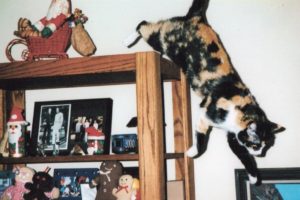 Olivia loves chasing chew sticks and balls across the wood floors in our long hallway. It’s a great way for her to get good exercise. No worries if one of the toys gets lost—Olivia knows where it is and she’ll show us so we can get down on our hands and knees and dig it out from under a piece of furniture.
 play. She’s in her own little world, chasing a bottle cap or jingle ball or just a piece of fluff around the kitchen floor among the table legs and chair rungs. You can see
  the jungle cat emerge as she stalks and chases and pounces, then rolls around victoriously with the toy between her paws.
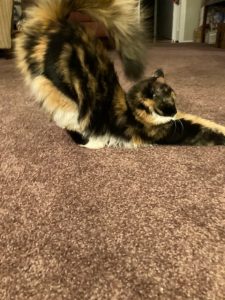 uncanny ability to live in the moment whether it is in a dream state or a full-on make-believe wild-cat-hunt in a marvelous jungle full of fascinating creatures and sounds. If you watch your cat closely, you’ll see that she can charade as the king of the cats in that jungle and switch to the clever and crafty prey staying just out of the hunter’s reach. Oh the imagination of a cat.
 In honor of National Trivia Day (January 4), I thought I’d share some cat trivia—what fun! Here are a few things I found interesting. Of course, some of it we already knew, but some of it was a complete surprise to me
 ways a cat uses its tail. They say for balance and to express her mood. Olivia actually overuses her tail. In fact I’ve seen her reprimand it a time or two as if it actually has a mind of its own. She uses it sometimes to scold me—if she’s sitting next to me and I’m not petting her, she might slap that tail against me—slap-slap. Sometimes she pets me with her tail. Such sweet caresses.
 Did you know that cats have something in common with giraffes and camels? No other animal shares this trait—they walk using both right feet, then both left feet. That’s a strange bit of trivia. Here’s another: Cats share 95.6 percent of their genome
  (DNA) with the tiger.
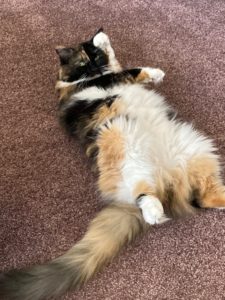 chill privately. Other times she’s all about cuddling and teasing and getting bunches of cheek scratches and tiny kisses all over her face. Some experts, however, believe there should be a kitty-cat daily schedule—a time for awakening, a time for play, a time to clean the litter box and refresh the water bowls, etc. Here’s the link to
 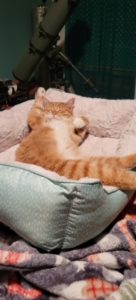 the schedule if you’d like to take a look and maybe discuss it with your cat.
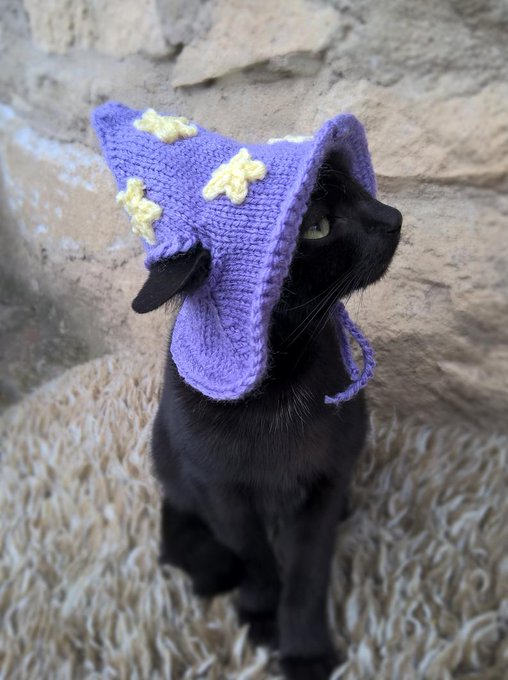 Say what? Yes, there is such a thing.
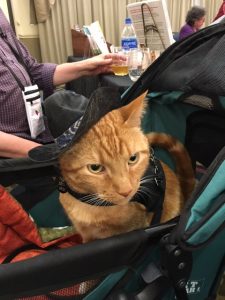 You can also use cat hair in your garden, to sop up oil spills, to felt, spin, or knit into craft projects and wearable items, in making fishing flies or jewelry. You didn’t know cat hair could be so versatile, did you?
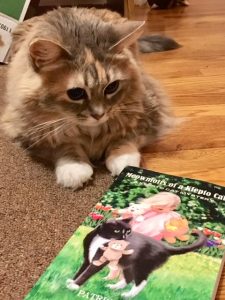 Reviews for the latest Klepto Cat and Calico Cat Mysteries are coming in. If you haven’t read Book 61 of the Klepto Cat Mysteries and Book 11 of the Calico Cat Mysteries, you might want to put this on your “fun things to do for me” list.
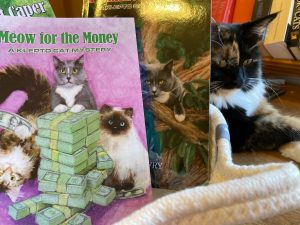 Calico Cat Mystery, Purrfectly Olivia,
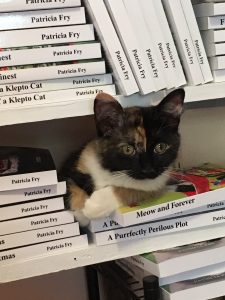 So what am I up to this first month of 2023? Book 12 of the Calico Cat Mysteries is with the editor as we speak. I project we’ll publish around the middle of February. This book has a special surprise as Olivia travels to an exotic country to help with a large cat colony. Oh, the mysteries we’ve conjured up for you in this interesting page-turner.
 What is it about cats that you love so much? I think most of us will say “everything.” But I also believe that over the years we develop a special appreciation for certain types of cats. Well, you probably know people who breed Persians or Sphinx or Maine coon cats. You have friends who always adopt short-hair cats or calicos. Most of us have
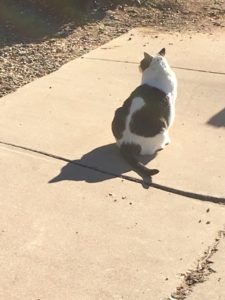 had a variety of styles and colors and types of cats. I know I have—Siamese types, tabbies, calicos, Manx, torties, a white odd-eye cat we adopted as a kitten from a friend, a snowshoe type cat I found in our woodpile, a couple of purebred cats (Himalayan and Persian), and several others. So what is my cat style?
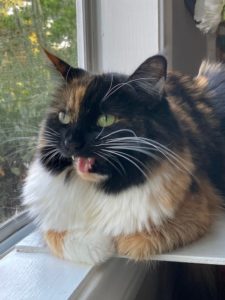
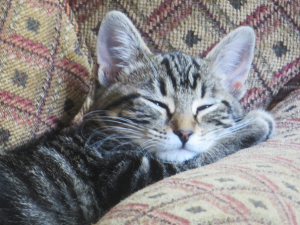 I fall pretty quickly for a cat or a kitten that looks me in the eyes and purrs. That’s how I picked Lily from a litter of three. And I’m so glad I did. But I do believe I’m now living with my absolute purrfect style and type and purrsonality in a cat—a sweet medium-long-hair calico with
 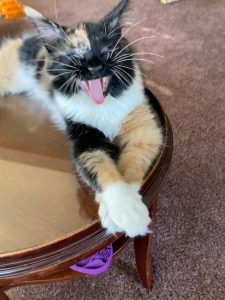 cattitude.
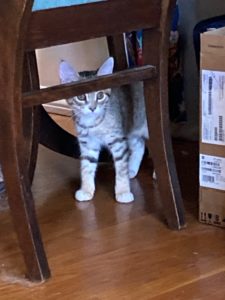
 Here’s something you might want to prepare for. Sunday is “Answer Your Cat’s Questions” day. It shouldn’t come as a surprise to you that your cat is curious. Throughout a typical day she expresses her curiosity in many ways. It’s obvious that she’s inquisitive about anything new that you bring into the
  house, the contents of a box left by the delivery person, what’s under the blanket you just laid across the sofa, and what makes her mechanical or
  motion toys do what they do.
 “Why can’t I go outside and chase those birds?”
 developed into the most popular household pet in the world? I think most of us can look into our cat’s eyes and see a knowingness that we’ll never quite understand. Do they carry some level of knowledge in their DNA that speaks to the plight of cats as they found their way out of the wilds and into our hearts?
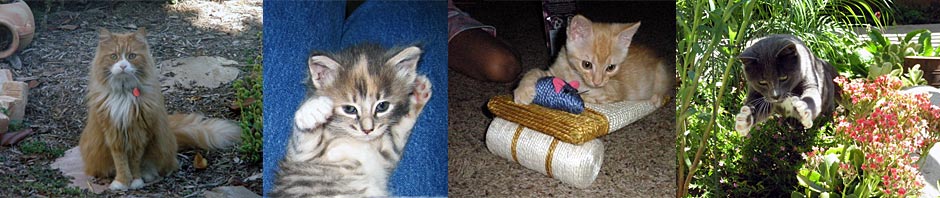
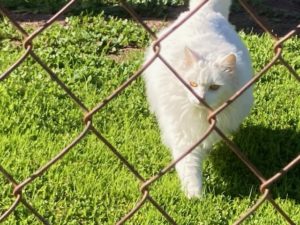
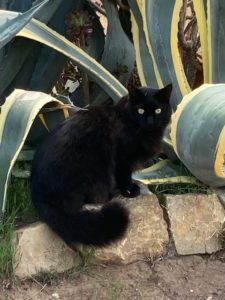
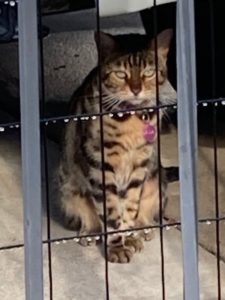
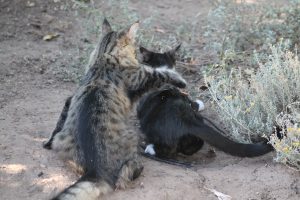
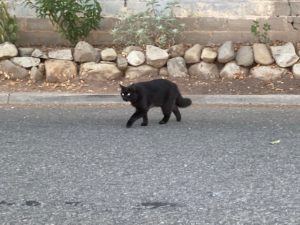
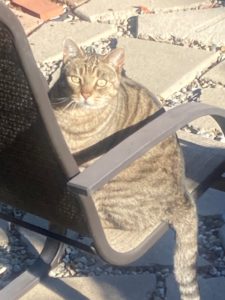
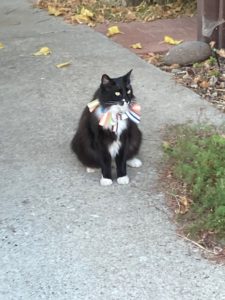 My cell phone probably has more pictures of cats than anything else, unless it’s great grandkids. I take a lot of pictures of Olivia, of course, but I also adore taking pictures of neighborhood cats and cats I come across while shopping or traveling or just taking a walk.
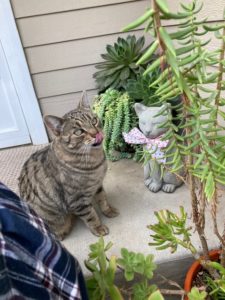
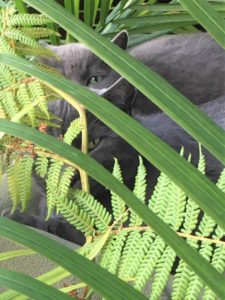 and sitting on porches. When I see a cat among flowers or even cactus, I grab my phone/camera. Recently I’ve taken pictures of cats crossing the street—ever notice how focused they are about getting to the other side? I’ve
 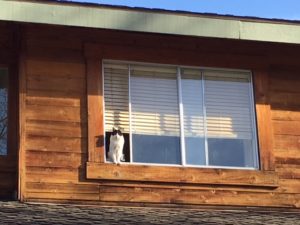 photographed cats eating on a back porch, making their way through long grass, lolling in the sunshine, looking at the world from
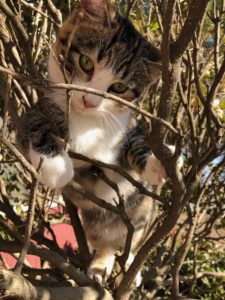
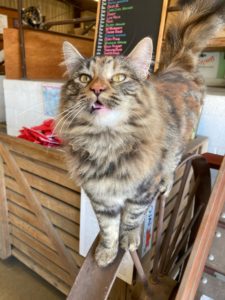
 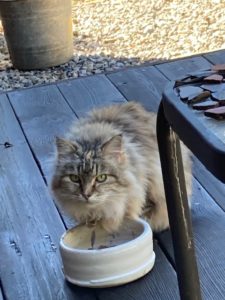 amidst tree branches, working as mousers at a packing house, entertaining shoppers in a pet store, wandering around a nursery, stalking birds in the neighborhood, sitting on a fence. Recently I got to photograph a cat named Morty who was camping at a local campground with his people.
 If you read a lot about cats and follow cats on social media, you’ve probably heard some of the strange words used to describe or reference cats. A clowder, for example (or a clutter) refers to a group of cats. More than one kitten together is a litter or a kindle. And, of course, an untamed cat is a feral cat.
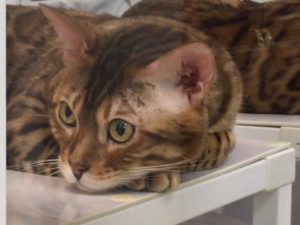 Have you heard the term “making biscuits?” What about pawdicure and pawtograph?