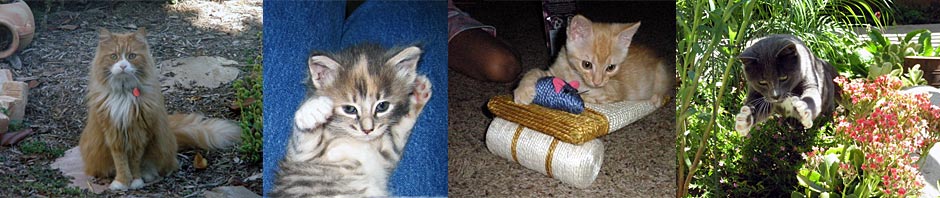
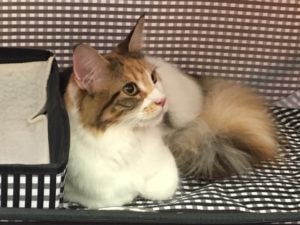
 Did you know that behavior traits in cats can be inherited? When we rescue a cat or a kitten without knowing anything about their breeding we’re pretty much taking a chance on the cat. Will she be naughty or nice, full of energy or lazy, pleasant or cranky? If you can identify her breeding background, you might be able to predict something about her temperament. A cat’s or kitten’s coloring and features will sometimes give a clue as to her heritage.
So which breeds are more friendly and sociable, active and so forth? There was a recent 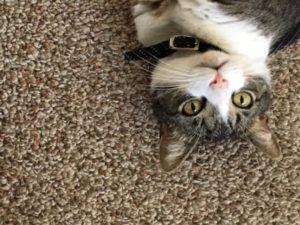 study involving nearly 6,000 cats of various breeds focusing on the cat’s activity level, sociability, aggressive behavior, and so forth. Here’s a peek into what they learned: the less cordial/friendly cat breeds are the British shorthair and the Russian blue. Some of the most friendly breeds are the Korat and the Devon Rex. The most active are known to be the Cornish Rex and the Bengal and the least active are the Ragdoll, Birman, and British Shorthair.
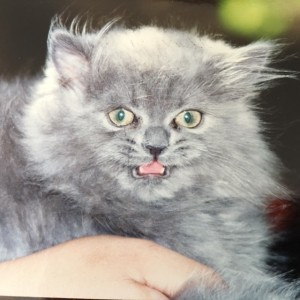 Those of us who’ve been around cats for a long time grew up knowing only two breeds—the Siamese and the Persian. We were conditioned to believe (and some of us learned firsthand) that the Siamese is more vocal and active and clever and teachable. The Persian is quiet, more docile, and sweet.
Today science has taken this concept to much higher levels. Here’s a site showing the behavioral traits of certain breeds.
https://healthypets.mercola.com/sites/healthypets/archive/2019/08/27/feline-behavioral-traits.aspx
Here’s a list of the most docile cat breeds. https://petcentral.chewy.com/behavior-breeds-10-docile-cat-breeds/
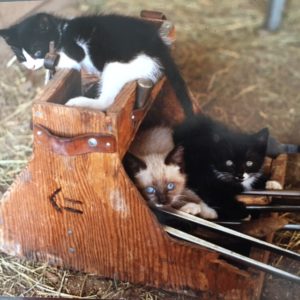 One of the most under-considered household dangers in your house for kittens is probably the recliner chair. We have two—one is used every single day for back pain relief. Up and down that thing goes many times each day and night. When our cats were kittens, we were always watching out for them as the recliner chair is more interesting to a kitten than a cardboard box or an expensive cat tree, play tunnel or closet.
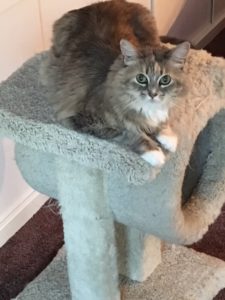 kitten in our recliner chair. I didn’t realize it until the mother cat began fretting nervously behind the chair. I found her comatose kitten lying there, cold to the touch. This was a time in my life when a veterinarian was a luxury we couldn’t always afford, so I treated her myself and, happily, was successful. Rest and warmth and her mom standing by her for forty-eight hours seemed to do the trick. On the second day, the little girl was up walking around and eating. She survived to live a long life.
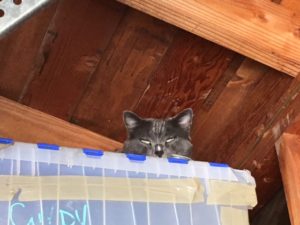 As it turned out, we did have an accident with Lily when she was about ten weeks old, but it had nothing to do with the recliner chair. It was the cat tree—an ultra-sturdy cat tree (we’d had the cat tree for a long time and they made them strong back when). Well, Sophie, who was about two then, and Lily (about ten weeks old) were playing on the cat tree when it toppled and caught Lily between the fallen tree and the fireplace bricks. Yeah, I don’t even know why the cat tree was in that spot at the time. I guess I’d moved it to vacuum or something. But then it didn’t occur to me it would ever fall over. It never had before. Well, Lily had an awful head injury and a long and difficult recovery. After that, we left the cat tree lying on its side for years.
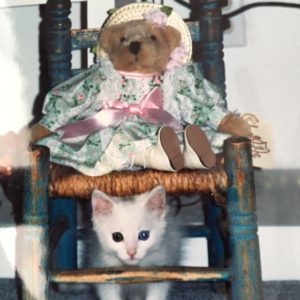 view.
view.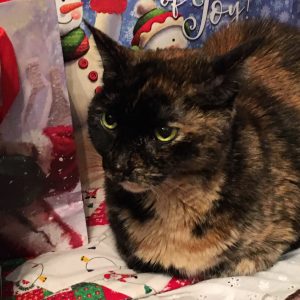 Why is it that anytime something new arrives in your home, the cat claims it as hers? You unpack a box from Amazon and the cat takes it over. You bring in a bag of groceries and the cat climbs inside to take inventory. A new sofa is delivered and the cats morph into an investigation team. And if you like to decorate for the season, I’ll bet your cats want to help you with that too.
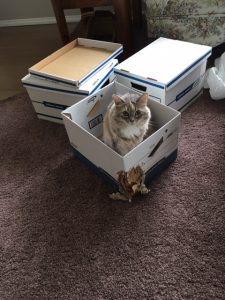 try destroying it.
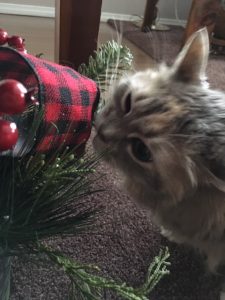 Each cat’s different. They have different degrees of curiosity and different tastes. While Lily might play with a ribbon or a fluffy bow on a package, Sophie has a serious addiction problem to metallic bows and pieces of string, rattan, and ribbon. We cannot use bows or ribbons
  on packages in this household because of Sophie. Have you ever seen the results of a cat nibbling on metallic Christmas bows? It’s a bloody mess, I’ll tell you. Lily likes to chew on plastic—tape, bubble wrap, and such. This year she tried to devour a decorative pot of artificial greenery. I consider that the cats’ way of helping me decide where to put things.
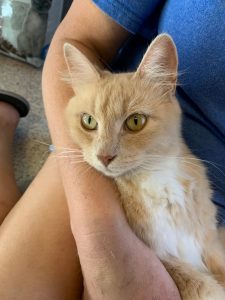 Don’t you just love to hear stories of lost or runaway cats being reunited with their family? And these reunions are made possible most often by the microchip.
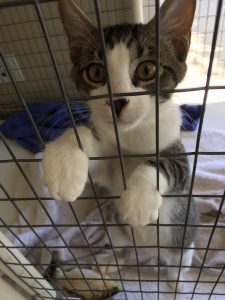 owner. They even escape from their home. Sometimes a cat will see an opportunity—an open door or window—and just go out for a little adventure. If they don’t get picked up by someone or frightened away into an area they aren’t familiar with, they may come home later that day or the next.
 Cats and dogs are often victims of a house or apartment fire, earthquake or flood. Some find a new home around the corner, others might run as far away from the disaster as they can, avoiding humans along the way.
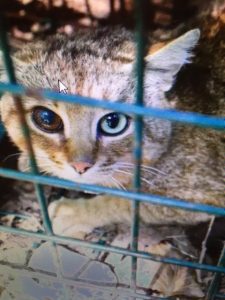 Have you ever heard of a cat with PTSD? When you consider the stress homeless, neglected, and abused cats are under day in and day out, it’s not hard to imagine that their constant fear could affect their bodies and their psyche. But some cats have a higher stress level than others. Even well-loved and protected cats can suffer from anxiety.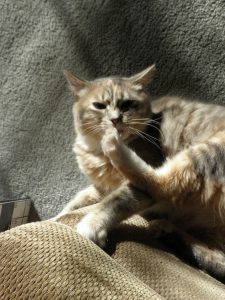
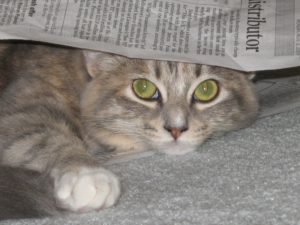 was also overweight, so his coworkers have been asked to stop giving him treats. His chief caregiver announced into the building when he returned with the cat, “Watch out, mice, Palmerston is back.”
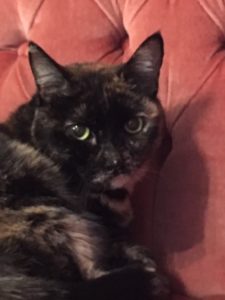 to our home safely, but a month later or so we noticed that Sophie was losing fur on one hip. The veterinarian’s first question was about Sophie’s evacuation experience during the fire.
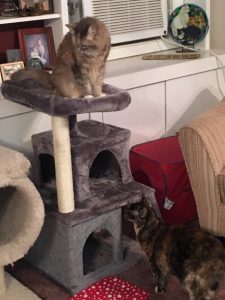 Just about every home with a cat also has at least one cat tree or other device intended for your cat to use for clawing instead of your furniture or your Persian rug or even your antique lampshade. Oh yes, cats can be creative.
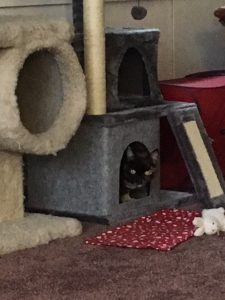 the more enticing sisal for clawing, and even an attached toy to play with, I was eager to have something less ratty-looking in the living room.
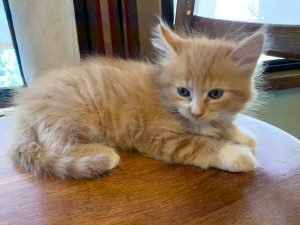 Yesterday I shared with you the stunning news about Smokey’s heritage—at least where he got his coloring from. If you have a red/orange cat or you’ve ever had one or you know someone with one, you may have done some research on this cat color. If not, some of my findings might surprise you.
 ginger and all orange cats are tabbies. There are four basic tabby patterns, classic, mackerel, ticked, and spotted. Some orange cats have white accents on their feet, throat, tummy. Others do not. And many of them have the tabby M on their forehead.
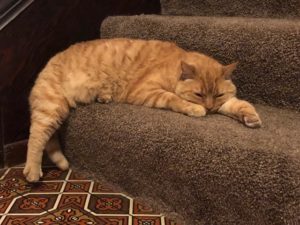 These cats typically have great personalities if you like a friendly and often lazy cat. They love to eat and often have a weight problem.
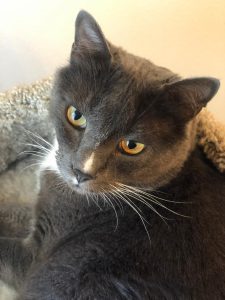 Interesting/shocking fact: Smokey’s sire is probably an orange tabby!
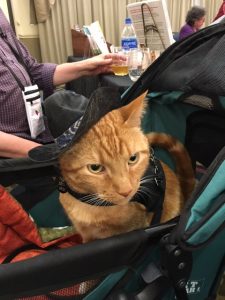 that was a surprise.
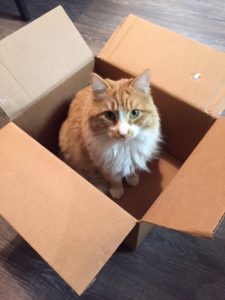 My sister-in-law (who owned the Ragdoll) saw an orange shorthair in the neighborhood at the time of perceived conception, and a black cat. I would have thought what most of you are probably thinking—yeah, Smokey is probably a product of the black cat.
 One of my upcoming books—Book 41—will be unusual in that Savannah wants to locate Rags’s siblings and possibly his parents. To prepare for this story, I’ve been researching cat genetics. Did you know that you can swab your cat and learn something about his heritage? Evidently all domestic cats came from one of eight regions and these cats still carry some of the DNA from their original
 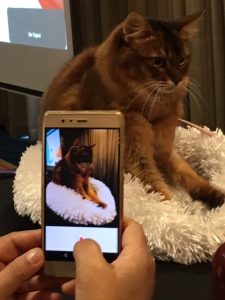 wild cat ancestors. These cats make up the breeds we know today.
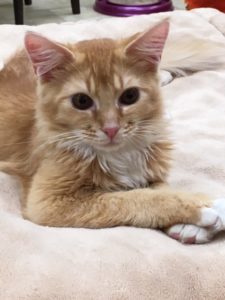 The eight geographic regions are Western Europe, Egypt, Eastern Mediterranean, Iran/Iraq, Arabian Sea, India, South Asia and East Asia.
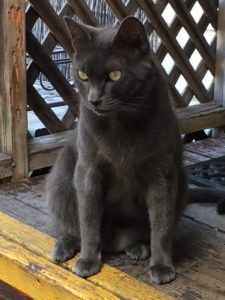 understand it, is around $100—some less, some more.
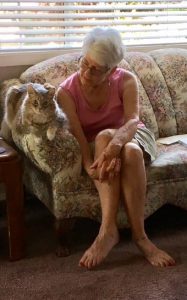 It seems unnecessary to set aside a time to love and appreciate your cat. Aren’t our cats always, consistently, continuously our first and foremost concern every day of the year? Don’t they get more of what they crave than any other family member—except maybe the dog? Isn’t your cat(s) the first to greet you each morning and the last to tell you good night? Lily puts me to bed every night and makes sure I
 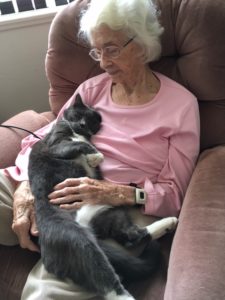 follow my evening routine, too. She’s always a few steps ahead of me as I close up the house for the night and prepare for bed.
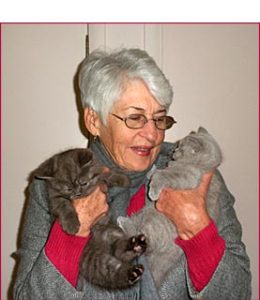 You’ll be busy this month thinking about others, but don’t forget to put your cat at least near the top of the list. She doesn’t know it’s December and that your mind is on giving and celebrations. All she knows is that she loves and depends on you.
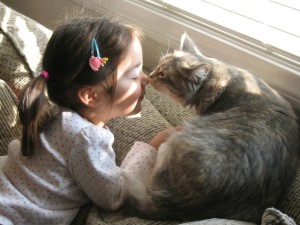 less fortunate cats. Find out what your local shelters need this season and consider dropping some of it off (cash, toys for the kittens, blankets, etc…). Visit a cat café or a shelter (most cats at the café have come from a shelter). Take pictures and post them on your social media pages. Someone just might be inspired to adopt. Here are two sites offering ideas for celebrating National Cat Lovers’ Month. Maybe you can think of others. Share your comments here.