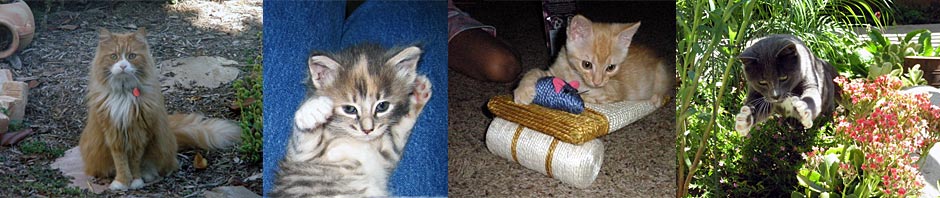
 If you’ve had cats for any length of time you know that they have their preferences and their objections in the way you interact with them. While one cat adores attention—it’s “all hands on me,” others may shy away when you approach, allowing only certain types of petting and only at certain times. And different cats like different styles of petting.
It doesn’t usually take long to learn a cat’s petting 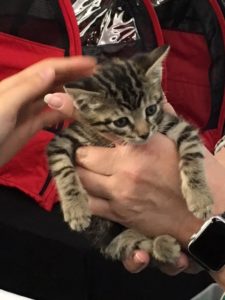 preferences. But you have your petting style, too. I invited a neighbor over to meet one of my cats once and she mesmerized Dinah-cat with her massaging-petting style. This woman really had a knack for creating a calming moment for the cat by gently massaging her neck and back in easy strokes. Dinah loved it and I attempted to emulate it afterward. But my petting style is a little different and I generally adjust it to fit the cat and the mood of the cat at the moment.
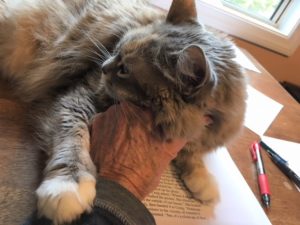 If she crawls into my lap and relaxes, I’ll pet and scratch gently. I’ll do the same if she’s rather wound up and I want her to relax. If we’re playing I might ruffle her fur in a different, more energetic-playful way. Olivia is young and robust, so she gets a different kind of petting session that Sophie does. And we do not touch Olivia’s tummy—that tempting fluffy belly is off limits. Sixteen-year-old Sophie, on the other hand, gets gentle full body massages.
What’s your cat’s petting style? Here are a few sites with tips and ideas for petting your cats. Your cats, however, will have the last word on this issue.
 We all take strict precautions to keep our cats safe. A huge fear for many of us is that our indoor cats will get out and that our indoor-outdoor cats will not come home at the end of the day. We’ve probably all had close calls. Our precious Himalayan, Katy, fell (or climbed) out a window screen the first night in a house I’d rented thirty years ago. I slept through the whole thing and was surprised to find Katy on our doorstep the next morning when I went out for the newspaper. Katy escaped a second time during my move into a home I bought a year later. This time she ran under the house. The best we could do—because she refused to come out and it was dark—was close her in under there until morning. I had a miserable night and she probably did too. But come morning, we removed the crawl space cover and she came
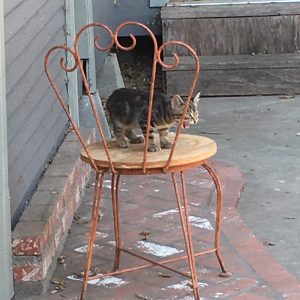 right out. Whew.
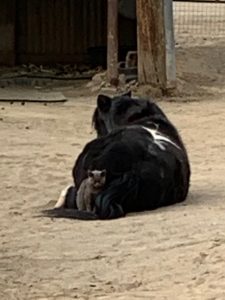 Here’s the story of a woman whose rental car was stolen with her beloved cat inside. To make things worse, she was traveling and this occurred in a strange city. She eventually contacted PetFinders and they were able to help her locate Willow. This is quite a story with a lovely happy ending.
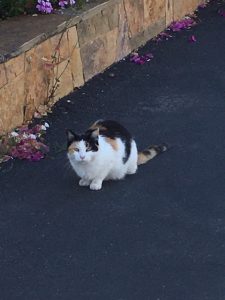 I read this week that if you’re preparing houses for feral cats this winter—in particular where it freezes—you should not use blankets in the house. Use straw instead. Evidently blankets tend to freeze in icy temps, defeating your efforts to warm the cats. Hmmm, definitely something to consider.
 turns out, the toxins in the rubber that can be a danger to the cats.
 Book 50 of the Klepto Cat Mysteries is here. Imagine, Book 50! Even I can’t figure out how one person can imagine so many stories. It’s a mystery!
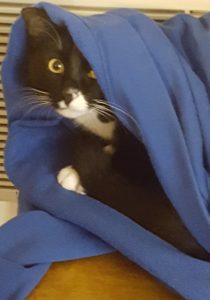 I’ve been going through my cat photos—boy are there a lot of them. Many are still on the computer and I haven’t used them in the blog yet. I spent time this week going through them and they helped me to come up with some blog topics. One of those topics is a favorite of mine—cats under blankets. Don’t you love it? What’s cozier?
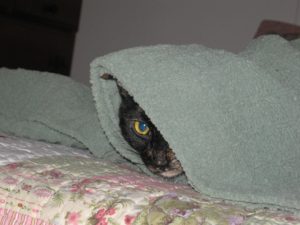 hide under, so when there were workers around or in the house, garbage trucks rumbling by, visitors knocking on the door, Max would hide under the covers in the bed. He taught Lily to do it, too. They felt safe there.
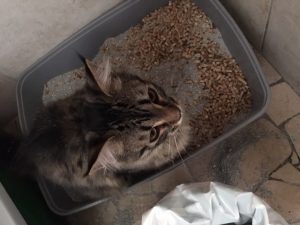
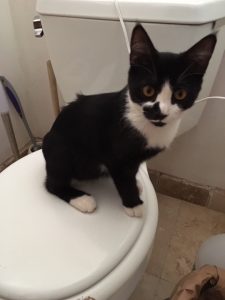 One reason some some people won’t take in a cat or keep a cat indoors where she’s safe is because of litter box hassles. I used to say, “I’d love to live at the beach, except for the sand in the house.” Wouldn’t you always be sweeping and cleaning up sand? Wellll, I might as well have the joy of watching the ocean waves from my office window because I sure deal with a lot of sand in the house. Having cats—even when they’re indoors only part of the time—requires litter boxes. One for each cat, plus one. Well, we have the one for each cat. I refuse to have a third litter box in the kitchen or living room—even in my office. Sorry kitties.
 who knows how to use the toilet. Or teach your cats how. Of course, you’d have to leave the lid up all the time.
 Isn’t it enough that we must constantly monitor our own weight and changes in the toning and flabbing of our own bodies? But no, we must also be watchful when it comes to our cats’ weight. Are they eating enough—too much? Is their food nutritious? Should they be getting kibbles and wet food? When should I worry about their eating habits? And how do you make sure each of your cats get what they need.
 eater along with one who can take a meal or leave it. We have a bully cat and one who is submissive. I don’t know about you, but we have to monitor the feeding of the cats. It’s the only way we can be sure that each of them is eating. And
 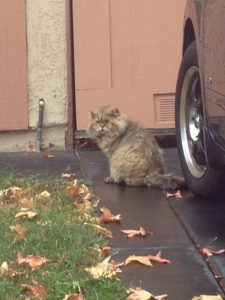 sometimes that means chasing down a cat with a plate of food, closing doors to keep everyone honest and well fed and most definitely sitting by and monitoring the cats’ meals. It can be a zoo.
 about ¼ of what we feed our cats, yet they’re chunky—in fact, downright fat. Our two current cats are totally indoor cats and each actually keep a pretty good weight. Sophie is older and I’d like to see a little more meat on her bones… Olivia isn’t even a year yet and seems to be a good weight for her bone structure and all, but I sure know some fat cats. Here are some I’ve photographed recently.
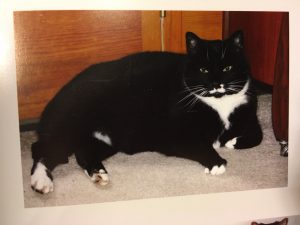 So what is the answer to slimming a fat cat down? I mean, once they get in this condition, how do you take control and help them drop the weight. Experts say play with them more often, bring in more challenging climbing
  apparatus, less food (fewer calories), but is that always the answer? While I’ve had pleasantly plump cats, I’ve never felt that any of mine were obese–but a veterinarian may have disagreed. Hey, I kind of like cute, chubby cats
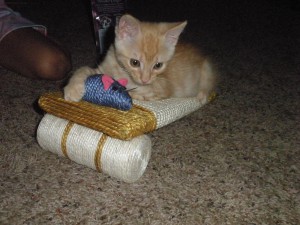 Those of us who have adopted a kitten are often stunned when we wake up one morning to find that the tiny pipsqueak we brought home now takes up half the bed. She has grown practically overnight. All you have left of that adorable kitten stage is fading memories, a few kitten scratch scars
  here and there, and maybe a frayed brocade chair you once loved. Kittens go through the infant, adolescent, and teen stages in a blink of the eye. Soon you’re sharing your home with a full-grown cat you hardly recognize. Yes, a kitten can change enormously in just a matter of months—even weeks.
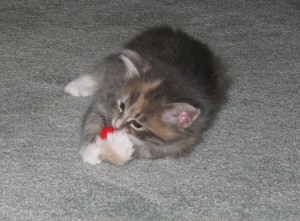 Imagine a kitten squeezing into a small space for a nap only to wake up and discover she’s grown so much she can’t fit through the opening to climb back out. Looking back on Olivia’s growth journey, I’m sure if I’d paid close enough attention or used time-lapse filming, I could have actually seen the growth occurring.
 that much over time. A puppy is pretty much a small replica of how he’ll look when grown. Not always so with a kitten. Check out these photos of Marmalade, Mollie, and Lily and you’ll see what I mean. Even the color shades changed a little over time.
 possible when you rescue or adopt. If you buy a purebred, then you have a pretty clear idea of
 what your kitty will look like as an adult cat. Otherwise , it can be a surprise. Olivia, my calico (who will return to appear in posts later in the week, by the way) has developed into a much different cat than I expected, and she’s not through growing. I had no idea her tail would grow so long and luxurious. I love that about her, although it seems to make her a little awkward at times. I think it’s a bit more of a tail than she can gracefully manage. She isn’t the daintiest cat around or the most coordinated. And her fur has changed from being kitten fluff to the softest, sleek and luxurious coat.
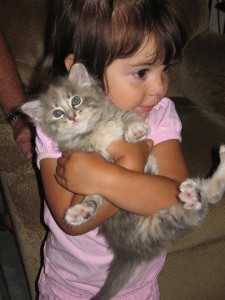 There’s nothing quite as charming as a child with a kitten. I’ve witnessed this adorable connection numbers of times over the years—and I’ve also felt the stress of a poor kitten when the little one squeezes too hard, makes too much noise, moves to fast, and puts the kitten in precarious situations. But there’s no denying it, most kittens are fascinated by small people.
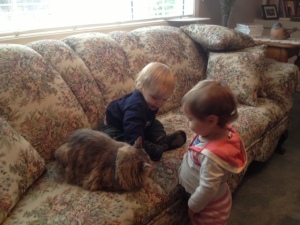 (They told us she was eight weeks.) Lily adored sitting on my desk watching the small children next door play. She’d hear their voices through the open window on a summer day and scramble to get to her spot on my desk so she could watch and listen.
 We regularly took care of a granddaughter when she was a toddler and Lily loved interacting with her. Wherever the child was, Lily was—under a tent, playing a game, stacking blocks, eating lunch, coloring. It was charming.
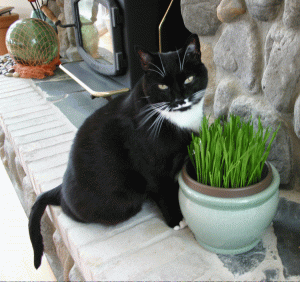
 Did you know that catnip—the herb of choice for most cats—can also ward off mosquitoes? Do cats know this? Evidently birds have a clue—some species will rub against citrus fruits in order to discourage insect pests.
 but it’s also an excellent deterrent for fleas and other insects. This is good news for those who live in areas where fleas thrive and have cats (like I have) that are super sensitive to veterinary flea treatment. This substance will also kill and deter ants, bedbugs and other insects. The most recommended treatment is to sprinkle it over
  your carpet, on hard surfaces in corners, around baseboards, on furniture and that cats’ bedding. A professional applying this to the carpet would tamp it with a machine that would help to break up the powder and filter it deeply into the carpet. Vacuum after a few days.