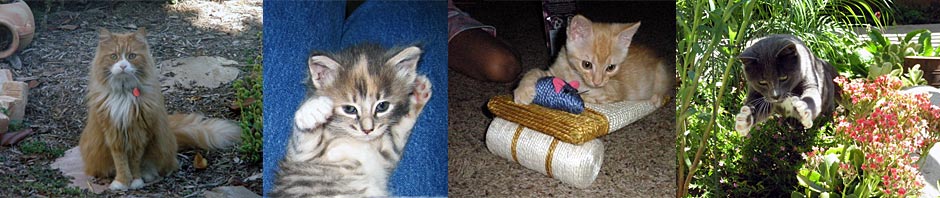
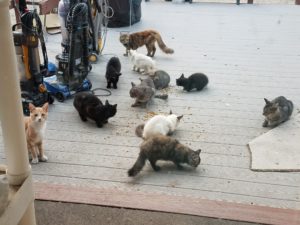
 Are you a rancher? Whether you raise and care for llamas, cattle, goats, horses, or tortoises—or a mix of these and other animals—your “herd” or “menagerie” probably includes one or more cats. He, she, or they are barn cats. Most large and small ranches keep cats around for a variety of purposes—most predominantly for rodent control.
But did you know that the purpose of cats on a large property where there are barns, workshops, out sheds and the like, goes beyond keeping the rats and mice away. In fact, barn cats tend to save the owner money in lost grain and other animal feed. Cats are thought to keep the bug population down—yes, cats love to leap after grasshoppers, squash beetles, and the like.
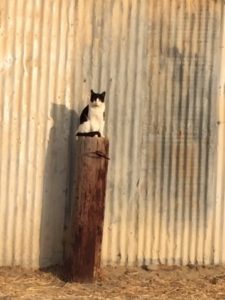
Cats are fun to have around. They’re entertaining—even when they’re too feral to allow 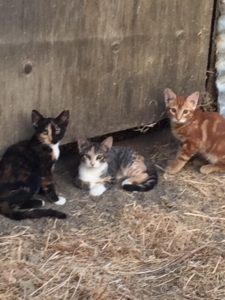 petting. They might keep your other animals calm by befriending them.
But if you take in a barn cat (bless you for giving him or her a home), remember that she is a living, breathing being just like your prize bull or best laying chicken or favorite horse. And she deserves proper care. Contrary to what some believe, barn cats need to be fed. Keep clean drinking water out for them at all times and a fresh bowl of kibbles. Feeding a good hunting cat will not deter him from doing his job. If you don’t feed him, and he survives, he’ll likely wander off to another property once he’s cleared yours of rodents.
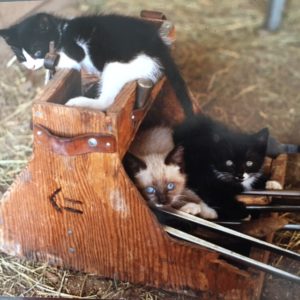 Have the cat spayed or neutered, make sure he gets all of the appropriate inoculations, prepare a safe place for the cat to hide out and relax—an old dog house will do or a canvas shelter, for example. Learn what substances are toxic to cats and keep them secure.
If you’re looking for a barn cat—one hasn’t found his way to your property yet—contact one of the many feral cat organizations and shelters in your area. There are a lot of homeless cats and some of them are too skittish and wild to settle into a home environment, yet might be purrfect as a barn cat.
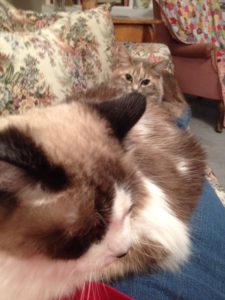 What’s better after a huge Thanksgiving meal and a wonderful family visit than a nap? I don’t know about you, but I love to snuggle with my kitties. When I really, really need a nap, I’ll seek out a cat to curl up with. Well, they do it to me all the time.
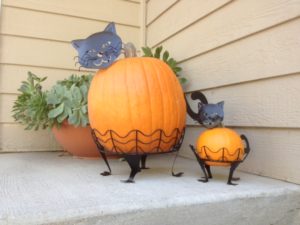 From our cats to yours, we wish you a wonderful feast with those you love most. Don’t forget to keep your cats safe during your celebration. Secure all turkey bones. Cats and dogs can choke on them or become injured when trying to swallow splintered bones. In fact ban cats from the kitchen during the height of meal preparation activity. Cats underfoot can be a hazard for everyone(and every cat) involved.
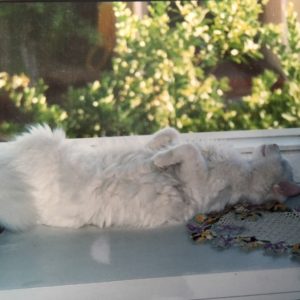 There’s nothing as charming as the antics of a kitten. They can go from skittering around the room like popcorn to falling asleep while eating from their bowl. So cute. Even as they grow into remarkable cats they still make us smile with their expressive eyes and intriguing curiosity. I enjoy photographing cats in unusual positions.
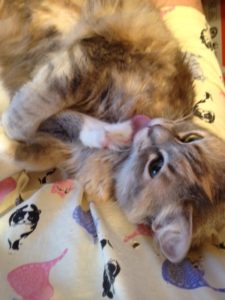 pictures of cats if you have any you’d like to share.
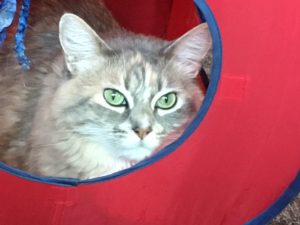 If you have a cat in your home you probably sometimes find yourself being drawn into the soul of Friskie or Fluffy or Tommy when you stare into those remarkable eyes. They’re hard to resist. And why would you want to, they’re so beautiful.
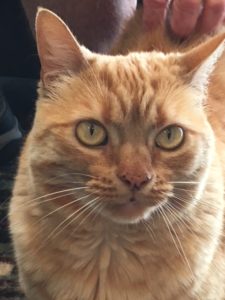 cat’s eyes correctly? I maintain that there’s no way of knowing for sure what she’s thinking, but the speculation is fun.
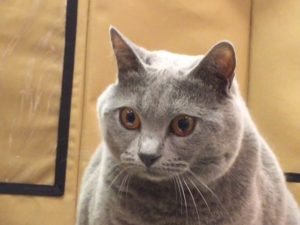 Of course, when I come home from someplace and see Lily either waiting at the screen door for me or peering out the closest window, I like to think she’s happy to see me. But I rather suspect she’s eager to be fed again. Some cats take food for granted and treat meal time as if it’s just another mundane routine in the day. Others, however, like Lily, consider mealtime the main events of the day. While some cats eat to live, lily lives to eat. She even begs for tidbits from my plate when I’m eating. Thankfully, she has developed some manners. She’ll sit back and stare until my last bite, then she’ll move forward and snatch the piece of chicken or fish or yam or pea I’ve left for her on my plate. Spoil my cats? Not me, I say with a wink.
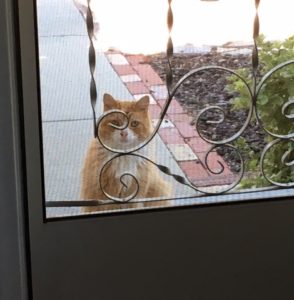 Do you have security cats in your neighborhood? They hang out among your geraniums, curl up on your doormat, and walk the perimeter of your yard keeping an eye on things. They also watch your indoor cats through your windows, the birds you feed, and any vermin that might stop by to eat a carrot from your garden.
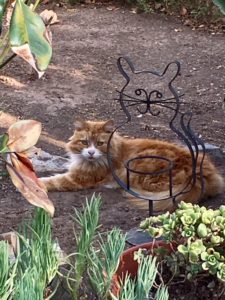 yard. And I often take advantage of their presence by photographing them for this blog. Here are a few shots of George, a Maine coon cat posing for me. Do you think he’s trying to camouflage himself so we think he’s one of my cat yard ornaments?
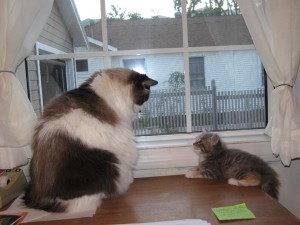 Is there anything as charming as watching unlikely animal friends interact? I saw a picture of a fawn and a bobcat curled up together this week trying to find shelter from one of the fires. I also saw the most adorable scene showing an elephant and a lioness walking together toward a waterway. The elephant carried her cub curled up in his trunk. (I was suspicious of this picture, however, and discovered it was photo-shopped—bummer.)
 frolicking together in a pasture or snuggling together on a sofa—a pig and a duck, a lamb and a pony, a dog and a goose, and certainly many types of animals make friends with cats—horses, calves, gorillas, birds, and dogs.
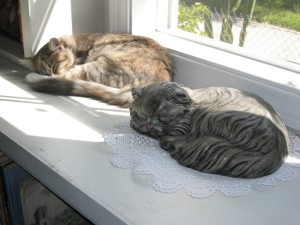 This morning I did a little internet search and found cats pairing up with an owl, a fox, a duck, a crow, and even a dolphin. There are many stories of wild cats making a sweet connection with other animals—dogs, bears, and others. One of the sweetest to hit the internet lately is the mother hen keeping a litter of kittens warm. Adora-dorable!
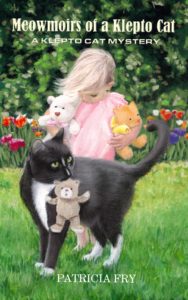 One of my challenges as the author of cozy mysteries with cats is creating titles for so many books. By comparison, it’s easy to come up with titles for nonfiction books. In order to attract the right readers for your nonfiction book, you must be literal in your presentation of it; and a major part of that presentation is the title and subtitle. Here are some examples of my nonfiction book titles. The Mainland Luau; How to Capture the Flavor of Hawaii in Your Own Backyard. And how about this one: Youth Mentoring; Sharing Your Gifts With the Future? And this one: Creative Grandparenting Across the Miles; Ideas for Sharing Love, Faith, and Family Traditions. These titles pretty much describe the book you’re about to buy. Then there are my publishing-related books, for example, Propose Your Book, How to Craft Persuasive Proposals for Nonfiction, Fiction and Children’s Books and A Writer’s Guide to Magazine Articles.
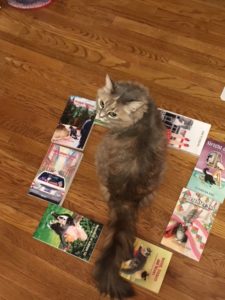 intended. But it’s not as easy to capture the essence of your story in a brief title for fiction. I tell authors that if the main title isn’t descriptive, always use a subtitle—yes, even in fiction. My subtitle for my novels is always “A Klepto Cat Mystery.” Then folks know this is a mystery and part of a series and it involves a cat—one that presumably takes things. They get the idea that this story is fun, probably light, and entertaining. This is a technique used by many novelists.
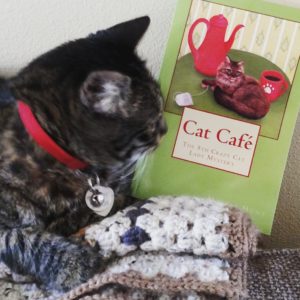 what? I suggest adding “A Novel,” “Memoir of a Street Urchin” (War Veteran, Holocaust Survivor, etc.) or “A True Story.” You can see that my friend Mollie Hunt has done this with her series of cozy mysteries. The title of this book is “Cat Cafe.” The subtitle says, “The Fifth Crazy Cat Lady Mystery.”
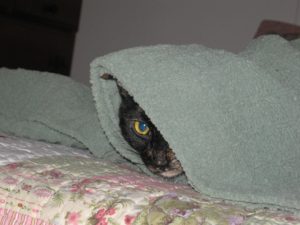 What does your cat do when she feels vulnerable? Many cats, when a stranger invades her space, there’s a loud noise (the trash truck picking up barrels in front of your house, a siren screaming past, the vacuum cleaner running over the carpet), will hide. They’ll seek out a dark closet in the back of the house, a cozy spot behind your computer, or under a bed. In our house, Sophie hides under a piece of furniture and Lily scrambles to where she feels most safe—under the covers.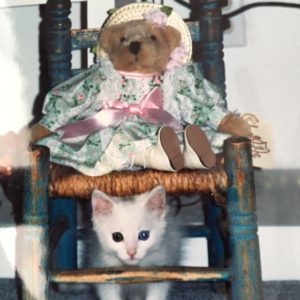
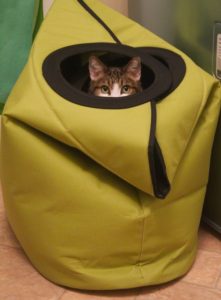 So it’s no wonder that the Thundershirt works to calm some cats during a thunder episode or fireworks display too close to home, for example. Pressure for calming is widely used among veterinarians and other animal practitioners on a wide variety of animals for various purposes. Cats feel secure in tight spaces. So it follows that the Thundershirt—designed to apply a comforting pressure around the torso of the cat can create a calming effect in times of stress. I should have thought of this when we had to evacuate during the fire in December. It’s probably something worth getting your cats accustomed to for unexpected storms or natural and unnatural disaster episodes. They only cost anywhere from $15 up to around $40.
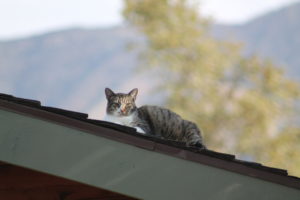 It has happened again. There are horrific fires raging in Southern and Northern California. Along with news reports of the fire’s intensity, evacuations, deaths, etc., come personal stories. Many of those focus on the animals. I’m appalled by the number of people who leave their pets behind. Some people are shown on TV coming back to check on their dog or cat after the danger has passed (or after their home was lost). What??? Why was the pet left alone amidst that danger in the first place? This I do not understand.
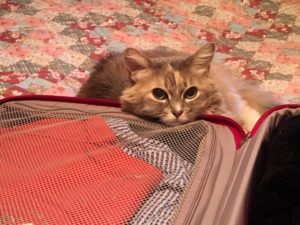 window of a flooded home, cats are found suffering from injuries after a tornado or hurricane. Last week a fireman rescued a cat on the front porch of a burning home forty miles from me. The cat was drenched (from the firemen’s hoses) and badly burned. They were able to capture him and get him help. But the question remains, why was he left behind?
 Many of us do not have adequate provisions and a plan for disasters. We might buy extra water and bandages, then use them up over time and not replace them. But surely you have carriers for each of your cats, bunnies, tortoises, birds, and harnesses/leashes for dogs, pot bellied pigs or whatever else you care for. You wouldn’t leave a child behind to fend for themselves in an emergency situation. Why do people bother to take in a pet and commit to him or her, then abandon the pet when he really needs your protection?