 First, let me announce that both the print and Kindle versions of Book 34 of the Klepto Cat Mystery series, FURever Friends, are now available for purchase at Amazon.com. ENJOY!!!
Some of you reading this, no doubt, have had a cat with kidney disease (renal failure). It’s fairly common in aging cats and can occur in young cats. Our Lily was diagnosed with kidney disease when she was around two or three years old. It seems like the symptoms began to appear before she was a year old. It took our veterinarians a while to consider that such a young cat could have kidney disease and to actually run a blood test.
Her symptoms were a lot of water-drinking and huge pee clumps in the litter box. Her  urine continues to be quite dilute. They thought she just had an extraordinarily large bladder—which she seems to have, as well. Thankfully for Lily (and for us), prescription food and plenty of water supplies have kept her healthy for almost 10 years. But she had a serious setback when she was around three or four. It took a lot of research on our part and experimentation and three veterinarians to get her going on the right track again. That was a frightening time. The best thing we did was consult with a holistic veterinarian in a conference call. He was extremely thorough and knowledgeable and he put her on a program that seemed to save her life.
We lost our Himalayan, Katy, to kidney disease. Hers was age-onset kidney failure. Her symptoms appeared when she was around sixteen. We treated her at home (with our veterinarian’s guidance) with subcutaneous fluids for a few years until her disease became acute. She died at the age of 18.
Symptoms of kidney disease include elevated thirst, decreased appetite, vomiting, weight loss, lethargy. Causes include aging, trauma, infection, and/or toxins. I read the other day that one bite of an Easter lily, for example, can cause kidney failure. The veterinarians can only guess that trauma at birth may have caused Lily’s kidney disease. She also had a head injury when she was a kitten. I wonder if that could have contributed to the disease.
If your cat shows any signs of unusual thirst, lethargy, she’s off her food, vomits more often than usual, get her to your veterinarian immediately and ask about the possibility of kidney disease.
Here’s more information on the topic. https://www.cathealth.com/cat-health/urinary-system/1334-feline-chronic-kidney-disease?goal=0_3e73124b70-c8e158b353-587741849&mc_cid=c8e158b353&mc_eid=ad8616dba2
 I don’t know where this site’s been all my life, but I found it and I’m fascinated. It’s “101 Interesting Cat Facts,” put together by Karen Lehnardt for FactRetriever. If you love obscure facts on a variety of topics, you might want to look at some of their other posts on people, mammals, food, geography, and much more. Here’s the link to Cat Facts:
 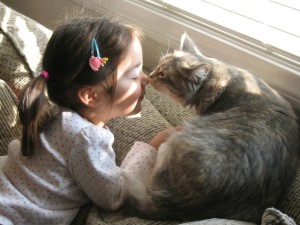 Isn’t this an interesting question? But if you’ve had a lot of cats with a variety of backgrounds, you know it’s legitimate. Some cats will practically turn themselves inside out to feel the human touch and others seem to dislike being petted. They shrink away from your hand—avoid your overtures. Then there are those who will accept and even direct just the type of petting they prefer: a vigorous neck scratch, strokes alongside their cheeks, or a tickle at the base of their tail.
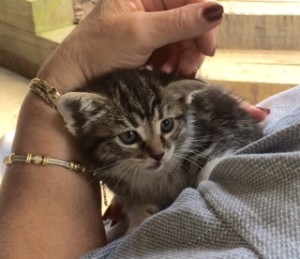 or vice versa? Is this something their early life experiences create? I thought so, until our once homeless, standoffish tortie grew to adore being petted. She can’t get enough of it—she’s extremely needy of affection now that she’s accepted it.
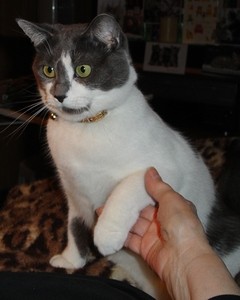 She almost always enjoys neck and cheek scratches and sometimes she loves being petted. Other times, however, she slinks away from me when I run my hand over her. I can only guess that she just wasn’t handled enough as a kitten and this feels foreign to her—she was taught not to trust. Maybe someone (a child, perhaps) was frighteningly rough with her when she was tiny.
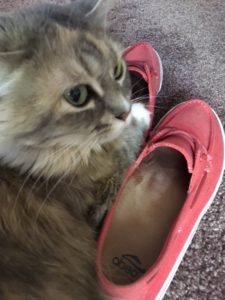 Yesterday we talked about support animals on planes. I heard someone say the other day that all pets can be considered therapy pets. Isn’t there truth in that statement? Don’t you find comfort in your cat, for example? He brings you joy, calms you, makes you laugh (and we all know that laughter is therapeutic).
 You’ve probably heard the news. At least on some major airlines, you cannot fly with the following service animals: peacock, chicken, gopher, hedgehog, gecko, rat, camel, hippo, or squirrel. But you may get away with bringing on board a cat, dog, or miniature horse. You might need more than a vest purchased at WalMart showing the animal’s service status, however.
 they’ll eventually crack down on approved animals on flights because of another passengers’ allergies, ailurophobia, or equinophobia for example. It’s an unstable world out there!
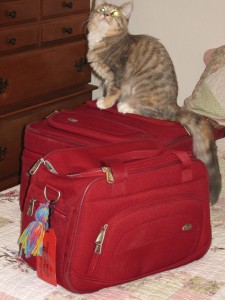 Rags, the cat in my Klepto Cat Mysteries flies on occasion. Yeah, if I were a flight attendant, I might ban him from the plane. He can find mischief wherever he goes.
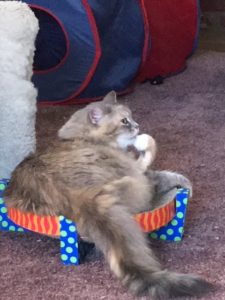 It’s true, there’s at least one study on cats and their paw preferences. This one shows that most female cats are right-pawed and most males tend to reach out and lead with their left paw. I’ll bet you will do what I did after reading this—watch for your cat to make a move so you can see which paw he or she favors.
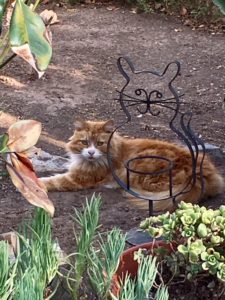 Can a tiger change its stripes? So to speak, yes. If you’ve had cats long you know that they can change their habits and offer little surprises over time. The cat or kitten you bring home isn’t always the cat who shares your house eight or ten years later.
 to pet her and sometimes she’d even greet them as they came in.
 We’ve all experienced a cat who suddenly wouldn’t take her medicine or let you clip her claws or brush her. That’s usually because of an unpleasant occurrence—the brush pulled her fur, something happened to scare her or make her feel uncomfortable during a claw-trimming. But I find it most interesting when a cat suddenly develops a new habit or begins pursuing a new activity as an adult. It’s rather charming. Such as Lily’s latest pastime—bringing me my slipper socks. Now, instead of her stuffed toys spread across the floor all the time, it’s my heavy socks I wear in winter that decorate our house. How nice of her to think of me.
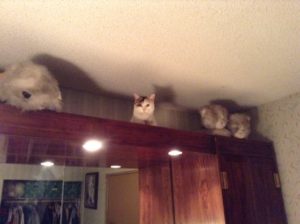 cats seem to retrain themselves to open a cabinet door, begin napping in a closet, develop a fascination for something they never paid attention to before (sheets of paper coming from the fax machine or printer, earrings hanging on your jewelry tree, a potted plant, etc.). Max, our snowshoe-type cat, discovered how fun it was and how much I’d react when he’d push my pen off my desk—usually into the wastebasket. He taught Lily to hide under the bed covers when she was frightened. My heart breaks for her now when something scares her—thunder, a noisy truck on our street, the gardeners, etc—and she has to crawl under the blankets alone. I believe she started sharing that space with Max for support and comfort. The two cats didn’t have a close relationship, but they became hiding buddies in times of stress. Sweet.
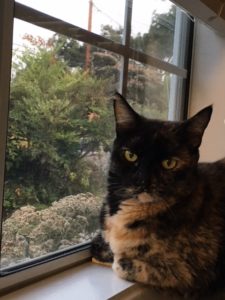 Monday I shared a tale of cats NOT being tempted by an open door. Some cats crave being outside. We’ve talked about many ways to allow outdoor time with safety restraints—a catio, cat-proof fencing, electric wire that gives off just a pinch of discomfort. I suppose there are collars for cats that would teach them to stay within a particular perimeter as there are for dogs. But another solution for cats is simply creating more interest outside your windows to entertain, mesmerize, and soothe her.
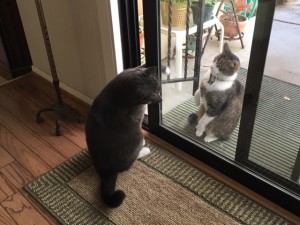 attract birds and butterflies, interesting wind chimes and sun catchers. I’d suggest changing them out fairly often to provide something new for the cats to look at.
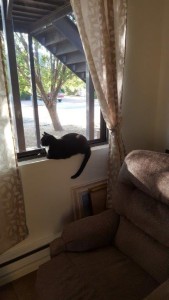 Sometimes cats sit at a window to feel the warmth of the sun, to smell the rain, or to watch for your return when you’re gone.
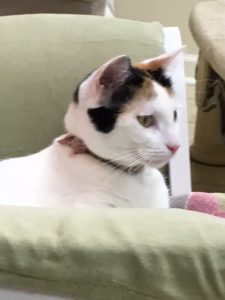 to learn about the purr-sonality of a cat before you take him or her home. Oh, and if you want a cat-
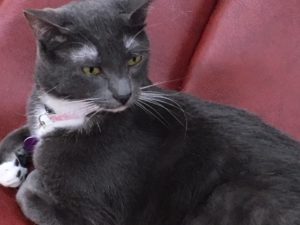 related gift for someone, you can often find it at a neighborhood cat café.
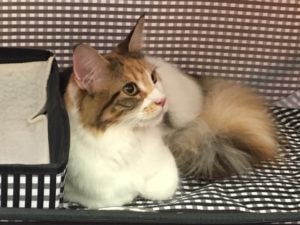 There are cat cafés now in many cities throughout the world. At last count there were 103 in the US. There are ten in Canada. Aside from being a fun place to visit, are they helping our helpless cat population? Catfe Cat Café in Vancouver has adopted out 176 cats in three years. Java Cats Café in Atlanta has adopted 250 cats in a year.
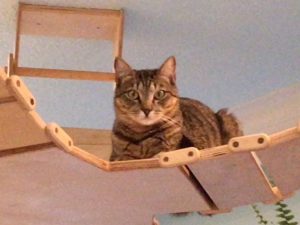 Generally a cat café will partner with a local shelter. And all of the regulations for adoptions apply.
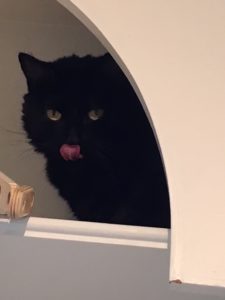 Just where are these cat lounges? New ones have cropped up in Las Vegas, San Diego, Miami, Cleveland and Los Angeles. Crumbs and Whiskers Cat Lounge just opened in Georgetown, Washington DC. Between this lounge and the Crumbs and Whiskers Lounge in Los Angeles, they’ve found homes for over 900 cats and kittens. If you haven’t visited a cat café yet, plan to do it this month. Invite a friend for a cup of tea and a frolic with a delightful collection of cats and kittens. Find a cat café near you here: