 Many of us grew up knowing about the local animal control facility in our community. Here, it was called the pound. You could go there to adopt an animal, to search for a lost pet, or to drop off a stray cat or dog.
In those days, there were also a few cat hoarders. I don’t think we used that term then. These people opened their hearts and homes to an unusual number of cats. Some, like my step-grandmother, knew the importance of a good spay-neuter program and would come up with the money to take care of the cats they collected. And they’d do it without donations. Others simply continued allowing the cats to breed indiscriminately and ended up with many cats who suffered because they’d become overwhelmed—just like occurs today.
And then there were cat breeders—those who liked a certain breed of cat and enjoyed surrounding themselves with more and more of them, selling some off to make extra money.
Now, in a time when so many people are trying to protect cats and save cats, there appears
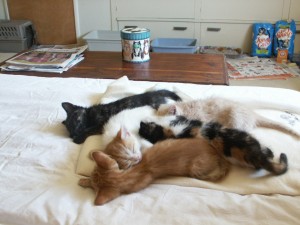
Kittens waiting for a home
to be more cat breeders than ever. Yikes, I even learned this morning that there are those who breed cats specifically for research purposes. Oh don’t worry, they’re regulated and licensed. Say what? That certainly doesn’t make it okay with me.
Today, I’d like to talk about human heroes who give their all to save and protect cats. There are hundreds of shelters and sanctuaries designed to provide cats in all manner of need the care they require for a better life. Did I say hundreds? At last count, statistics show there are actually 13,600 community shelters. Why so many? Well, because we aren’t doing a very good job of taking care of our cats.
There are 3.4 million cats entering animal shelters per year. And some of those shelters provide permanent homes for unwanted cats, some provide hospice care, others take in disabled cats, and some even specialize in cats with communicable diseases.
Cat House of Kings in California, is billed as the world’s largest no-kill no-cage sanctuary. They maintain around 700 unwanted cats and they’ve saved more than 24,000 cats over the years.
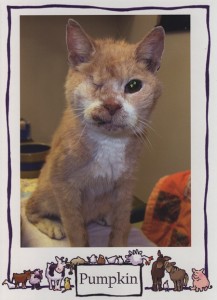 Other similar sanctuaries that specialize in special needs cats are Tabby’s Place in New Jersey and Milo’s Sanctuary in Burbank, CA. There’s also HEART in New York. Many cat sanctuaries focus on cats that can’t be re-homed—those that are terminally ill, have been abused, or have disabilities.
If you have a heart for cats with disabilities, here’s a link where you can tap into the possibility of adopting one http://www.petswithdisabilities.org/catadopt.html
Most of us do what we can. We adopt (rescue) the number of cats we feel we can properly care for. We become educated so we can most appropriately care for our cats. And we spoil our cats in every way possible. But aren’t we grateful to those who go beyond and take responsibility for the thousands of cats that have no one else, those that have come into being or are left behind because of ignorance?
Yesterday was Love Your Pet Day. Today we celebrate those who go above and beyond loving a pet or two. They embrace all of the furry beings who come to them in need.
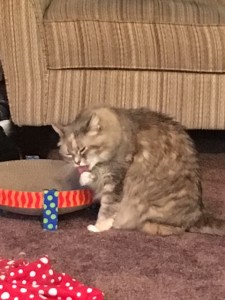 There are dozens of videos and stories online featuring cats having a bath. Have you ever bathed a cat? It used to be common to plunk a cat into warm water with gentle cat-friendly shampoo in order to free the cat of fleas—at least here in California. When I bought my silver-shaded Persian, she came with this instruction: “Bathe her once a week.” Say what??? I didn’t understand why—still don’t. But I did give her one bath. Neither of us were happy campers. Never did it again. Never saw a need to do it again. She was purrfectly capable of licking herself clean.
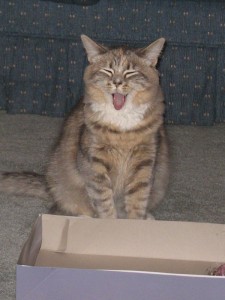 Does it sometimes seem like your cat is dissing you? When you want to pet her, she bites. Or you wriggle your fingers in an attempt to play with her or toss her ball and she just looks at you like you’re weird. I was talking to Lily-kitty the other day—having a meaningful conversation with her—and she yawned in my face.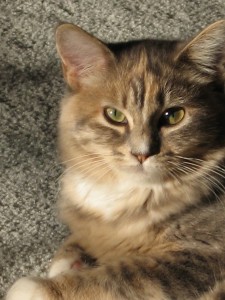
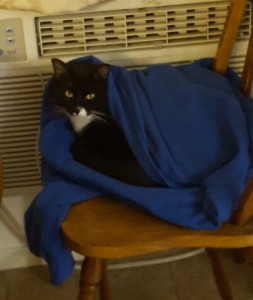 How does your cat keep warm when the weather turns cold?
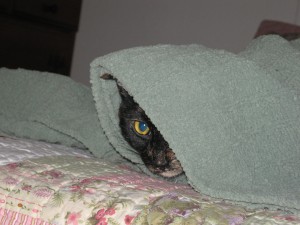
 showing cats and dogs in their comfort zones—sharing a shard of sunlight, sleeping curled up together, hugging a space heater (probably one that was either not turned on or turned very low). Most cats will navigate toward a warm body—any body on a cold day. Lily practically never gets in my lap in the summer months. But come winter, she’s curled up with me almost every morning. Sophie, who has a shorter coat, needs lap time every evening even when it’s 100 degrees outside. And this time of year, she cozies up to our radiator heater until the sun comes out and begins shining through the living room window across the floor. Then she and Lily lounge there for a while.
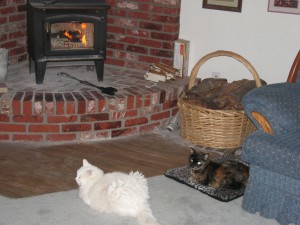
 When we were heating with our wood-burning stove for all those years, our, then, four cats all curled up in front of it every morning in winter.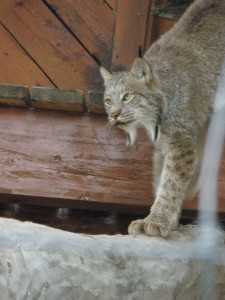
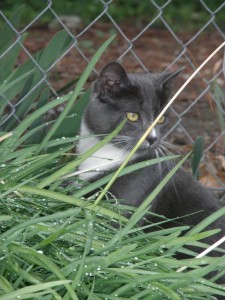
 All together, there are reported to be 21 first cats. And few of them had any breeding behind them. William McKinley had two Angora kittens, named Valoriano Weyler and Enrique DeLome. The only other first-cats I located that might fit into a breed category were Rutherford Hayes’s Siam—supposedly the first Siamese cat to enter the United States (in 1878); Gerald Ford’s Siamese, Shan; and Jimmy Carter’s Misty Malarkey Ying Yang, also a Siamese cat.
 ball the cat might hurl just before a dignitary enters the Oval Office? And the cat hair! Is there someone assigned to the task of using a lint roller on the back of the first-lady’s skirt before the media arrives and making sure the dignitary’s chair is not covered in cat hair? I suppose there’s someone in charge of picking up the cat’s toys before a visiting queen trips on a plastic ball and scouring the grand Persian rugs for any sign of mouse or bird remains, lest the queen is queasy.
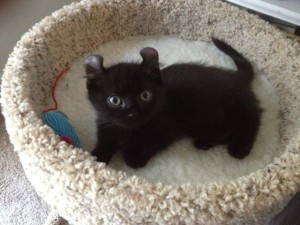
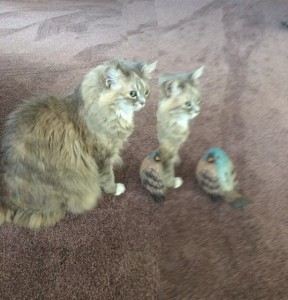 Ever hear of a Munchkin, an American Wirehair, or a Twisty Cat? Surely, you’re familiar with the Scottish Fold and the Manx. These are all cats stemming from mutations. At some point, a breeder got an unexpected peke-faced Persian or a tail-less kitten or one with six toes, for example, and decides to breed for this deformity. Why?
 shows. You do not touch the cats. However, this time, as I admired a large buff and brown cat, the owner held him out to me and said, “Here, want to hold him?” Of course, I did. And I was told that day that the Ragdoll, known for its large size and floppy, relaxed nature, is an accidental mutation. I was told that a pregnant white cat was hit by a car and when she delivered, the kittens were very calm and quiet. Some say this cat feels less pain than most. This is a fairly new breed, having been started in the 1960s.
 Sure, kittens are sometimes born with a deformity—deafness, blindness, crooked tail, or diminutive size, for example. And we just take care of it in the best way we can. Just scour the Internet and you’ll find cats with an extra set of ears, cranial abnormalities, two faces and more, but this doesn’t mean that we should capitalize on the defect by trying to breed for more such kittens.
 One of the best things about writing for publication is the feedback you get. That’s also one of the worst things about putting yourself out there. You’re bound to have critics as well as fans.