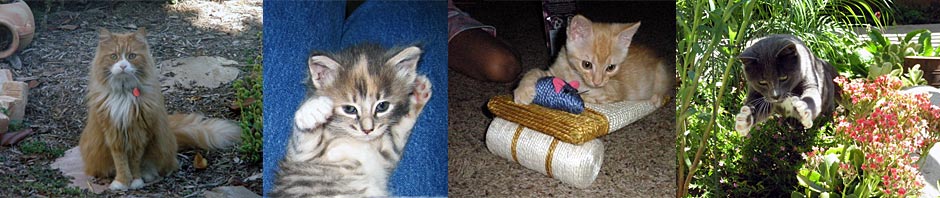
 I know we cover this topic every once in a while. Most of you know that we keep our cats inside. The last cat we had that went in and out was Dinah. We adopted her from a local shelter when she was almost a year old and she refused—I mean REFUSED—to use the litter box. She had to be let out even in the rain. While our other two cats were indoor-only cats, Dinah had outdoor privileges during the day. She didn’t spend a lot of time outside, but she’d go out to garden with me and, as I said, she pottied outside. I have to say she never had an accident inside. That wasn’t the problem. She just held it and begged at the door until someone let her out. Never once did I see her use the litter box in the few years we had her before she died of a brain
  tumor.
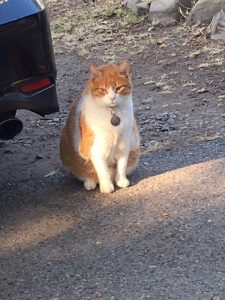
Why did I decide to keep our cats inside? We were experiencing too many problems—fleas (before there were the excellent flea products available). However, some of my cats could not tolerate the flea products—another problem. When we were allowing our cats to 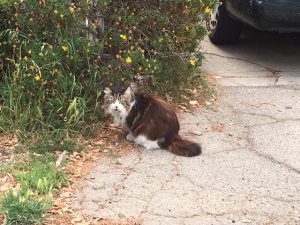 go outside, we lost cats to cars, predators, poisoning, and disease. Sure, our inside cats died too, but most lived to ripe old ages.
Another argument for keeping a cat inside and close is that you’re more apt to catch a 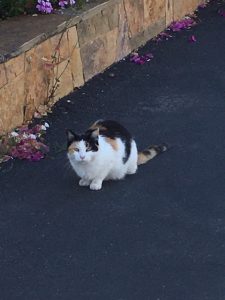 health issue early enough to treat it. A cat will often hide out when she isn’t feeling well. If she lives inside it’s much easier to monitor her health on a daily or even hour-by-hour basis.
Here’s a site giving just five reasons for keeping your cat indoors. I’m sure some of you can think of more. For example, there are dangers out and about—cats get inadvertently closed into sheds and garages, people 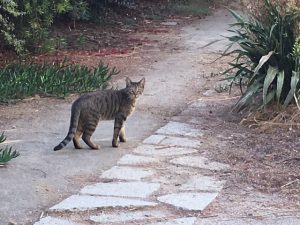 and other domestic animals can be a danger to a cat, especially if the cat is infringing on their property or lifestyle. A birder isn’t going to tolerate a cat stalking the birds they feed. Other outdoor cats can
 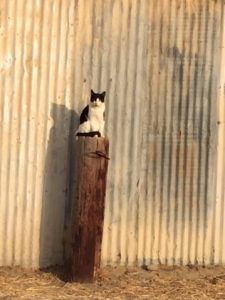 be territorial—something your cat might not understand or respect. Injuries from cat fights can be deadly. People without cats don’t appreciate your cat using their garden as a litter box and might retaliate. I’ve known of some who will trap neighborhood cats and haul them to a desolate area to turn them loose. You sure don’t want that to happen to your Fluffy, Ginger, or Tom.
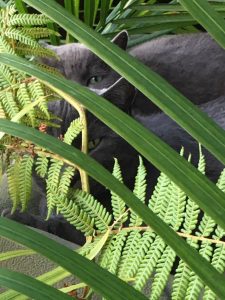 Speaking of Tom, an outdoor cat that is not spayed or neutered could be responsible for litter after litter of kittens that no one wants and that are ultimately left to fend for themselves or worse.
It takes some strategy to maintain happy indoor cats and to keep peace within the household. It boils down to plenty of enrichment for the cats—especially kittens. And perhaps a higher tolerance and a lower expectation for your belongings. Yeah, there will be cat hair and maybe some inappropriate clawing. But there are apps for learning how to handle those issues. That’s for another post.
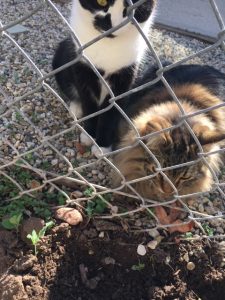
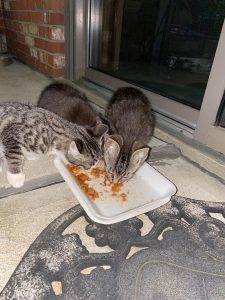
As a postscript, one of the cats in this picture of the two cats peering out from the tropical plants was hit by a car this year and killed, leaving his very dependent sibling to fend for herself. These are throw away cats that a local chiropractor had taken under her wing–offering what shelter they would accept out of doors and close to her office.
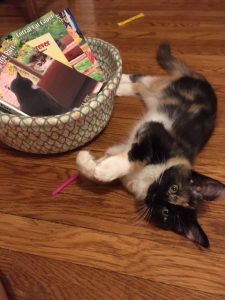
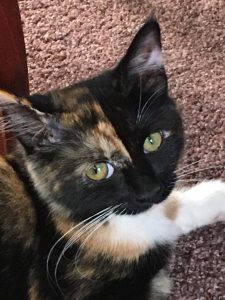
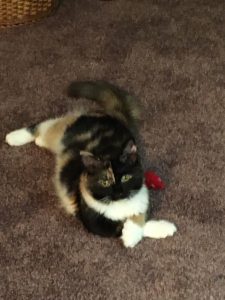 Does your cat have quirks—odd things she does that irritates you or delights you? Our new kitten, Olivia, crosses her paws. Almost always, when she lays down, she crosses her paws. Is this a calico trait? Several people have contacted me after seeing pictures of Olivia saying that their calico does the same thing.
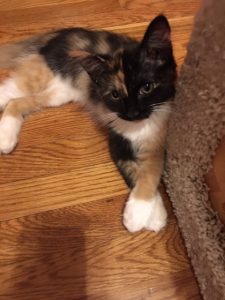 when she wants to rest or roll around and play or expose her tummy for some tickling. And one of her trademark poses (which I have yet to capture with my camera) is her stretch. She stretches out her front paws, butt in the air and her pretty tail loops across her back and touches the top of her head. Pretty! But so far only those in our household have been able to enjoy her pose. If I happen to catch her in the act before this post goes live, I’ll definitely share the picture.
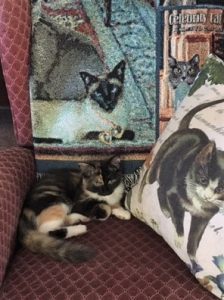 What are some of the other quirky things cats do? Olivia attacks and bats around her treat before eating it. She was found alone with her siblings when she was barely six or seven weeks old, so you wouldn’t think she had much hunting training by then. Instinct, maybe.
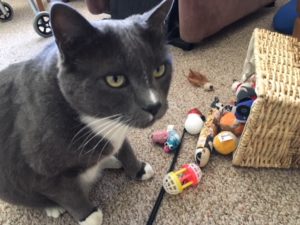 one cat who chewed electric wires and cables—oh my! Lily would eat anything I was eating. Smokey, my mother’s cat (my model for Rags in my Klepto Cat Mysteries) dumps his toy basket just for fun. He doesn’t want a toy, he just pulls the basket from the shelf until it spills, then he walks away.
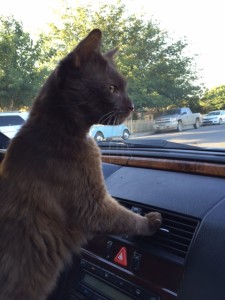 Cats have been known to travel long distances with their person and sometimes on their own. I know a couple who take their cat on all of their vacations—even when they spend an extended holiday in Europe. Many people today travel in their RV with their cats. But cats have also been known to hitch a ride with a long-haul driver, deliveryman, in cars, trailers, etc. Some cats find their way back home and others discover new living situations either with a kind human
 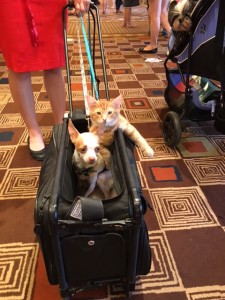 or in a colony.
 Here’s a site with several stories of cats finding their way home even sometimes to a new home where they’d never been.
  part Persian cat who traveled 1,500 miles to join her family in a home she had never visited. It took her fourteen months, but she made it. The reason they left her behind with a neighbor was because she had a hip deformity and it was difficult for her to travel by car. So she traveled by foot. What a cat!
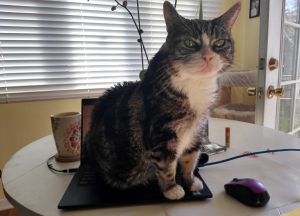 It’s easy to express your love for your cat. We adore cuddling and snuggling with a precious cats, petting them, and keeping them safe at all costs. But what we don’t always take into consideration is how our efforts come across to the cat. Does she recognize our brand of affection? Does she understand it as an outpouring of love or an annoyance?
 and motivations as we do. You know how sometimes a wonderful petting session can abruptly end before you’re ready to end it. The cat jumps off your lap and wanders out of the room never to be seen again until meal time. What’s up with that?
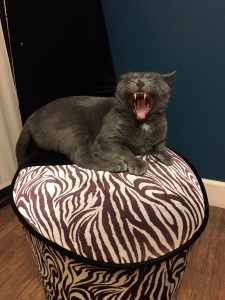 For those of us who want to give back to our cats at the level they give to us, experts have put together these five tips. I think some of them will surprise you.
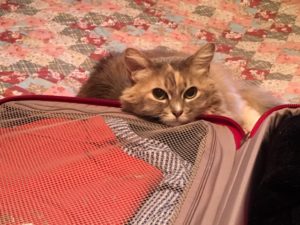 Those of us who have had cats for a long time and have known several cats have a pretty good idea of when a cat is demonstrating a sense of caring or dare I say love toward you. This may be more an expression of dependence, appreciation or maybe some other emotion that we aren’t evolved enough to understand yet.
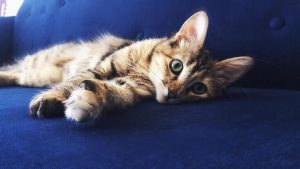 describe as love on my cats’ faces, in their body language and behavior. But cats have a reputation for being aloof and self-serving, so how can that be?
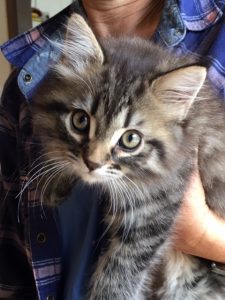 lay here and snuggle with you because I adore being close to you?” Or is she saying, “Sit still and quit moving your arm. I want your hands on me—me—me!! I’m trying to take a nap here?”
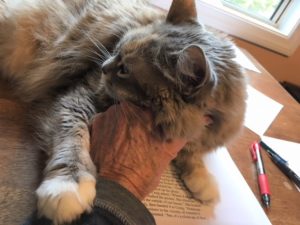 did. YES! According to the experts, Olivia is head-over-heels in love with me. Sophie? Yeah, she thinks I’m okay as long as I keep the food coming.
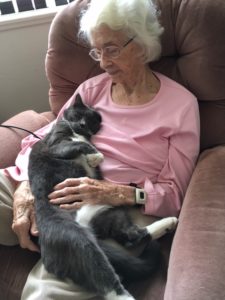 love. Then there’s the clingy cat or the clingy stage for a cat. Kittens, for example, will often choose someone in the family to cling onto and it’s usually the person who pays them the most attention, feeds them, plays with them… For Olivia-kitten, it’s me!!! That makes me so happy, as you can imagine.
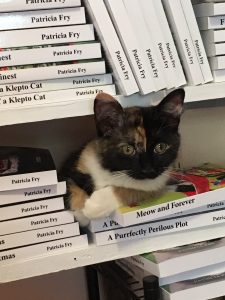 Would you believe I just finished the final first draft of Book 47 of the Klepto Cat Mystery series? I expect to publish the print version in late October or early November–maybe things will happen more quickly. As usual, the e-book will follow within a few weeks. That will be seven published books this year. And the reader reviews are spectacular—getting better and better all the time.
 on our toes and laughing.
 Cats are fastidious—everyone knows that. Well, except for wild cats. Why would I mention wild cats? Because the domestic cat shares nearly 96 percent of his DNA with the tiger. Have you ever seen a documentary featuring wild lions, tigers, and other large cats eating a meal? They are not dainty eaters. They come away covered in blood and… Then they wash themselves. It’s imperative that they keep themselves clean so their predators or antagonizers don’t find them.
 I sometimes write about the things I’m interested in or that I want to know more about. So why do I care about the third eyelid in cats?
 Is your cat too clingy? Are you having trouble getting anything done because your cat is constantly underfoot or on your lap or laying on your paperwork or needlework? There might be a reason for that.
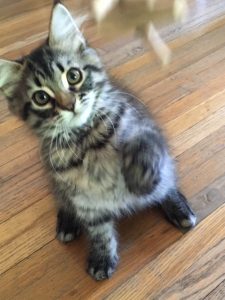 professionals, it could be because of a medical issue or the cat has separation anxiety. It might be breed-related. Some cats are just more cuddly than others. A kitten usually requires a lot of attention because she’s still adapting—getting her bearings in the world. Sometimes the kitten has been moved from her birth place to a shelter, then maybe to a couple of homes before she finds herself in her forever home. She’s insecure and fears that you might disappear in a poof if she closes her eyes, so she keeps her eyes (and her paws) on you.
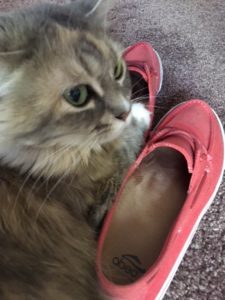 I’ve had needy kittens and also older cats that suddenly became clingy—my 17-year-old Himalayan, for example. Perhaps she was suffering from a mild case of dementia and needed the extra support and encouragement, or she forgot that she was a bit aloof. If you have a clingy or overly needy cat or kitten, learn more about this here:
 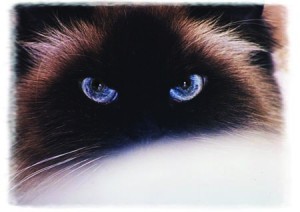 cat become more independent and confident is to add more enrichment to his world—make his surroundings more interesting and challenging. Bring in cat trees, tunnels, and toys. Install perches and ladders for the cat. Build or purchase a catio, for example, where he can spend time out of doors expanding his horizons in a safe place.
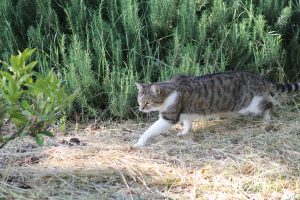 I love reading happy-ending stories of lost or stolen cats being reunited with their human and this happens more and more often now with the advent of the chip.
 actually have my first “chipped” cat. Olivia came with a chip and, of course, I followed through and filled out the paperwork so IF she were to become lost there’s a much greater chance that we would be reunited.
 this year I saw pet spa employees chasing after an escaped dog. Pets can become lost while traveling with their humans.