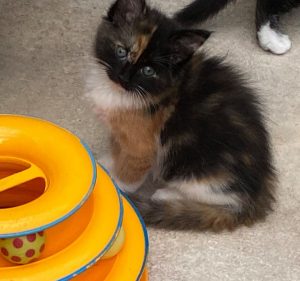
 I told you that I sent Olivia’s swab to BasePaws Cat DNA testing. Well, I have received the report, and it’s very interesting. I learned that there’s some Maine coon in her heritage make-up as I suspected, also American shorthair and British shorthair and peterbald. Now the peterbald surprised me as this is a Russian hairless cat and Olivia certainly has a beautiful and lush
 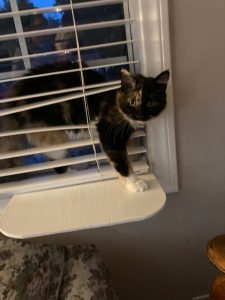 coat. While she’s over 45% Western varieties of cats, she also has some exotic blood from the Savannah and the Egyptian mau and quite a bit of Thai Siamese (the old-style Siamese cats we knew some fifty years ago—the apple heads). Of all the wild cats, they say she most closely associates with the Cheetah. We can go along with that. Our little girl has speed like I’ve never seen in a kitten before.
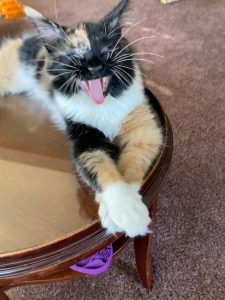 And great news!!!! There are no signs of her being predisposed to any of the gene-induced diseases they test for. She’s “clear” on all of them.
How did I like dealing with BasePaws? It was interesting. It takes two to four weeks to get results (it was close to four for us). The report comes to your email address and it’s quite extensive. I wanted to print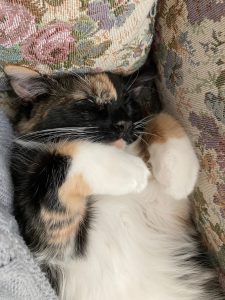 it out to review off the computer. No can do. You can print it, but the entire thing doesn’t come through. I’m pretty sure that’s because there are links and things designed for you to click and get additional information on line.
T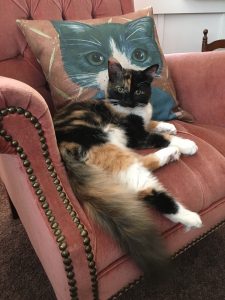 hey offer discounts fairly often. So if you’re thinking about running your cat’s DNA to learn more about her heritage and health markers, you could save twenty dollars if you’re watchful. I believe I paid around $89 for Olivia’s report.
One thing we can be pretty sure of with regard to our little calico girl, she’s probably going to be a big girl with Maine coon in her genetic pool and the Savannah (which is related to the African serval)—a large and healthy cat. Already she’s growing big fast. According to experts, a six month old kitten should weigh around 4-5 pounds. Olivia is just over six months old and she’s pushing 7 pounds as we speak. Looking forward to many happy and healthy years with our beautiful, fun, affectionate, and smart cat.
 If you’re a crazy cat-lady or guy (and remember, this is no longer a derogatory term), boy do I have a holiday gift idea for you.
 According to some, today is National Black Cat Day and I’m taking this opportunity to honor the black cat and to share some interesting facts about these beauties.
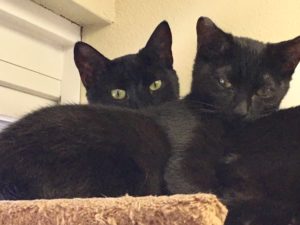 learn a few things myself. For example, it’s guestimated that only 5-10 percent of cats are black. Despite the belief that black cats are the last to be adopted, one study shows that 31 percent of adoptions are black cats with 20 percent of them grey and 18 percent brown.
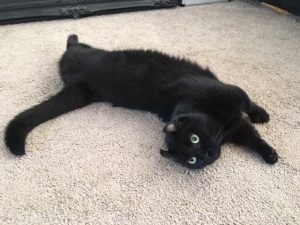 While the Bombay (cat) is almost always black, technically there are no actual black cat breeds. There are, however, cat breeds that include black cats—the munchkin, Scottish fold, Norwegeian forest cat, Japanese bobtail, American bobtail, Rex, Persian and others.
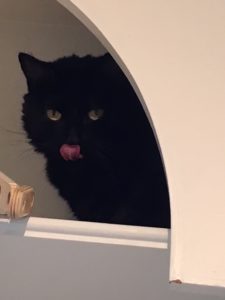 gene that causes black fur may also help to make black cats more resistant to disease. Now there’s a good reason to bring a beautiful black cat into your home—fewer vet bills—a healthy cat!
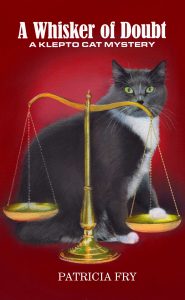 I’m happy to announce publication of a new Klepto Cat Mystery. And this one is even more special than most as it’s my 90th published book. Ninety books published over a nearly 50-year career. That’s almost two published books a year.
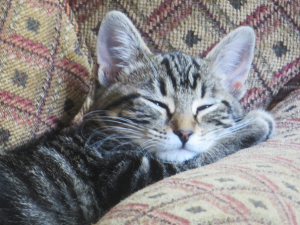 A major reason we adopt a cat is for the comfort they can bring and for most of us a big part of that is the cuddle-snuggle factor. Right? But the truth is that cats aren’t necessarily snuggle-cuddle beings. Remember, they’re aloof and want to be left alone. Not always, thank heavens.
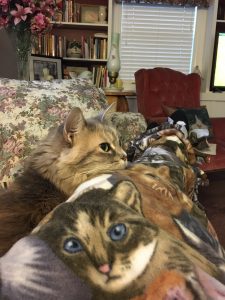 don’t we all? But many of them also adore curling up or sprawling across a warm lap, or even just initiating a good scratching behind the ears.
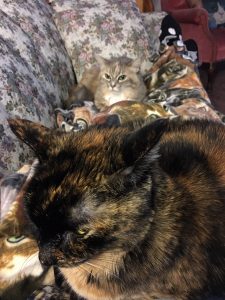 Lily had her moments when she loved cuddling, but mostly, she just wanted to be near me, at my feet—at least within eyeball distance. Most cats I’ve had want affection on their own terms. Isn’t that the way of the cat? But what if you end up with a cat or a kitten that doesn’t want any part of handling? Did you know that this is usually a learned behavior? That’s one of the dangers of rescuing cats—first, you don’t know their background—how much snuggle experience
 they had. Second, many abandoned cats or kittens come with aversion to being handled. But all is not necessarily lost. Here are a few tips.
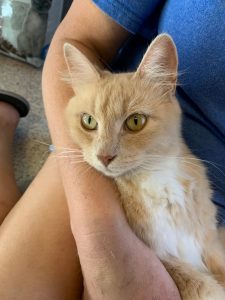 Sit and spend quality time with your cat when she wants it.
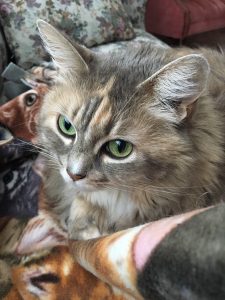 As you know, we lost a precious fur-baby this year. We have Olivia now and we love her dearly. She’s such a bright spot in our life. But how I miss Lily. Yes, still. There’s no duplicating or replacing a cat.
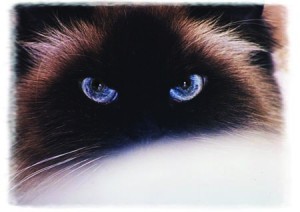 feeling emotional, and she died sixteen years ago at the age of 18. We can love again, but a new cat can never take the place of any cat. They come with very different personalities and traits. We love them, but in a new way.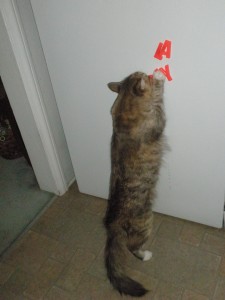
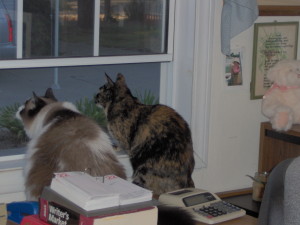 loss of a pet does not go unnoticed by remaining pets—in particular cats. Yes, cats can and do grieve. When Lily passed, our remaining girl, 16-year-old Sophie reacted. At first, she stayed in solitude a lot and ate very little. Then she’d walk the hallway yowling. She’d check every room one by one as if she was looking for
 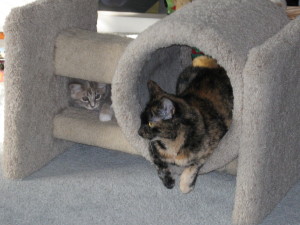 and calling for Lily. Eventually she stopped eating, began licking her fur out in one spot—over-grooming—and she became very sick. It took a lot of meds and attention and consideration and urging to bring her back to health.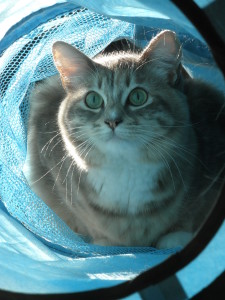
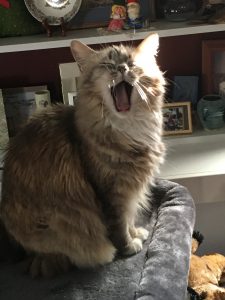 alike? If you have more than one cat, you can usually tell which one’s coming down the hallway yowling. In some cases, only one of your cats typically does it, so you know which one it is. But you’ll also notice that Buster has a different meow sound than Fluffy, or not. If they’re the same breed, they probably have similar sounds. We had a Himalayan from a kitten mill in Missouri and she had the most southern-sounding drawl of a meow—low and lingering.
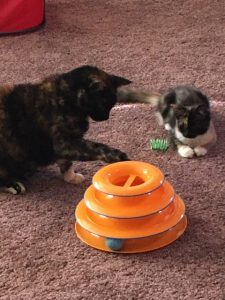 Technology and innovation is advancing to the point that you can have a cat without ever lifting a finger to care for her. I say, then what’s the point of having a cat? The only alternative care apparatus I haven’t seen is a mechanical petting machine. However, there are items you can place here and there for your cat to rub against for comfort and the petting sensation.
 what are touted to be 16 of the BEST cat products. They include self-cleaning litter boxes—yeah that would be handy—toys that help your cat get more exercise—that would be beneficial. But you can now also purchase a device to track a wandering cat, webcams for keeping an eye on her, numerous styles, shapes, and sizes of cat beds, shelters, hammocks, houses, but here’s something new to me:
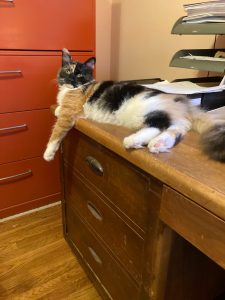 when she’s not tearing around the house at breakneck speeds, she’s lounging somewhere gracefully or not so gracefully. Sometimes she rolls off a perch or a piece of furniture while sound asleep. You should see the surprised look on her face—then comes the, “I meant to do that,” look.
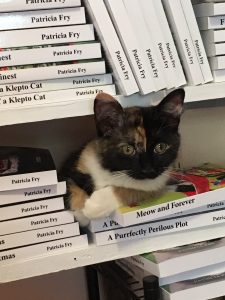 adolescent stages for two reasons. One, they’re still in agility training—learning how to maintain a successful balancing act, and they play at speeds that could break the sound barrier. So if you have a clumsy kitten, don’t worry. Once she grows into her lanky legs and clunky paws and slows down a bit to smell the bacon, she’ll become that graceful being you envisioned lolling in your lap or on the dining room table. Yes, she’ll learn to pad through the elegantly set table without disturbing a crystal water glass or antique dishware. Just know that she might lick a spoon or sit on a dinner plate in the process, though. And she might eat part of your flower arrangement.