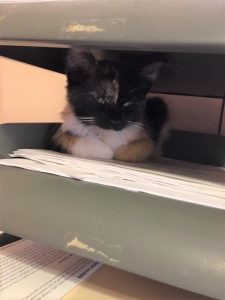
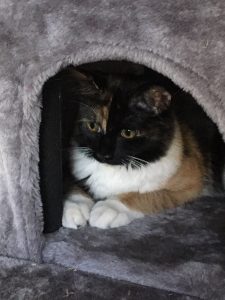
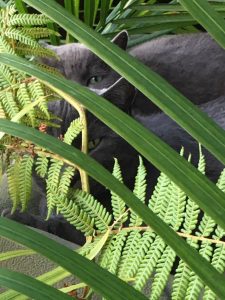
 We play a game around here sometimes called, “Where’s Olivia.” I’m considering that as a title for an upcoming book featuring our precocious calico. Like so many cats, she hides. I’m sure this is a trait handed down from her wild ancestors. In the wilds, cats hide from predators, intruders, and even prey, and especially while sleeping, recovering from an injury, and caring for their young. In order to remain safe, it is
  necessary for a wild jungle cat or a feral domestic cat to change location from time to time—maybe often. Olivia still does that.
She has her favorite places to sleep, but occasionally when things get quiet, I check and she’s not on the small recliner chair with the cat pillow or in the cubby of the cat tree or in a sun puddle on the living room floor. She’s certainly not in any of the three cat beds I’ve provided for her—heaven’s no! When I can’t find 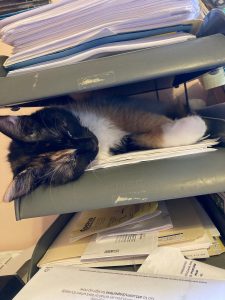 her, I go in search of her. Why? I guess because I’m still in the habit of checking on her—making sure she’s safe. Besides, I just love spending time with her. She makes my heart happy.
So where do I usually find her? I’ve found her in the closet on a folded-up blanket. She often naps under the sofa. I’ve discovered her on a kitchen chair, which was pushed under the table, and in various other spots where I didn’t expect to see her and where she was 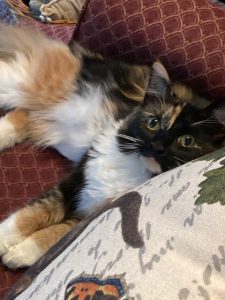 practically in plain sight. Cats are good at the disappearing act and they’re good at hiding. When I find her, I sense that she’s secretly giggling at my level of stress building when I’m sure she was lost—or she has somehow slipped out of the house. Frightening thoughts.
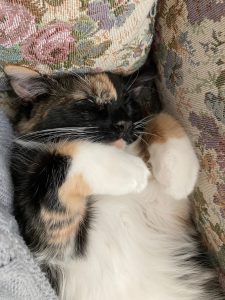 Cats are known for sleeping in interesting positions and in unusual places. When she was a kitten, Olivia slept in a cubby on a stacking metal shelf in my office. The first few times I found her there, I’d already scoured the house looking for her and there she was a few feet from me tucked into the little stacking trays.
Here’s a photo of a kitten sleeping in a baseball cap. 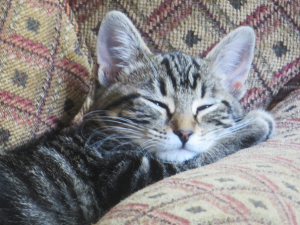 Max used to sleep under the covers in my bed. Some cats fall asleep in a pretty basket or a toy crib or wagon or another picture-perfect place. Not my cats. Most often they opt for my bed or the chair I want to sit in. That’s another cat trait. My dad had a magnet on their refrigerator that said, “If you want the best seat in the house, move the cat.”
I’m not sure where Olivia’s favorite sleeping place is. She does move around, but my favorite napping place for her is in my lap. So sweet.
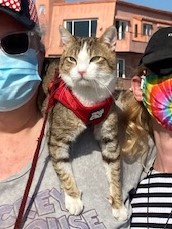 Many of us keep our cats indoors only. Some provide outdoor enrichment through harness and leash-training or an enclosed catio. But for many indoor cats, their only experiences beyond the confines of the house are views from the windows and a car ride to the veterinarian once in a while. Our Olivia is a year old now, and still very much a kitten at times. She gets the zoomies and she tears around the house like a crazy cat. Sometimes she meows and meows—probably out of boredom. When this happens, I get creative and find a way to spice up
 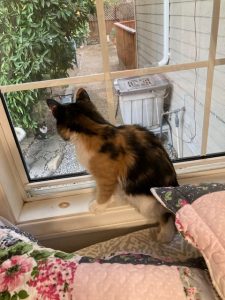 her world through play—usually wild, active play. One of her favorite midday activities is chasing her bumpy rubber ball up and down the hallway.
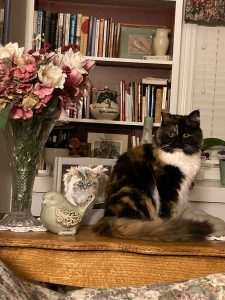
 gives me flowers, I often delegate them to the deck outside as so many flowers are toxic to cats. So we make a lot of concessions around here for the cats, but what more can we do to provide additional enrichment for Olivia and Sophie? Here are a few ideas I’ve used and that I’ve found through research: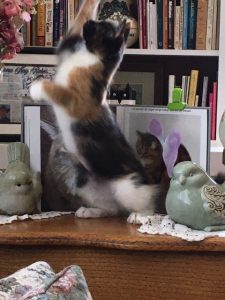
 Anyone who embraces a cat will suffer loss. The fact is that we outlive our cats. We know it and we still rescue them, bring them into our homes and our hearts, and love them with everything we have. When it comes time for that cat to go across the rainbow bridge we hurt something fierce. It’s an awful ache. We feel the loss with every fiber
  precious cat is filled with remnants of her or him.
 We talked earlier in the week about how smart cats are. And there are probably many things our cats can teach us: to relax—I mean, really relax; to be alert to potential dangers around us; to do a thorough job of grooming; to take care of our nails; and to stretch. Cats seem to know the benefits of stretching.
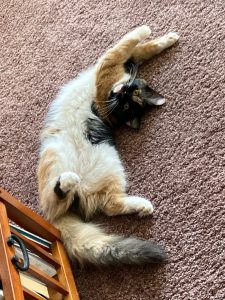 step after a snooze or after just a period of relaxing without stretching first. Cats stretch to keep flexible. And, as you’ve noticed they can contort their bodies into all sorts of shapes. Sometimes you come into the room, look at your cat, and wonder which end is actually up—where the nose begins and the tail left off. They’re contortionists. Some say they’re natural yoga cats.
 It’s an exciting month for us here in the factory as we’re about to launch a brand new series featuring Olivia—the calico you’ve seen so often and read about so often here in this blog. Perhaps you’ve also seen her on facebook. She has quite an enthusiastic following, especially since she debuted in Book 51 of the Klepto Cat Mystery series with Rags.
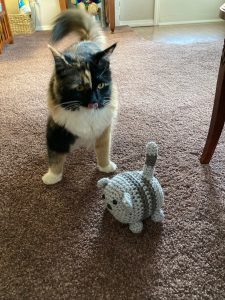 Cats have a sense of humor. Isn’t that one reason we keep them around? I can tell you that getting to know Olivia has been a blast and she has sure kept us entertained over these last 10 months. I wonder if cats know they’re comical or if they’re just being cats. Are they puzzled by our laughter?
 during the game it’s hilarious.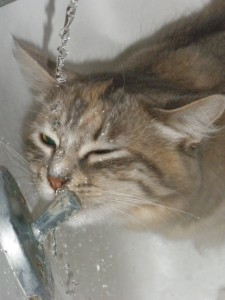
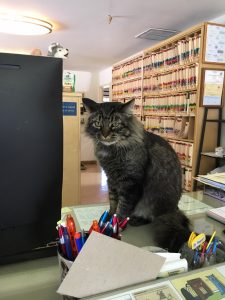
 There are two interesting cats in the news this week—a newly discovered cat that roamed North America millions of years ago and a new resident of the Mt. Washington Weather Observatory in New Hampshire.
 new find with those specimens on display and are now reporting that the new cat is something special. He weighed around 900 pounds and hunted prey weighing one to two thousand pounds. Here’s additional information about this amazing find.
 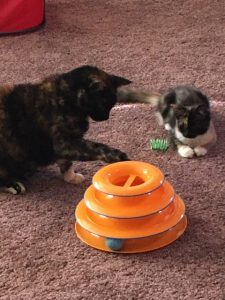 If you live with a cat, and if you’re paying attention, you’ll notice all sorts of interesting behavior throughout the day. Mostly it’s subtle and you find yourself wondering, “Did that cat actually say what I thought I heard?” “Did she sit on that page because she knows that’s what I was reading?” “She didn’t actually know that was the puzzle piece we were looking for did she?”
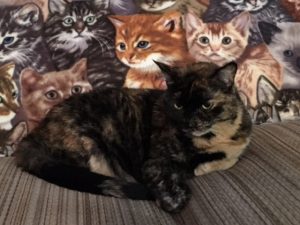 than you realize. Think about some of the things your cat does throughout the day.
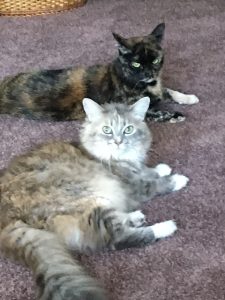 comes from nowhere and starts greeting me. She also uses it to get me out of my seat so she can take my chair. Sophie watches TV, but only when it’s around dinner time. Could it be that she recognizes certain commercials or the voice of a certain TV judge or newscaster? Because I’ve seen Sophie stare at the TV for several minutes, then suddenly turn and meow for her supper. Other times, a commercial seems to catch her ear and she’ll watch, then go back to her lick-bath. Yes, I’m convinced that she figures out what time it is based on what’s on TV.
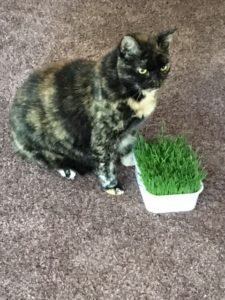 an aside, cantaloupe is a favorite of some cats, but not all cats can handle it. Do not feed cantaloupe to a cat with fluffy pantaloons when it gives her diarrhea. My attempt to please Olivia with cantaloupe did not go well. Sorry, Olivia. (She did not enjoy the dip in the sink of warm water to clean the results of that cantaloupe treat off of her back end.)
 show up in the kitchen within at least a few minutes of my arrival home, I was pretty sure the cantaloupe I bought wasn’t quite ready.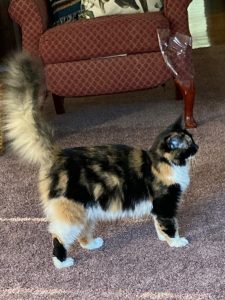
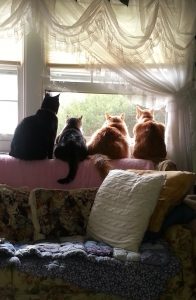 Have you ever had two cats you could consider clones in the way they behaved, their mannerisms, their traits and habits and PURRsonality? Probably not. While I can look back and say, “Katy used to do that same little cute thing Olivia does,” or “Winfield loved water, just like Lily…” I’ve never had two cats I could say were identical. The more deeply I learn to love cats, the more I realize how startlingly true this is. A cat is a cat, all right, but they can be as different as any two humans. If you’ve had a lot of cats over time, you know this.
 Yesterday I said, “What a different and interesting world it would be if a cat could say more than MEOW.” Wouldn’t it be fun and fascinating to hear a cat’s stories from the cat herself—where was she born, who were her parents, where did she live, how did she end up on the street (in a dumpster, under a car, in your neighborhood, in the stables, in a field, at a shelter)? All we can do is guess at where she came from and how she got there.
 morning, noon, and night with her, you begin to understand what her MEOW means, what her looks and stance and sound and body language mean. My daughters when they were young were astounded that I knew what our cats wanted. “Oh, you want out?” I’d say to the cat and she’d walk to the door and I’d let her out (years ago, mind you—before I became a believer in the total house cat). The cat would rub against my leg while I’m in the kitchen and I’d say, “Oh, are you hungry?” I’d feed her and she would eat.
 “How do you know what the cat says?” my daughters would ask me. Most of you reading this know the answer. Or do we? I always thought it was a matter of observation. If the cat is at the door meowing, she wants out, right? If she comes into the kitchen with you and engages you, she’s probably hungry. If she’s racing around the house or brings you a toy, she wants to play. If she climbs up into your lap, she wants to snuggle. It’s simple, right?
 Does your cat sometimes respond to your command or even a thought of a command? Mind-talk. I’m a firm believer in mind talk with cats—at least some cats.