 Today would be a good day to read one of my fascinating, intriguing, action-packed Klepto Cat Mysteries as you loll on the beach or curl up on the sofa with your favorite fur-friend. Start by loading Book One, Catnapped, onto your Kindle or other reading device, or pluck the hard copy from your bookshelf and finally read it or re-read it. If you’re like most of Rags’s fans and you’re waiting for Book 29, THANK YOU! Meowmoirs of a Klepto Cat is coming soon—I’m predicting that it will be out between the 6th and 10th of June.
In the meantime, here are a few other books you might find interesting. I’m currently  reading Fur Shui by Paula Brown. It’s a fun and lively guide for improving the quality of life with your pet. According to Brown, “By understanding the simple principles in FUR SHUI, you’ll immediately see that our pets have the power to improve our health, protect our homes, and commiserate with us on work, money, and love.” I’ve just started the book, but I’m eager to learn how Lily and Sophie can help me to write more Klepto Cat Mysteries—and maybe help with the filing in my office.
I’m also currently reading Jeffne Telson’s book, Cat Tails: Heartwarming Stories About the Cats and Kittens at ResQCats. Jeffne runs ResQCats in Santa Barbara, CA.
Have you read the book about Dewey, the famous library cat? Also in my library are Who’s Who of Cats by John R.F. Breen, Chicken Soup for the Soul: Loving Our Cats, and Bonnie Pemberton’s The Cat Master. I haven’t read this one yet, but it appears to be a sort of take-off on the play Cats. It appears that the animals in this story speak—unlike my Klepto Cat Mystery series, which are human-driven with a lot of cat action and activity.
Let me know what you read today and if you have any cat or pet book recommendations.
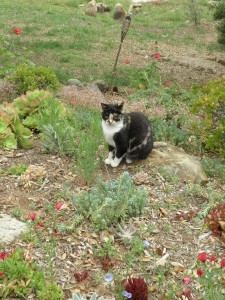 Yesterday we talked about keeping cats safely indoors. I know, I know, sometimes it’s not so easy to do. We once adopted a cat who refused to be a housecat. She loved being inside, but insisted on outdoor time, as well. My mom’s part-ragdoll cat is quite the wanderer and he could not be—would not be—confined. Years ago, I thought it was normal to allow your cat to roam. Well, it kinda-sorta was in those days. Then I bought a Persian cat and decided to groom her to be a totally indoor cat. Crystal probably would have had a long and safe life if she hadn’t been infected with feline leukemia at the facility where I’d purchased her.
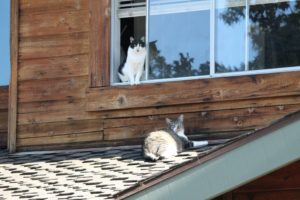 Install a kitty window box. It’s like a garden window for the cat to crawl into so he feels he’s close to the out of doors. Or do as many cat-people do and build a whole outdoor, screened in room for your kitty. I love that idea. Build it against the house at a window, then just open and close the window when you want the cat inside or out.
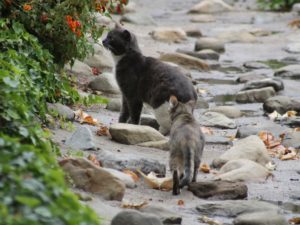 Can you look out your window and see a cat now and then—or maybe often? It may be your own cat enjoying a sunny day on a grassy spot in your yard, a neighbor’s cat wandering through, or a skittish homeless cat seeking a meal or a safe place to cozy down. Sometimes a cat that’s allowed outdoor time will visit indoor cats and either stare through the window or even instigate a tussle. Many a window screen has been damaged by a pair of cats on opposite sides of it. We had a terrorist cat in our neighborhood who had a beef with our indoor cats. Thank heavens that family moved with the cat. We still have cats with homes who roam and they seem to get along with Sophie and Lily. And I enjoy watching them explore our yard and snooze on a deck chair.
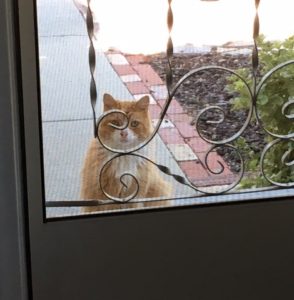 allowed inside at night. But some cats aren’t as fortunate. They’ve been left behind or turned out or dropped off or they became lost and never found their way home and were too frightened to accept new humans. Some scavenge on their own until they die of starvation, an injury, an accident, poisoning, or a broken heart. Others meet up with an established colony of homeless cats and learn survival techniques from the elders in the colony. In any case, a homeless cat is not a freak of nature and the cat is not at fault. Behind every homeless cat there is a human to blame.
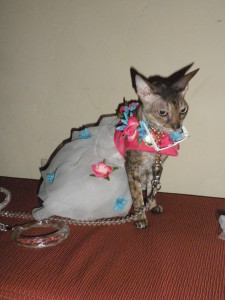 Did you enjoy the royal wedding? Did you watch it or simply review some of the links showing the ceremony and snippets of the reception? Maybe you watched it with friends. Did you serve tea and crumpets? And here’s the burning question of the day: Did you involve your pets in a royal wedding party?
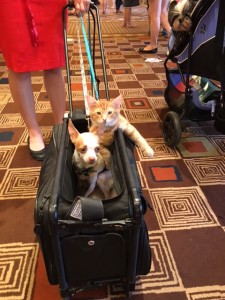 We all know people with both dogs and cats who actually get along. One of our neighbors has dogs, cats, and birds—oh yes, and fish in a pond in their backyard. Some cats actually establish strong friendships with other species of animal. I received one of those sweet books featuring stories of unlikely friends for Mothers day. This one shows a rabbit raising kittens, a cow feeding lambs, a dog with fox babies, a lioness with her antelope calf, a goat with a wolf puppy and more. So charming.
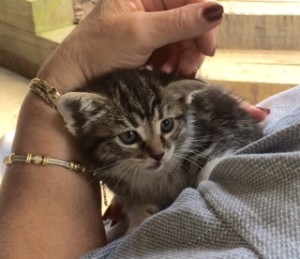 Sure, petting, brushing, and combing Fluffy (or Fido, or Trigger, or even Bun-Bun and Lizzie) is a wonderful way to bond with your animal, but it also helps you to be more attuned to the animal’s overall health. You, the animal’s caretaker, should be the first responder in detecting illness or injury.
 good health.
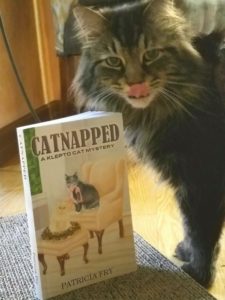 For those of you who haven’t read Catnapped or you’d like to gift someone with the Kindle version of Catnapped, I’m offering the Kindle version FREE for the next 5 days. Here’s the link:
 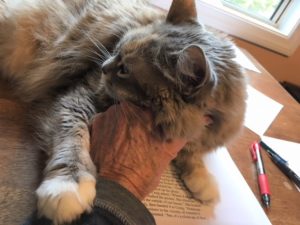 We’ve talked all week about support and therapy animals of all types. How many of you have relied on your cat for company, comfort, and/or companionship? Some of you have other types of pets that you adore and depend on for affection, to bolster your mood, make you laugh, and so forth. The truth is we become attached to a being that we care for—that needs us in some way, and that gives us purpose. Those of you reading this know this is true. We’re wired to become emotional about our pets.
 young this time of year. Along with the opportunity to watch the eagles’, owls’, hummingbirds’, ospreys’, etc. every move, you can chat with others who are watching. It’s interesting how attached you can become to these wild families. People express feeling grief-stricken when a nest fails or a predator takes one of the young—it really is sad to watch. It’s as if each of us watching has taken the wild family into our hearts and our homes. We so want them to survive and be successful.
 All week we’ve been talking about support and service animals. I think we all support the idea of therapy animals, but are some people taking this concept too far? Are we taking advantage of the public and the corporate world? I mean a goose or a goat as a passenger on an airline? A service kangaroo in a fast food restaurant? A therapy snake in a Mexican food restaurant? A turkey on an airline? What are we thinking?
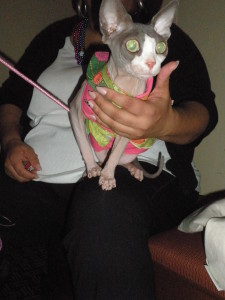 comfort. Some people, including at-risk or ailing children might need a more intense commitment from their pets and, as we’ve discussed before, some animals can help in detecting disease, predicting when a seizure is coming and so forth. But raise your hand if you think some people are taking advantage of this concept. And because of these people, who must take their turkey into the passenger compartment of an airline, for example, or a goose or a goat, well, I think they’re pushing the envelope and they’re making life more difficult for those who need a service dog or cat and for those who must travel on public transportation with an animal for a legitimate reason. One woman in Hawaii is training a miniature horse to be her support animal, which is wonderful. Horses are being used as therapy for children and less-abled adults all the time. But she intends taking this little horse into restaurants and other public places. Can you potty-train a horse?
 Are airlines cracking down on therapy and service animals on board? Oh yes. Here are some of the airlines’ new rules: United Airlines:
  What exactly is a therapy pet? Is it the same as a support pet or a service pet? This site gives information about the difference between a service dog and a therapy dog.