 I suppose all cat people consider their own cats exceptional. Some believe their cat is heads and tails above the rest. You know some of these people: They go through life either disliking or simply disinterested in cats until…Yes, until a cat wraps herself around his or her heart. Suddenly, this person (let’s call him Jack) allows himself to know a cat. Hack invites one into his home, begins paying attention to one that’s hanging around his office, or inherits one, perhaps. He comes to enjoy the cat’s company, notices that the cat is kind of cute, responsive, has a fun personality—she’s different from other cats, you know. I love these stories. But rarely, do you ever get people like Jack to admit that cats are okay—no, because the cat he has come to know is different—not like other cats—exceptional.
But then all cats are exceptional. We often marvel at how smart Sophie and Lily are—how
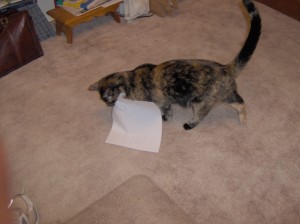
Sophie retrieving a fax
Sophie seems to know when it’s their supper time by what program’s on TV, how Lily comes to me and lays flat on the floor when she wants her back scratched, how they both know when I’m opening the freezer door to get something out to thaw for our dinner or when I’m retrieving their catnip.
There are many levels of intelligence and probably conditioning and even mind-reading among cats. And how they each react and respond as a result of these things is fascinating. Some people have even dared to list the cat breeds they believe are the most intelligent. Since the majority of us are more familiar with cats whose heritage is unknown, we rarely know where their instincts, traits, characteristics, personality comes from. Surely it’s from some of the most intelligent cat breeds on the planet. Here’s a partial list of those: Siamese cats, they say, enjoy mental stimulation—they’re extremely inquisitive. So often, when you’re filing, fixing a leaky pipe under your sink or doing needlework, your Siamese is in your face over-helping.
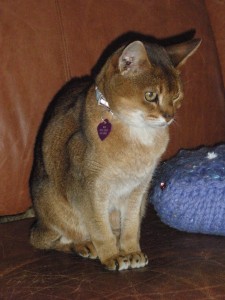
Everyone knows that an Abyssinian is physically agile, but she also needs a mental workout or she will get bored and maybe a little destructive.
 The Bengal is fun loving and likes to be the center of attention. They’re climbers and very good at using their paws (and claws). They’re also thought to be among the smartest cats in the world.
Burmese cats are good at figuring things out. That takes brains.
The Turkish Van is particularly friendly. She likes to connect with people, which is a sign of intelligence. They also like to play fetch.
The Tonkinese is on the smart list, too. They thought to be good at solving puzzles and they learn new tricks easier than most. It is recommended that you rotate toys regularly to keep the Tonkineses from getting bored. Beware if you decide to breed your Tonkinese. They have large litters. One is known to have had 19 kittens.
Do you see your cat among these traits? Perhaps she has a little Burmese in her or she’s vocal and cunning like a Siamese, active like an Abyssinian, or good at working herself out of difficult situations like a Burmese cat might.
Coming up this week, we’ll cover the world’s smallest cats and the most affectionate. Chime in if you’d like me to cover a particular cat topic or type.
 Winfield. To this day, she likes to sit touching me with a paw, or lay across my foot, or up against my leg like Katy did. She tucks me into bed at night. Like Katy did every day of her life. She waits for me to head toward the bedroom, then follows me around as I do my evening ritual and jumps up into bed with me. Once I’m settled, Like Katy did, she might leave and hang out someplace else for a while before coming to bed for the night. Lily also came to us with another of Katy’s traits. She’ll sit and stare into my eyes for the longest time, as if she’s looking into my soul.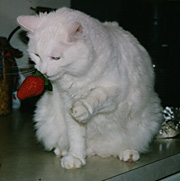
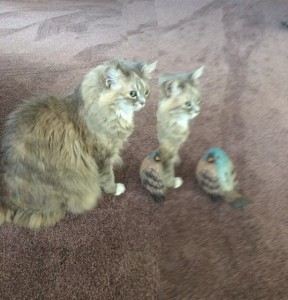 Yesterday we talked about cloning our pets. I think we’ve all had wonderful cats with maybe a few not so wonderful habits or idiosyncrasies, quirks, behaviors. I wonder if science will reach the point where they can isolate the beautiful qualities of our two or three favorite cats while culling out the less favorable aspects of them and create an even more purrfect cat.
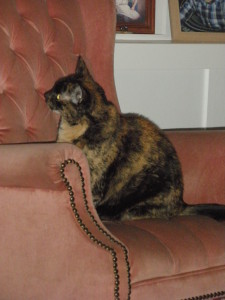 yesterday. We took over her care after she was plucked from the streets and spayed by a caring veterinarian. Rather than return her to the streets, the vet saw potential for Sophie to become a pet and we stood at the head of the line to rescue this tortie. Today, Sophie is a well-loved part of the family with seemingly no regrets and no desire to step foot outside ever again.
 They’ve actually gone and done it! A company called ViaGen Pets announced yesterday that they delivered the first American-born cloned puppy—a Jack Russell Terrier named Nubia.
 imagine? Evidently, the leaders in this company see a shift in the way end-of-life issues for pets are handled in the future. Veterinarians will have the option of informing clients about cloning as an option to soften the impact of their loss. One veterinarian says she’s seen cloned dogs as patients and that the owners are extremely happy with their decisions.
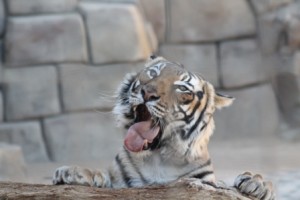 What happens when you get up on a Monday morning and you don’t have a topic for your blog that day? What do you do when you didn’t take time over the weekend to outline a few potential blogs or even jot down an idea or two? You could panic, like I started to this morning. Or you could do a little research—find out what’s trending in cat-dome—what cat stories are in the news, check in with your own cats for ideas, think about conversations you’ve had about friends’ and acquaintances’ cats, look at past posts, peruse the cat-a-day-calendar for topics, look back at my many, many photos of cats…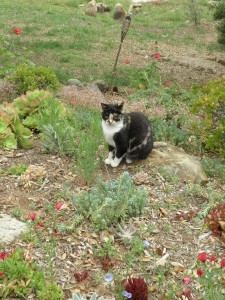
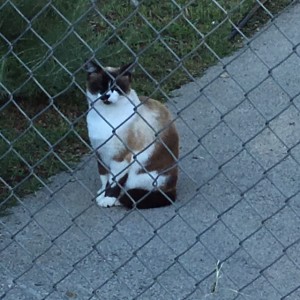 I’ve mentioned the fact that our cats stay inside, but we still have cats on patrol in our neighborhood…gentle, sweet cats that I actually enjoy seeing in the yard. Not only are the birds coming back since Rocket left, but I’m enjoying more cats in the yard. Suddenly, we see more of Joy (the petite part Siamese) and Blackie from across the street and George (a Maine coon female they thought was…well, you know how hard sexing a kitten is…).
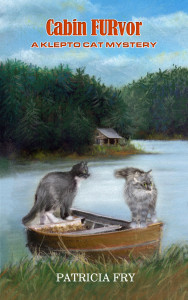 I don’t usually post on the weekends, but I wanted to share the news. Book 16 of the Klepto Cat Mystery series, Cabin FURvor is now available in print at
  Certainly, heat-related illnesses in pets is not a frivolous subject. Even though there seems to be plenty of publicity when a dog dies after being left in a hot car, or a dog is rescued near death after being locked inside a car on a scorching day, people still do it. There are constant public service notices through all nature of media about the dangers of leaving your pet in a car even when the temperature is mild. And common sense tells us that the inside of a car can become stiflingly, dangerously hot after sitting for just a few minutes. Still hundreds of people kill their pets each year by leaving them in their car. There’s even a report of eleven police dogs dying from heatstroke after being left in cars.
 your car after it’s been sitting in the sun on a hot day? You roll the window down and start the air conditioning. Yet, it doesn’t seem to register with some people when they leave Fido or Fluffy in the car just “for just a few minutes” with little or no air circulation while they go off shopping in an air-conditioned store.
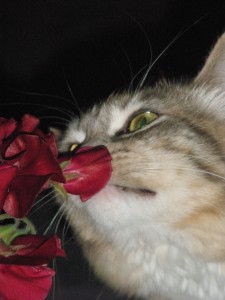
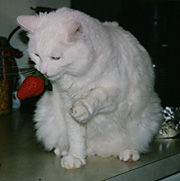
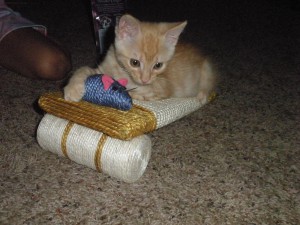 What is the solution? For some it is an increase in activity—toys and climbing apparatus that encourage activity and/or more playtime with people. Some behaviorists suggest giving these cats more greens or, perhaps a chew toy soaked in a flavor the cat can’t resist. There’s also a device available called a SSScat Automated Cat Deterrent. Evidently, it has a motion sensor and when the cat gets near the forbidden object, it automatically sprays a nontoxic, harmless gas that startles the cat and discourages his return to that area.