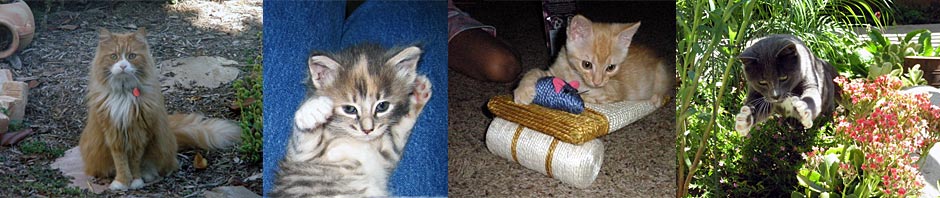
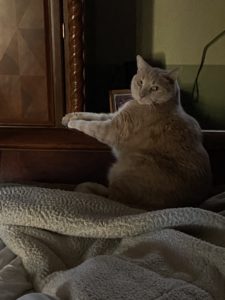
 Olivia is a year old. She has plenty of toys and interesting cat condos, tunnels, furniture to play on. She has perching places at several windows where she loves to watch the neighbors, their pets, and wild birds. We’re here with her practically 24/7, yet she sometimes seems to be bored. In fact she will come into my office while I’m working and attempt to entice me to take a break. Most times I can’t resist her—she can be persistent. But we all know some cats are more
 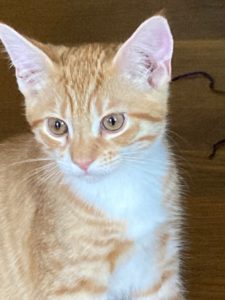 needy than others and when we work from home we have to set boundaries.
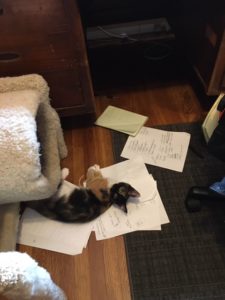
Well, I often tickle her fancy when she wants to play and I want to work. I usually do need the break and the laughter and she evidently needs the connection and the workout. She likes me to throw her chew sticks and toys up and down the hallway for her to chase. 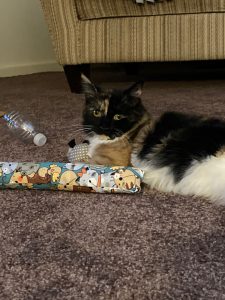 Occasionally she’ll bring me toys to throw—yes, she will play fetch. But sometimes she just seems bored. Nothing I suggest to her interests her, so I try to change it up—come up with something new and interesting for her. It’s called enrichment.
I’ll hide her treats around various cat condos and toys 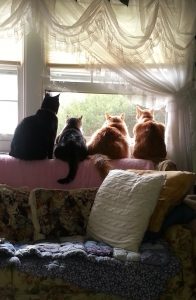 and encourage her to find them. I’ll reconfigure things—tip a cat condo over, make a tent for her—toss a blanket over the tunnel or a chair. I’ve created temporary cat condos out of boxes with doors and windows. That’s always a popular distraction for the cats and entertaining for us.
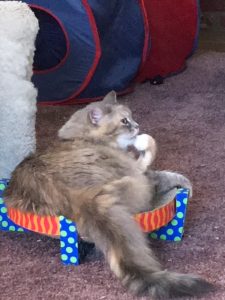 Catnip is a real mood booster for Olivia. Our 17-year-old cat, Sophie, also enjoys a little catnip. And don’t forget about the plain old paper bag. With toys inside and out and a little participation on your part, a bag can entertain a cat for a long time.
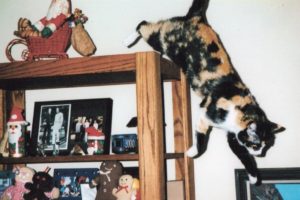
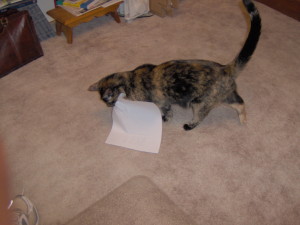
For Olivia’s and my entertainment sometimes I’ll toss wads of paper into the air and watch her jump after them. She loves catching or swatting them in the air. And boy can she jump.
Have you tried an app on your phone designed to intrigue cats? I used to have an adorable program on my computer where you could play with kittens, feed them a bottle, pet them and hear them purr. It was so much fun for me and for my, then, kitten, Max.
Entertaining a cat and being entertained by a cat is what it’s all about. Shame on any of us for ever letting our cats become bored.
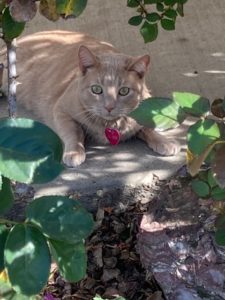 Have you ever wondered why your cats are so suspicious? They sneak up on things—even toys they’re familiar with. They sniff their food and treats before eating it as if they suspect you’ve laced it with poison or something. They stalk a piece of new furniture or a package delivered by Amazon or a bag of groceries as if it’s going to transition into an enemy monster. And boy
  does a cat become suspicious of you when you seek her out for some reason. You might want to simply pet her, but she seems to fear the worst—a trip to the vet, a bath????
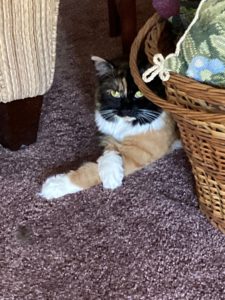
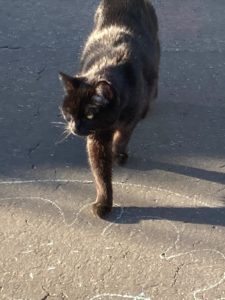 Although cats have been domesticated for around 10,000 years, they still carry their wild ways with them—they seem to not fully trust us—at least not all the time. Many of us are now rescuing cats that may be one or more generations feral, and trust can be an issue for them. Sure, Olivia and Sophie (both rescues) will curl up on my lap and purr contentedly as
  if they don’t have a care of a fear in the world. But let there be a small earth trembler, a rumble of thunder, or the doorbell rings and they become their
  ancestors—feeling a sudden rush of deep embedded fear.
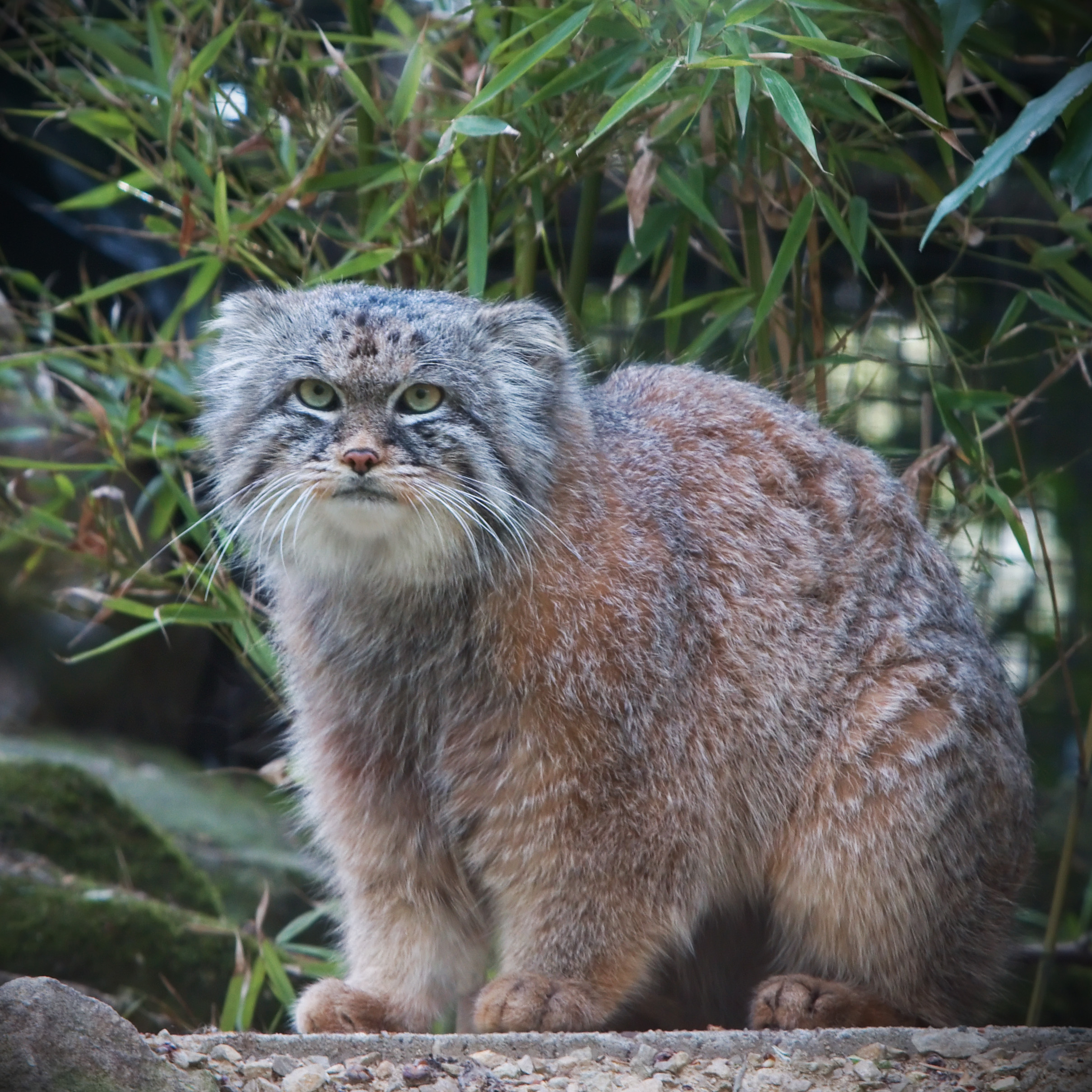 You may have noticed that I’m rather fascinated by the unusual and mysterious Pallas’ cat, an elusive small cat first discovered by German, Peter Pallas in 1776—nearly 250 years ago. This cat, considered the original grumpy cat, lives in cold, rocky areas of Russia and Central Asia. It was once thought that the Persian cat is descended from this most unusual-looking wild cat. A romantic idea, but evidently it has been found to be untrue.
 Budding and potential authors as well as readers are interested in the author’s life. I’ve been writing for publication for nearly 50 years. Here are the two most frequently asked questions I get. First: “How do you come up with all those ideas?” I was asked this question many times over the 40 years that I wrote articles on so many different topics for so many different magazines. Now that I’m writing fiction,
 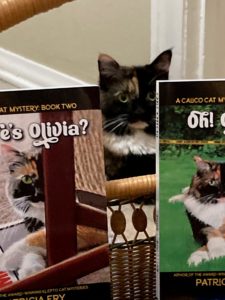 people question my ability to imagine—how can I come up with so many different stories for my Klepto Cat Mysteries and Calico Cat Mysteries? Note: If you’ve read my fiction books, you know there are stories within the stories.
 I’ve actually been dinged by reviewers because of my style, yet Rags’s and Olivia’s fans claim that’s the way they like it. As some of you know there’s a lot of activity and action on the way to the main mystery in both series.
 write a book?” Yes, I am prolific. Before the Pandemic years I was producing 6 books a year. In 2020, however, I produced 9 books and again in 2021 I published 9 books. How long does it take to write a book? I did the math. I can write and edit a book in two-three
  weeks. The beta readers get it then and they take about five days to read through the manuscript. It takes about 7-10 days for the editor to do her work, then I do another edit/proof or two and we start the process of formatting the print book. Oh, and I do another complete edit/proofing once the hard-copy is ready. Are you following this? This
  process takes another week or so. Then we turn the manuscript over to the woman who formats the ebook—for your Kindle reading pleasure. She spends another five or seven days on that process and we’re ready to publish! Six weeks. It’s right around 6 weeks work for each book.
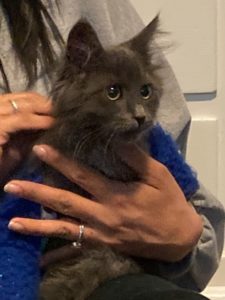 My grandson and his wife just adopted the sweetest kitten. He’s an ordinary grey kitten. There’s nothing really special about him, until you get to know his sweet purr-sonality and until you know the rest of his story.
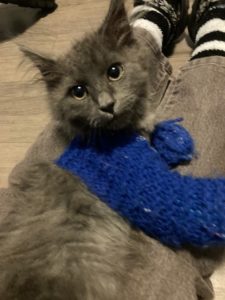 Yellowstone, was apparently horribly abused. When he was found, presumably seconds after he was possibly dumped at a pumpkin patch, he was missing his two front paws and bleeding profusely. They figured he was about four-weeks old then. A kind-hearted woman took him in,
 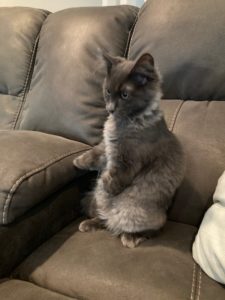 worked for weeks with veterinarians to save his life and try to give him a chance at a normal life. They succeeded and Rip is a healthy, happy, precious kitten living in a loving home, with a loving great-grandmother (me) living across the street. As you can see in the pictures, he does now live without his two front paws. And he manages life meowvelously.
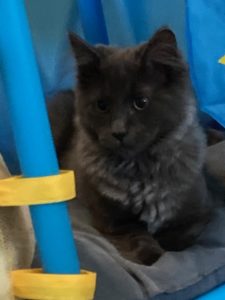 overcome a many different kinds of issues and challenges. Those kind souls who rescue cats are so very aware of this truth. We’ve all known and/or read about cats that survive and thrive although blind or deaf or missing limbs or a tail they once depended on for balance and communication. Some of them can still hunt and all of them are still capable of loving and being loved. I can tell you that Rip sure seems to be a trusting, playful, brave little soul who is loved to the moon and back.
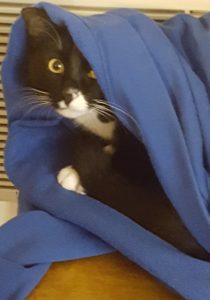 Do your cats have unusual fears? Sure a cat might be afraid of a boisterous dog—but certainly some cats make friends with the family dog. Loud noises and unexpected sounds are high on the list of things cats fear. A cat will often run and hide when a loud or unusual noise breaks the silence. And most cats have a go-to hiding place where they feel safe. A sudden sound can be startling. Even we humans will flinch when we hear a loud, unexpected sound, and we might duck or run away from
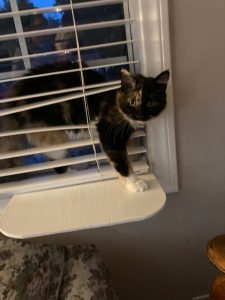 it.
it.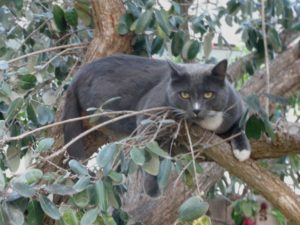 Max, not so much.
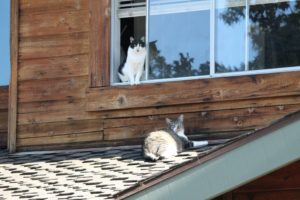 a loud truck rumbled by. Now, however, she runs to the window to watch the garbage truck or a fire truck drive past. She still hasn’t come to terms with motorcycles, though.
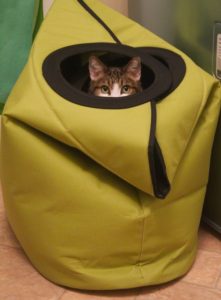 One day recently my, then, year-old twin great-granddaughters were here and they were crying. That freaked out Olivia. For several weeks after, she’d run away upon seeing a child on a bicycle out the window or in a stroller or walking past. She’d panic
 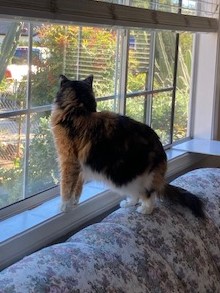 when hearing a baby on TV crying and she’d run into another room. She has worked through that fear as well. Now she watches children play outside through the windows out of curiosity, as it should be.
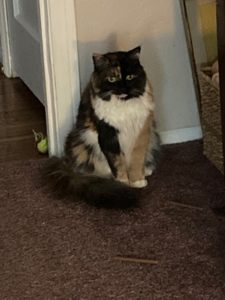 What about fireworks? I’ve come to really dislike them because of the fear they cause in so many animals. We had a large Akita show up in our yard one July 4th and climb into a friend’s lap for comfort during a fireworks show occurring a mile away. Our cats have all learned to tolerate those fireworks as long as we remain calm.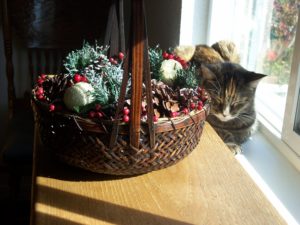
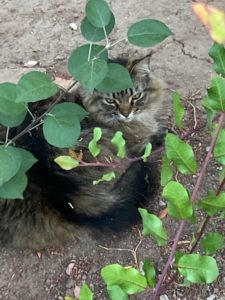 Cats love to hide and they’re good at it. Your cat might hide during a play session with you so she can practice her hunting maneuvers—you know, the one where she jumps out when most unexpected and attacks a toy or your hand or your ankle.
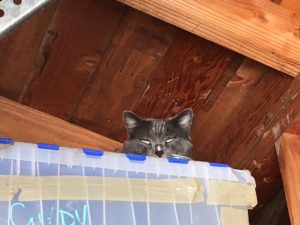 Smokey, (my mothers cat and my model for Rags in the Klepto Cat Mysteries), used to hide in the garage. And
 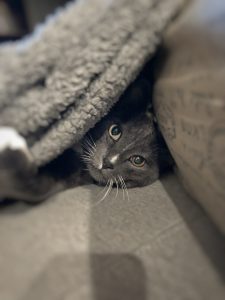 Once he somehow got closed in the car in the garage. That was puzzling. And there were times when she was sure she saw his form in the garage rafters, so she closed the kitty door, only to have him show up outside at the sliding door meowing to be let in.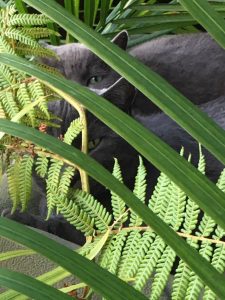
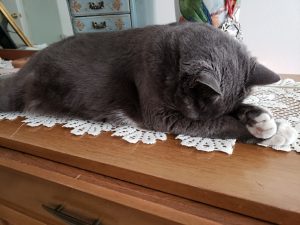 enjoy knowing they have the power to drive us crazy looking for them. Don’t you feel a bit silly when you’ve spent several minutes frantically calling for and looking for your cat, only to finally see her crawl out from
 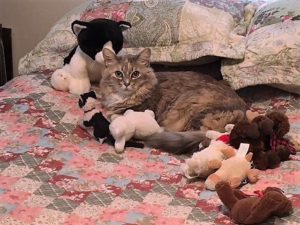 under a sofa you were sure she no longer fit under or from atop the refrigerator?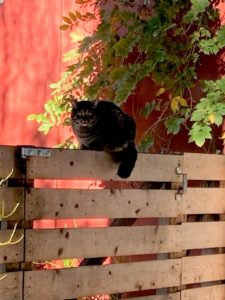
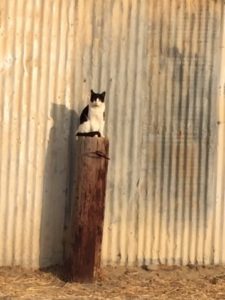 They should and you can make it happen. If you know of a cat that roams free and, consider providing shelter for that cat and his friends. Here’s a great DUI site showing how to create a cozy, insulated shelter for a cat from a heavy plastic storage
 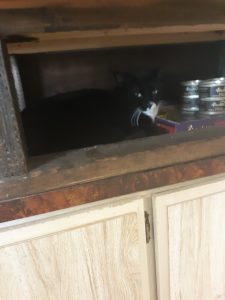 container. If you don’t use tools or have the strength to do the work, grab a neighbor kid or a grandchild and work on it together. What a satisfying project—it’s called saving cats one cat at a time.
 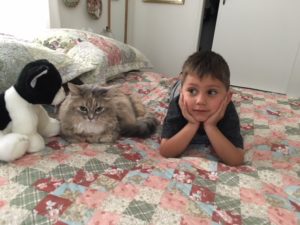 Some of you know that I am blessed with a lot of children around me. My three daughters gave me six grandchildren and now I have eleven great-grandchildren from the age of eighteen-months to twelve years. And most of them are fascinated by animals—cats, dogs, horses, the bear and raccoons
 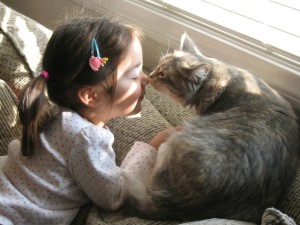 that visit their properties… My seven-year-old twin great-grandchildren are junior bird-watchers and can identify and discuss a wide variety of our local birds.
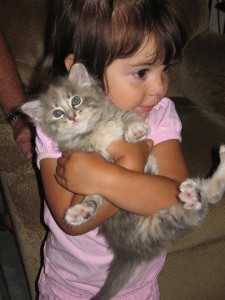 They will stop during a walk and entice a friendly cat with petting. They read the books I give them—most of the time featuring cats. One three-year-old carries around a small plastic cat that goes to a puzzle I gave her, and the twin eighteen-month old girls sleep with stuffed tigers. They also have two cats that love to romp with them. I’m pretty sure the girls
 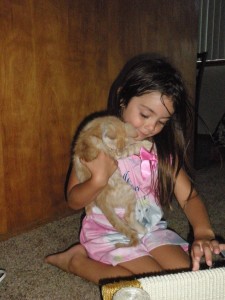 will be trying to put doll clothes on the cats at some point. These are lovely cats and may actually allow it.
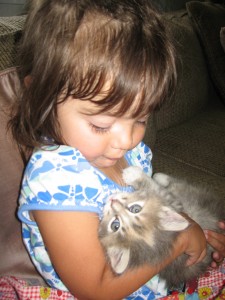 Do you have cats and kids in your life? What a great opportunity to teach kids about cats—from the care and responsibility of caring for cats to compassion for cats and other animals. Remember, they learn a lot by watching. And I don’t know if you’ve
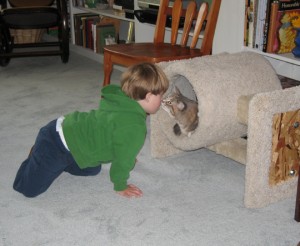 had the opportunity to notice this, but cats tend to like children.
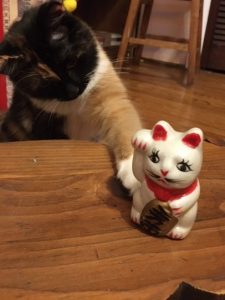 Does your cat make up games? Ours do. You’ll probably notice that some cats are more creative than others. Our precious tabby, Lily, made a game of decorating the house with her toys. She couldn’t stand seeing them piled neatly in her toy basket, she wanted them out where she could see them and we could stumble over them. Olivia, on the other hand, will not
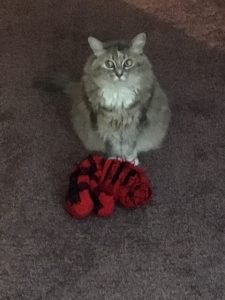 disturb her toy box. She loves to play with her toys when you get them out, but she won’t venture in to get them herself.
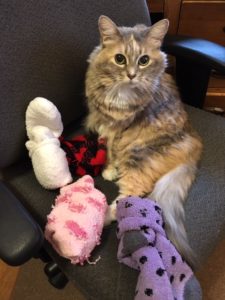 Do your cats put you through agility trials? I’m getting too old to get down on my hands and knees and dig out Olivia’s toys (and my fingernail file) after Olivia has kicked it under the furniture to live with the dust bunnies.
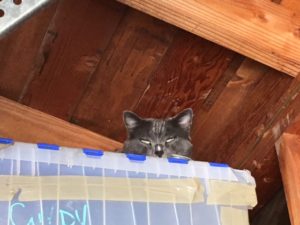 stare seemingly into space? I’ve had cats actually follow something across a room with their eyes when there’s absolutely nothing there? Do cats see spirits? The jury’s still out on that one for me.
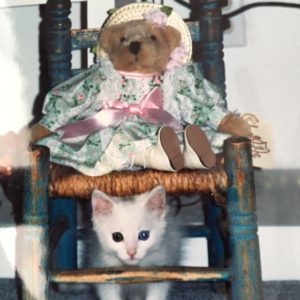 Cats also like to play fetch—most of the time it is you doing the fetching. Occasionally Olivia will bring toys to me to throw. Such fun. Love it when she returns time and time again with a toy for me to toss.