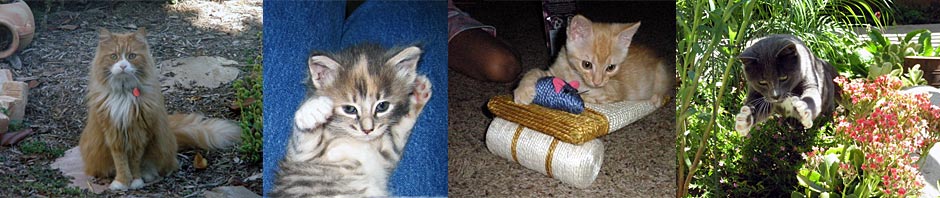
 Some cats seem born to be an only cat. Others thrive with other cats around. In our household, I don’t recall ever having an only cat for more than a few weeks, until now. Olivia is an only cat. Some say that when you have a calico, you have more than one cat—there are several purr-sonalities inside a tri-colored cat.
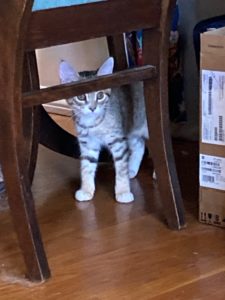
Olivia is, for the first time, an only cat. She was trapped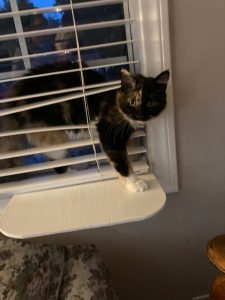 as a kitten with her siblings, lived in a shelter with other cats until she was almost three months old, then she came to live with us and our tortie Sophie. Sophie crossed over the rainbow bridge a week from her 18th birthday in July, and Olivia is now an only cat. I wonder sometimes if she’s lonely.
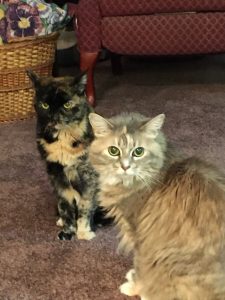 We’ve been watching her closely to see if she seems to need another cat presence here in the house. What we’ve noticed is that Olivia is bonding more closely with both of us, but she also continues to seek solitude now and then. Is this Olivia just wanting to chill or is she lonely?
I’ve been particularly concerned when we’ve gone away  for any length of time—for the day, even. For the most part both of us are home. The first time we left Olivia overnight was when we took a ten day trip. Sophie was still
  here at the time. I really fretted over that decision, and made every effort to accommodate the cats. I ended up hiring two friends to come in and feed, etc, but to also spend time with the cats. One came every morning for an hour or so and the other came in the afternoon for a couple of hours. The results were good. These ladies
  helped to socialize Olivia, but when we got home, I had the pleasure of extra, super-duper kitty-cat affection. It was obvious that Olivia missed us.
Recently we took another trip—it had been planned for over a year. This time we’d be gone four days and this time Olivia would be alone. We called on the same two ladies to check on her and entertain her and it appears everything went swimmingly.
 A few days after we returned I came across an article about cats and loneliness. This writer says that cats can experience anxiety and loneliness, which I think most of us with cats know. And there are signs that a cat is experiencing this in excess: over-grooming, not using the litter box, excessive meowing, and maybe aggressive and destructive behavior.
This writer suggests that if your cat seems to be acting out since you’ve gone back to work or if you’re suddenly going to be gone a lot, hire someone to come in and spend time playing with the cat and/or adopt a second cat. We continue to observe Olivia and so far are convinced that she is okay as things are. So we are not considering adopting again. I’d rather spend one-on-one time with Olivia depending our bond with her.
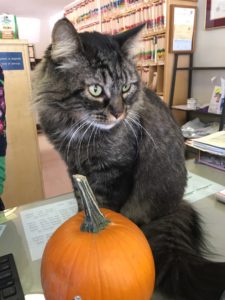
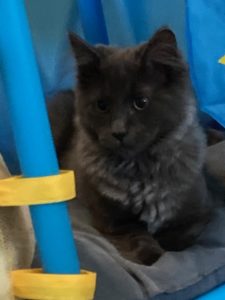 Yes, they’re as ordinary as they seem—in color anyway. According to experts, grey is the most predominant cat color in North America. Now that’s a bit of trivia I didn’t know. And grey cats are not all mongrel cats. There are quite a few cat breeds that include grey or blue coat colors, including the korat, Russian blue, American shorthair, Norwegian forest
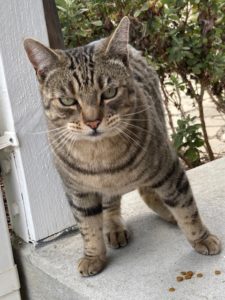 cat, Maine coon cat. Scottish fold and others. With so many grey breeds, maybe that’s why there are so many mixed breed cats born grey.
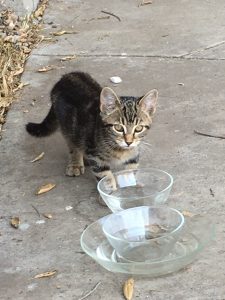 There are many shades of grey—grey tabby, deep-dark grey, soft-light grey with silver tones and everything in between. Grey cats come in all sizes too—my mother had a large Maine coon-mix cat at one time. He had long, wild grey fur. His name was one of the most common names for a grey cat—Smokey. Her next cat was a sleek short-hair grey cat with white. She named him Smokey, too.
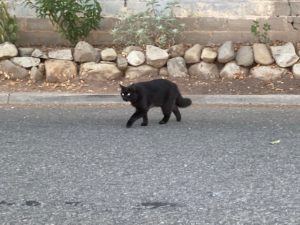 I love this story of a cat lost and found—lost for two months in Calgary after a camping trip with his family. As the story goes, Mom-Jody and her son took Gustophe camping and he slipped away from them. They hung around the camping area for four days looking for him, but to no avail. They had to get back home to work and school. They managed to get in touch with people in the area who decided to get involved. One woman put up cameras around the camp where Gustophe had wandered away from. Another woman had the family send clothes to leave at the site, hoping to entice Gustophe back. Something worked, as finally images of the fluffy black cat were spotted on the cameras.
 We see a lot of black cats associated with Halloween decorations—cats with pumpkins arching their back and appearing frightful, showing their teeth, and claws and we’ve heard of people harming cats this time of year.
 for our own cats and those of others. Bring your cats in on Halloween so they are safe from dangers. It’s a busy night full of small goblins and maybe more cars up and down your street than usual. Cats can become frightened and confused and run away or find
 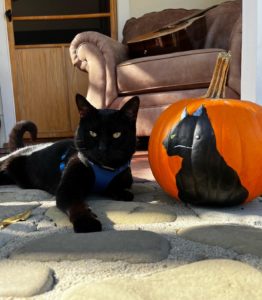 themselves injured.
 activity.
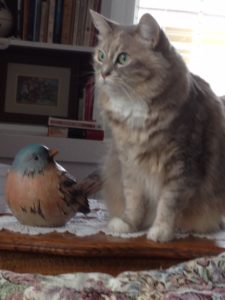 Lifestyle writer Colleen Paige has taken credit for establishing National Cat Day in 2005. Her stated mission: “To help galvanize the public to recognize the number of cats that need to be rescued each year and also to encourage cat lovers to celebrate the cat(s) in their lives for the unconditional love and companionship they bestow upon us.”
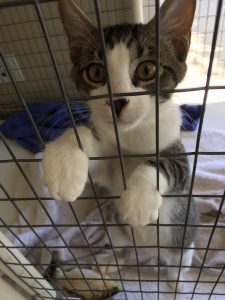 favorite meal, a new toy.
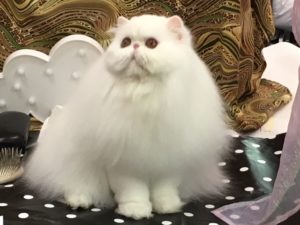 Have you noticed that some of the cats that are supposed to be well-bred—those that win the highest awards in cat shows–tend to look very uncatlike. They’re so fluffy and furry that they look like a pillow rather than a cat or they’re so long and lean and angular that they barely resemble a cat—a Gumby cat, maybe. Here’s a site with pictures of recent cat show winners. See what you think:
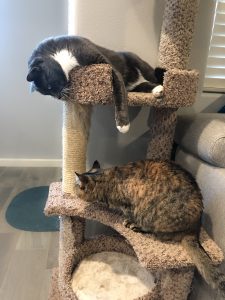
 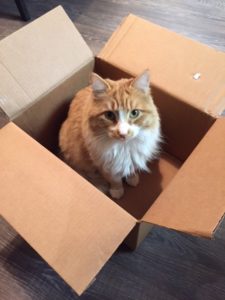 Do your cats have cubbies? You know, a basket, shelf, box, compartment, little house where they like to hang out—away from the hustle-bustle of the household activity? Does she use the little cubicles on her cat tree to curl up and sleep the afternoon away?
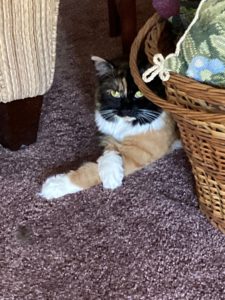 in my bed, under the sofa, on a window sill behind the draperies, and, of course, in a closet. When Olivia was young she evidently went into a closet when I opened it to get something one evening and she ended up spending the night in there. I was so frantic the next morning when I couldn’t find her. And, no, she didn’t scratch or meow at all. I just happened to open the door and out she ran
 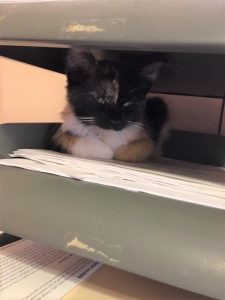 right to the litter box. I felt AWFUL! To this day she’s leery of closets.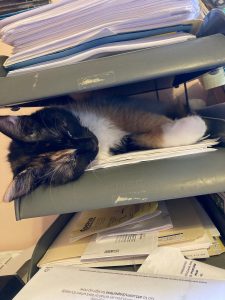
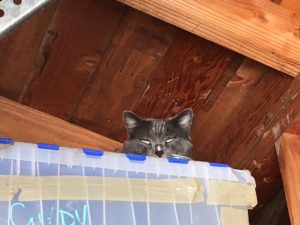 your cats. The cat we have now, Olivia, is probably too fickle to get much use out of something like that. Maybe it’s her feral background, but she isn’t always easy to find when we want to check on her or need to know where she is. Most of my cats were pretty predictable when it came to their sleeping habits—on the bed, under the blankets, or on top of the cat tree. But Olivia keeps on the move. Sometimes we find her under the bed, or under the sofa, or inside one of her tunnels, in a cubical on
 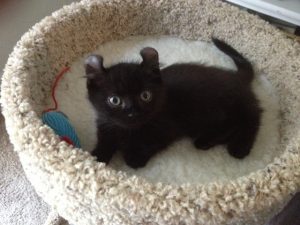 one of her cat trees, and she will occasionally take a nap in a random closet. Offer her a cat bed? Forget it. She has two plush beds, which I’ve placed in different areas trying to entice her to curl up and take a comfortable snooze. Nope. She creates her own bed or castle and sometimes it’s not even cushioned. She’ll spend hours sleeping on the hardwood floor when there’s a cozy bed and plush carpeting at her disposal, or on my desk amidst a smattering of papers, a calculator, stapler, pens and pencils and so forth.
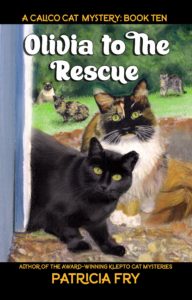 Olivia flaunts her superpowers.
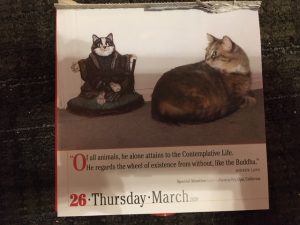 I enjoy my Cat-A-Day calendar. I’ve even had some of my photos of cats published in the calendar. This year I guess my spectacular photo of Olivia didn’t make the cut. How can that be???
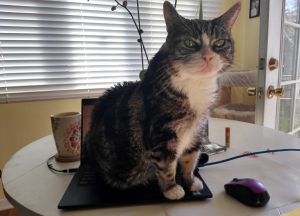 for cats in my stories and for some of the human characters. The whole world is a research library.
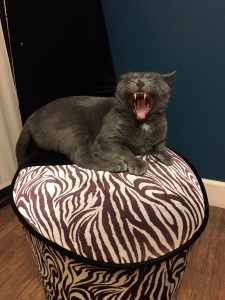 I’m not sure I go along with that. I’ve had cats that seem to have a lot to say and if they don’t think you’re listening they just talk louder. I swear I have taught Olivia to talk. Sometimes she’s obviously trying to get my attention—whining for attention. Other times it’s as if she’s actually trying to have a two-way conversation with me. Cuteness!
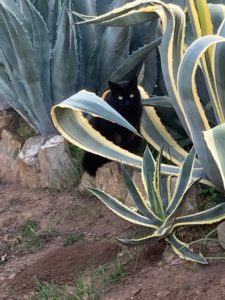
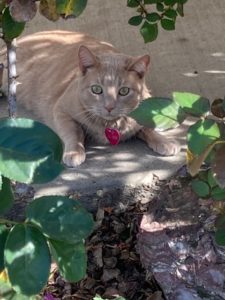 We all make cat friends—our own cats, but also other people’s cats, neighborhood cats and cats we meet along the way. This might include shop cats (in feed stores, pet stores, book stores, retail packing houses, nurseries, lumber yards, veterinarian’s offices, and cat cafés, to name a few), as well as at cat shows and those cats we happen across while traveling or out walking. I’ve even come across cats that were on their own walk
 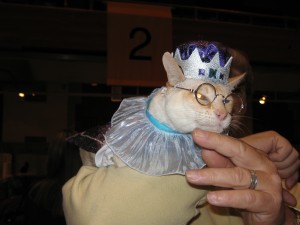 with their person—in a stroller, draped over someone’s shoulder, on a leash, or in a backpack.
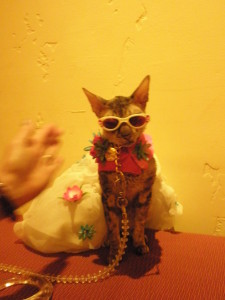 When we used to have in-person conferences with the Cat Writers Association, members with cool collected cats, therapy cats, trained cats would bring them to the conference. It was always fun to sit in a meeting or workshop or at a meal with a cat at the table, or to peek in on the kitty-cat playroom where well-behaved cats hung out while their person was attending a workshop.
 sure.
sure.