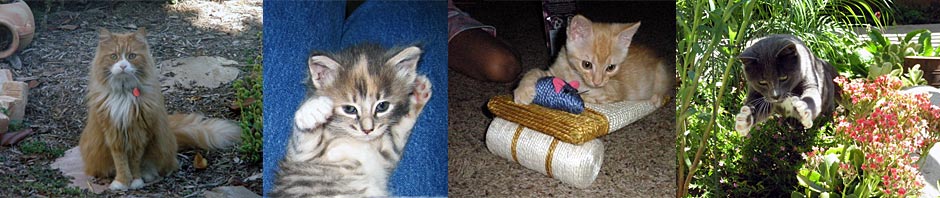
 We’ve established many times on this blog that a cat is not a dog and vice versa. But it’s hard to deny that a cat will sometimes take on traditional, typical dog-like behaviors, whether they’ve been exposed to dogs or not. A cat might not look at you with adoration like a dog will or sit and stay on command, ride in the car with his head out the window, chase a Frisbee, or bring you a beer from the cooler. But she might greet you when you come home, take a walk with you, follow you around the house, bring you your slippers (if they aren’t too heavy, but usually not on command), ride in the car with you… And some cats will beg like a dog.
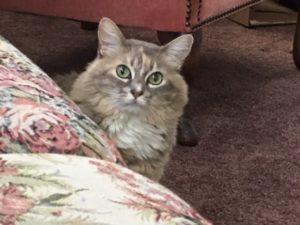
Lily is one of those. If there’s food, she will beg, and it doesn’t matter if she’s just eaten. In 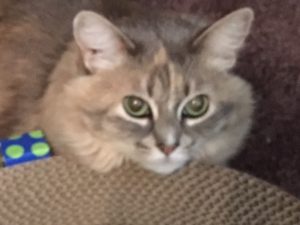 fact, she’s a three-meal-a-day cat. She and Sophie get lunch as well as breakfast and dinner. I always feed the cats before I get my own lunch. But, as soon as Lily finishes her meal, she starts stalking me until I fix my own lunch. If my lunch involves chicken or cheese or avocado or anything else she thinks she might like, she sits with me while I eat hoping for a handout. (I don’t give her any avocado—that’s a no-no for cats. And she’s on a strict diet, so if I cave and share some of my protein, it’s only a tiny token amount.)
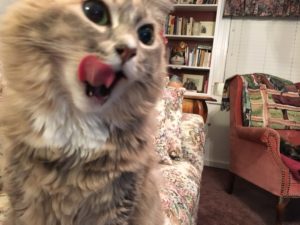 How do cats beg? Lily simply sits near me as I eat at my desk or in front of the TV and stares. Even if I act more civilized and eat at the table, she stares at me and at the food—just stares. Occasionally, she’ll reach out with a paw and touch me as if to say, “I’m still here in case you want to feed me.” If I linger too long over my meal or seem not to be paying attention to Lily, she’ll put her paw in my plate and try to scoop someone off of it.
And why do you think she does this as often as she does? Well, yeah, because I usually reward her cuteness with a tiny morsel of whatever is safe for her to eat. And she knows that I will. When she sees the food disappearing from my plate, she moves a little closer and she might mew. The emptier my plate becomes, the more interested she gets. And when there’s only a few tiny bites left, she might even become so brazen as to lean over and try to take one of them. I can’t be too hard on her for doing that. Partly because she’s so dang cute! And partly because I often offer her that last tiny morsel. I scoot it to the edge of the plate and let her have it.
I guess every cat parent has rituals with their cats. I mean, how else do you get any of their attention? Right? These are sweet moments for me.
Does your cat beg? What other “rituals” do you and your cat share?
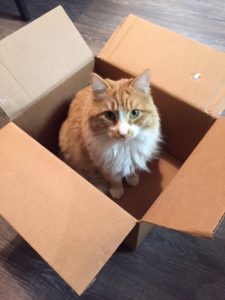 What’s up with a cat’s fascination with boxes? Does your cat get excited when the UPS truck shows up and a box appears on the porch? It seems that she’s eager to see what’s inside the box, but no. As soon as you open it and remove the contents, what happens? In our household, Lily chews on the tape until I remove it and throw it away. She has a fascination for tape. In the meantime, Sophie walks around the empty box, sniffing it, looking it over, examining it. Then both of them (or one, if the box is small) will jump into the box and sit there for a while. Sometimes we’ll cut windows and doors in a large box and turn it upside down for the cats to go in and out of. They often engage in a game of patty-cake through the openings in the box—
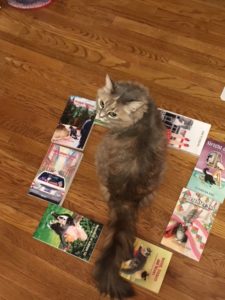 one on the inside and one on the outside. Cute.
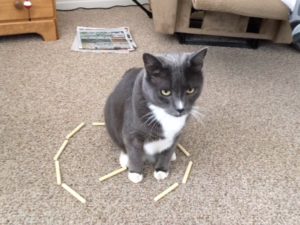 A couple of days ago I decided to see if my mother’s cat, Smokey (aka Rags in my Klepto Cat Mysteries) would do what most cats do when there’s the outline of a box on the floor. That is, to get inside the square or circle. First, I made a circle out of pieces of chalk–well, that’s what was handy. He ignored it for as long as he could–acting cool. Then he ambled over to the intriguing circle and began playing with the chalk, finally sitting down in the center of the chalk. When he walked away, I picked up the chalk and made a larger circle on the floor with his toys. This really got his attention. He rushed to the circle of toys and began picking a toy up and shaking it, then he’d drop it and pick up another toy, until he’d completely misshapen the circle. He seemed rather agitated until I returned his toys to the basket. Then he left the room. I don’t think he appreciates being laughed at. But we
 It’s been a month since I brought out Book 30—Revenge at its Felinest and two months since the Meowmoirs of a Klepto Cat debuted. And I’m hard at work on the next Klepto Cat Mystery, tentative title—Cats Don’t Squeal. Like it?
 the developing story.
 Next comes the massaging. I might decide there’s not enough Rags in a story, so I’ll give him something more to do. I may feel there’s too much dialog in one section that sort of makes the story drag rather than move it forward, so I’ll adjust that. Sometimes I create a new twist or turn just because I can and it sounds fun.
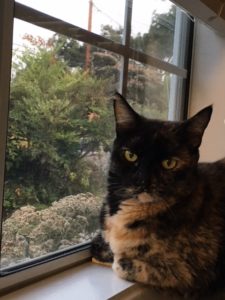 I’ve written before about how to offer the indoor cat the wonders of the out of doors. You can leash train your cat and take her for walks in the neighborhood or into the wilderness when traveling, for example. You can build a catio—a screened in room with a grass floor and some of your cat’s favorite plants inside. Or you can fence your yard and string an electric wire across the top of it to keep the cats inside. In any of these cases, be aware that you’re exposing your cat to fleas and ticks (in certain areas) and diseases that any free-range cats might bring around.
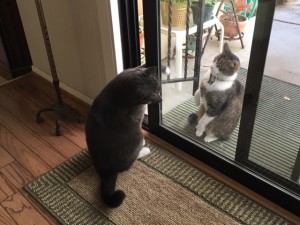 their cat has a wide view of the out-of-doors and fresh air coming in for them to feel and breathe. Here, we have a window perch for our cats where they can sit and look out the window comfortably. We open the windows when the weather allows, making sure the screens are secure. And we provide birdbaths, bird feeders, plants that attract birds, etc. to entertain the cats (and us). We also keep curtains and blinds open during daylight hours because I like a well-lighted room and so do the cats. If you have a particularly curious and maybe gregarious cat, you might look into cat-proof screens or grates to discourage cats from escaping through an open window.
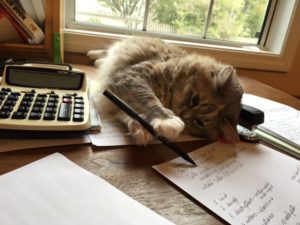 Is your cat smarter than my cat? Could be. But I guess it depends on how cat intelligence is measured. Are cats that do tricks on command smarter? Maybe they’re simply calmer, can more easily focus on training prompts, and/or are more interested in treats as a reward.
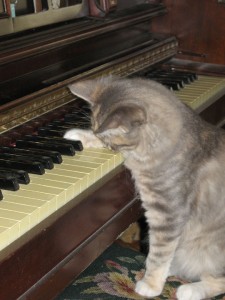 purpose in all this and I’m too dense to understand it.
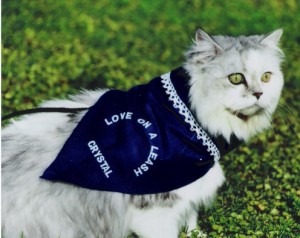 Is it conditioning based on habit and routine or is the cat actually planning, thinking, contemplating? Sometimes it seems they’re scheming.
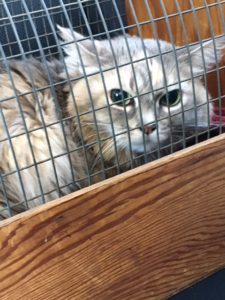 There are some things that experts say you should never do with, to, or around your cat and most of us have probably done them. For example, it’s thought that the shushing sound you make when trying to calm a nervous cat might actually make her more tense. It never occurred to me, but while we consider the “shhhhh” sound to be comforting, to your cat, some experts say it might sound like you’re hissing at her. Hissing, in cat language, is threatening not soothing.
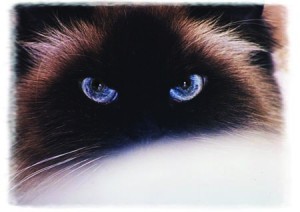 say you should not stare into a cat’s eyes. Why is that? Some cats are rather aggressive and will respond to a challenge. Yes, a stare can be considered a challenge. If you’ve ever watched two cats challenge each other, you’ll see them stare at each other until one drops his eyes and turns away or one of them attacks. Most docile domestic cats will stare into their beloved person’s eyes—sometimes for long periods. Maybe the cat’s waiting for that slow blink of affection. If you’re fortunate, she’ll return the blink. It’s oh, such a beautiful moment.
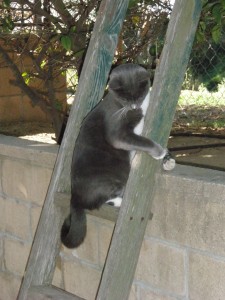 Never push a cat off a counter of other high perch (where she’s not supposed to be, for example). It won’t teach her anything and it could, in fact, harm her. People who depend on a cat always falling on their feet and who try to test this “fact” are asking for trouble (for the poor cat). Sure a cat, when jumping or even falling, can twist into position and most often land on his feet. But he can also end up injured. If you push a cat from a countertop, for example, he may not have time to rebound. Instead, encourage the cat to jump down or better yet, lift him down. If you want to keep your cat off the counter, good luck with that. One idea might be to bring in or build a great cat tree—you know, a climbing apparatus to keep your cat happy, entertained, and healthy. Tin foil can also be a determent for a cat who wants to be on the counter or claw the furniture.
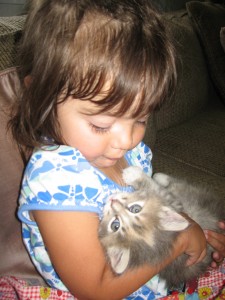 all petting they can get from anyone and everyone. Other cats have their limits. Sophie pretty much comes under the first scenario—she’ll accept petting anytime it’s offered and asks for it frequently—well, except from strangers. Lily loves being with us and sometimes she adores being petted. But she restricts us from enjoying sweet petting sessions with her. Sometimes she dips her back to avoid being petted. She’ll roll over and give you a play-bite when the petting or brushing has become too vigorous. I think she easily becomes over-stimulated and she’s not shy about letting us know. Some cats can become quite aggressive when they’ve had enough. While most will walk away at that point, others will bite and claw aggressively.
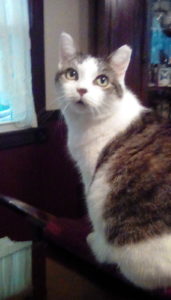 I love getting photos of cats from readers. You may notice I use them in my blogs occasionally. Here are some I’ve received over the years.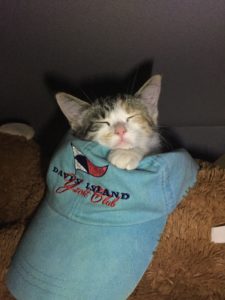
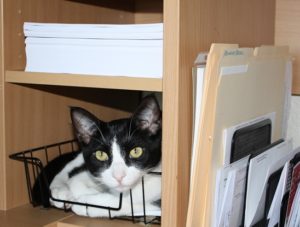 cat, Tucker.
 I feel sorry for cats in summer. It seems as though they’d get awfully hot under that thick coat of fur. I ask Lily, every once in a while, if she’d like to take off her coat. However, I guess the hot weather isn’t as hard on cats as it would seem—well, except for those who live out of doors or in pens without any cooling relief. And removing their coat is one of the worst things we could do. (More about that in a minute.) When I mention my own two cats, we’re talking cats kept inside with various cooling methods in place.
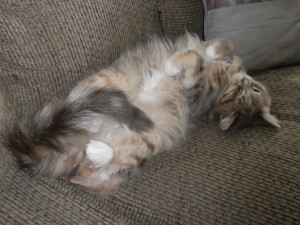 weather. While, of course, they can be overcome by heat, just as we can (we discussed this a few weeks ago), they are also engineered to handle the heat to some degree. Licking their fur, for example, is a method they use to cool down. They also seek out cool places to spend their days. A cat knows to conserve energy in the heat. So you might see your cats—especially those who live outside—sleeping more.
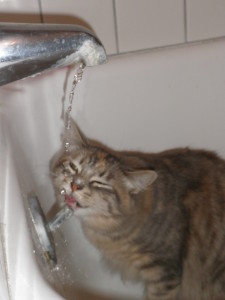 Are you thinking of shaving your cat in the summer so she’ll be cooler? Don’t do it! Cats’ fur is designed to keep them warm in the winter and provide insulation from the heat of the summer. This is not to say that cats are completely self-contained and the heat won’t harm them. It will. And it is up to us to make sure they have plenty of water to drink and to play in, if they’re so inclined. You may recall my post about water features you can provide for your cat on a hot day—ice cubes or ping pong balls floating in a pool of water, for example. Some cats will bat them around and stay cooler in the process.
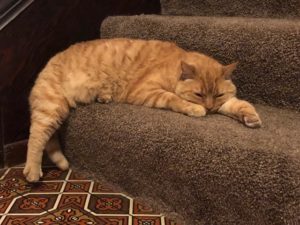 Do you marvel at how beautiful, energetic, relaxed, HAPPY, and healthy your cat is? Have you ever considered how he got that way? Sure, genes are involved, but what else do you think might contribute to your cat’s ability to rest completely, wake up refreshed, move freely, feel a sense of great satisfaction, and enjoy every moment of every day?
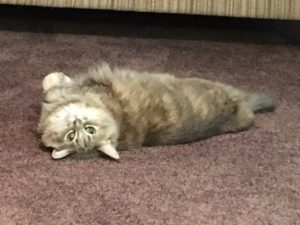 took cues from your cat more often? Maybe if you stretched every morning before getting out of bed, you’d have less pain and stiffness. Maybe if you moved more like a cat does, you’d feel more energetic. What if you approached all of life with the energy, enthusiasm, curiosity, and wit of a cat? It would sure make your world more fun and interesting, wouldn’t it?
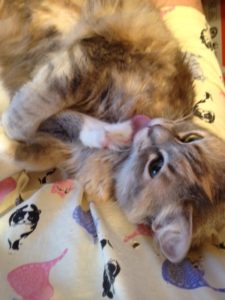 Your cat has a great sense of humor. We know how good laughter is for our health. While cats don’t laugh on the outside, who’s to say they don’t chuckle and even giggle on the inside? Cats take joy to a whole new level—I mean, when is the last time you marveled at a piece of string dangling from your scarf, a stream of sunlight coming through a window, or a wad of paper hurled through the air?
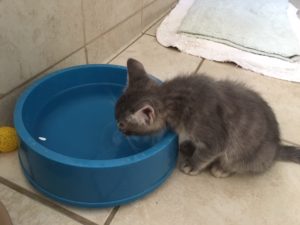 What do you feed your cat in? A tray left from last night’s frozen meal, a paper plate, a saucer from your grandmother’s favorite China set, or a cute designer cat food bowl? You might be surprised that it does matter how you feed your cat.
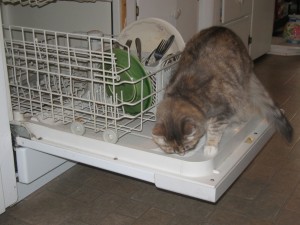 on the floor and pretend I’m going to eat with her. She loves an audience, even when eating. (The things we do for our cats!)
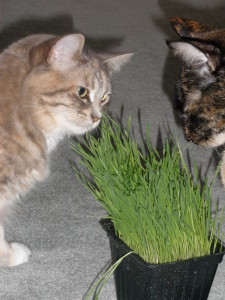 Some cats get chin acne from plastic bowls. We had this happen to one of our cats. We switched from plastic to metal and pottery and his feline acne cleared up. After further study on this issue, they now believe that it isn’t the plastic that creates the acne problem for cats, it’s the fact that plastic can’t always be cleaned as thoroughly as other types of eating vessels and the bacteria left on the plastic surface is actually the culprit, not the material.
 environment? How do you weigh the amount of water used in cleaning dishes against the waste entering landfills when using paper products?
 One benefit of using paper products in which to feed your cat is for sanitary reasons. I think we’ve all seen horribly crusted-over feeding dishes in industrial districts where feral cats are being fed and in backyards where the resident cats run free. Sometimes the ants beat the cats to the meal. Not very appealing or sanitary. Whatever type of feeding container you and your cat decide upon, make sure it is clean at each feeding. Feed freshly opened cat food or food that’s been kept in the refrigerator for not more than a day. Always provide one (preferably more) bowl of fresh, clean water. Keep in mind that if the water is outside or if you have a pet door to your house or garage, wild animals and other neighborhood pets could be eating and drinking from your cats’ plates. When this happens, the remaining food and water could be contaminated.