 We introduced Bobbi Florio Graham yesterday in Part 1 of this series. She mentioned her current cat, Penny. QT Penny (Quattro Teakettle) is her fourth cat since she adopted Simon Teakettle, the owner of her company, in 1972. As she says, “I added Q.T. for Quattro Teakettle, in honor of Terzo, who was Simon Teakettle III. But I realized it could also mean “Cutie” and I often call her Cutie Pie as well as Cutie Penny.”
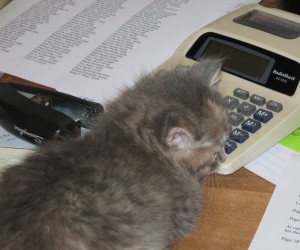
And Penny is a cutie—that’s her in the photo.
To remind you, Barbara (Bobbi) Florio Graham won the $1,000 Sticky Paws award for best article on training at the Cat Writers’ Association annual conference in 2002. Here’s Bobbi’s blog post:
Every cat is different, and training methods have to be adapted to that animal’s individual personality.
I adopted the first Simon Teakettle when he was 18 months old. It was clear he’d been hit by a rolled-up newspaper, perhaps when he tried to dash through the door, because he was startled any time he heard the rustling of any paper.
I didn’t have that problem with the second or third Simon Teakettles, whom I raised from kittens, but Simon II (Tiki) was a part-Siamese feral, who presented distinct challenges.
I’ve never encountered a cat so smart! I had to buy him new toys and invent new games just to keep him occupied, as he was easily bored.
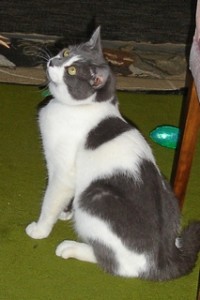
Simon III (Terzo) was the opposite. A black and white sweetheart, he was placid and cuddly, eager to please and willing to learn.
He’s the cat featured in the video which has received much praise from animal behaviorists. It’s at: http://lnkd.in/fKsbhH
I found Q.T. Penny at a local shelter in February of 2015. She was a year old, had been a stray, and was still pretty skittish when I brought her home. But she already knew her name, and began to come when I called her within the first few days.
It’s confusing to change the name of an older cat. I added Q.T. (for Quattro Teakettle) and she now responds to both “Q.T.” and “Penny.”
I start with “Come here,” and only call Penny when she will receive a reward for obeying.
It helps when you call the cat when you have full dish in your hand! I began by calling Penny to her tray when I fed her, and gradually began to insist that she sit by her tray in order for me to put the food dish down.
Now when she wants her wet food, all I have to do is say “Sit by your tray,” and she goes there, sits, and waits for me to bring the dish to her.
I always begin training using dry cat food, and only move to treats much later, when I start to teach special behaviors. I believe strongly in positive reinforcement, and my experience has been that cats react to praise and petting.
There are a couple of important things to remember. Always use the cat’s name when you praise him or her, and never when scolding. I always reinforce good behavior with “Good girl.” For any behavior I want to discourage, I employ a very loud and sharp “No!” accompanied by a loud noise, usually clapping my hands.
It’s important for every pet new to the household to learn “Sit” and “Stay,” and cats should be leash-trained, even if you never plan to let them go outside. It’s a matter of safety, in case you ever have to leave quickly without time to put the cat into a carrier.
In Part Three, I’ll discuss other commands, and the importance of consistency.
Barbara Florio Graham is an author and publishing consultant whose business is named after The Cat Who Owns the Company. Her website: http://SimonTeakettle.com contains Simon Teakettle’s blog, fan club, and a great deal of information about cats (as well as many other subjects). Here’s the link to the training article: http://SimonTeakettle.com/training.htm To learn the interesting story about how Simon Teakettle got his name, go to http://SimonTeakettle.com/simont.htm
 Today, I’m thrilled to introduce guest blogger Barbara (Bobbi) Florio Graham. Bobbi won the $1,000 Sticky Paws award for best article on training at the Cat Writers’ Association annual conference in 2002. Follow the link to that article at the end of this post. Here’s Bobbi’s story:
 My cat-a-day calendar today shares a cat curled up on a book with a caption about how smart some cats are. It says that kittens learn skills like hunting and grooming by watching their mother. According to this writer/researcher, cats have the ability to store both long-term and short-term memories and can be trained to perform certain tasks.
 There are tricks for toilet training your cat. Speaking of tricks, some people train their cat to perform tricks such as giving a high five, jumping through a hoop, sitting up, etc.. In fact, there’s a traveling cat circus I’d like to catch sometime. There’s behavior modification training for cats who have forgotten their manners or never learned any. Many trainers use clickers to modify their pet behavior—yes, even with cats. You might find it interesting to know that Barbara does not use a clicker.
 Cats have a reputation for being aloof—rather unapproachable, standoffish, and even snooty. But if you’ve had many cats, you know that at least some of them can be quite friendly, even affectionate. This is especially evident when kitty is hungry or she’s requesting some sort of favor (“let me out,” “I want to sit in your lap,” “give me a bite of your chicken,” etc.).
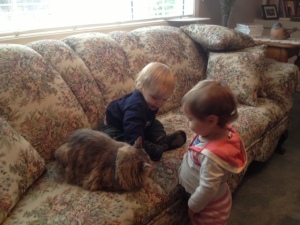 it came to strangers. A stranger was anyone who came to the house, no matter how often they came, unless they spent the night. Max, for example, ran every time the doorbell rang. But if the guest stayed longer than six or eight hours, he decided they were okay and he’d allow them to see him, pet him, and even hold him, if they so desired. Lily, on the other hand, although she’s still wary of adult visitors, she has always adored children. Go figure.
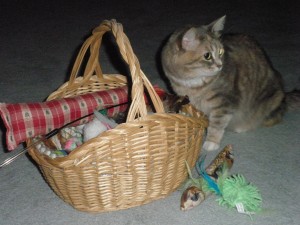 Often we don’t think ahead when we decorate our home. We move in, happy with our surroundings, then decide to adopt a cat and realize we’ve done something wrong. Suddenly, you have a kitten climbing the drapes and clawing the needlepoint chair. The black Persian quickly becomes attached to your cream-colored sofa and the white cat can’t resist leaving her fur all over the plum-colored settee.
 or a dark-colored cat—not both. Why? The light-colored cat fur will show up more on your dark-colored clothes and the dark cat fur will be evident on your light-colored clothes. If you have issues with shedding, while a short-hair cat seems like a better choice than a Persian or Maine coon or Angora, for example, I have to tell you that some short-haired cats shed like crazy. Here are additional tips for animal-friendly decorating.
 Today I’d like to talk about moving cats from one place to another against his or her will. I mean, what cat would consent to packing up and moving into new quarters unless it was their idea—the food’s better across the street, she’s tired of the household dog bossing her around, or the new baby has edged him out of the prime spot as top cat?
 spoke to her vet and he suggested she use a Feliway plug-in mist or spray to help calm the cats. She said, “The night before we moved our two tuxedos, we plugged in the misting Feliway in the room where they would be staying for the move. We also recommend spraying the baseboards a few times with Feliway spray.” She said she likes to spray a squirt into their carriers before the move, as well.
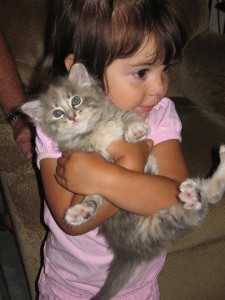 Tomorrow is National Hug Your Cat Day. Whether you have a cat of your own or six, a favorite cat belonging to someone else (a grand-cat, for example), or there are sweet neighborhood cats roaming free through your yard, this weekend is a good time to give them a little extra affection.
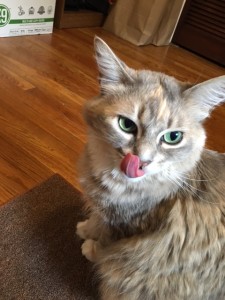 Cats are thought by most to be the most fastidious species in the animal kingdom. Sure, some people use terms such as, “mangy cat,” “filthy beast,” but in reality, cats spend around half their awake time cleaning themselves. And the reasons are many.
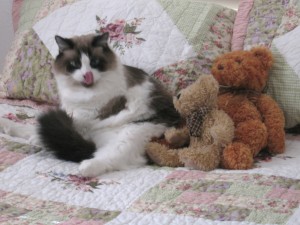 health and comfort, the process of grooming is also a good way to bond with a horse and gentle him. Isn’t this an important concept for your cat, as well?
 My Persian swallowed a needle once and it became stuck sideways in her throat. She loved sitting with me when I sewed and she must have been sitting too close to the pin cushion that day. We figure that when she licked her gorgeous shaded silver fur, she must have caught the thread from the needle on her tongue, couldn’t shake it loose and ended up swallowing it, needle and all. Thankfully I noticed the odd protrusion on both sides of her throat—still not knowing what it was or what had happened—and the vet was able to successfully and quickly remove it.
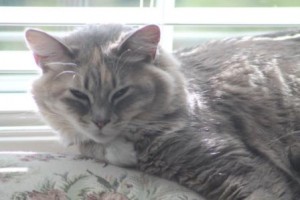 I’ve photographed Lily hundreds of times. I’d recently become enthralled with photography when we adopted her and what better subject than a kitten?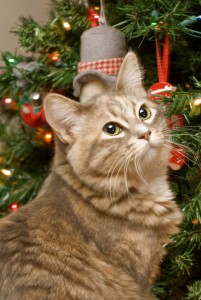
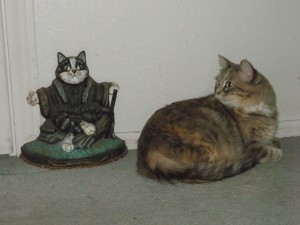 Sometimes Lily’s coat is dark and rich, other times it’s a soft mix of greys. In some photos you can see the mix of tangerine in her fur, other times not so much. I guess it’s the lighting. While Max, Katie, Dinah, Winfield, and Sophie were always recognizable in my photos, Lily seems to be a cat of many colors.